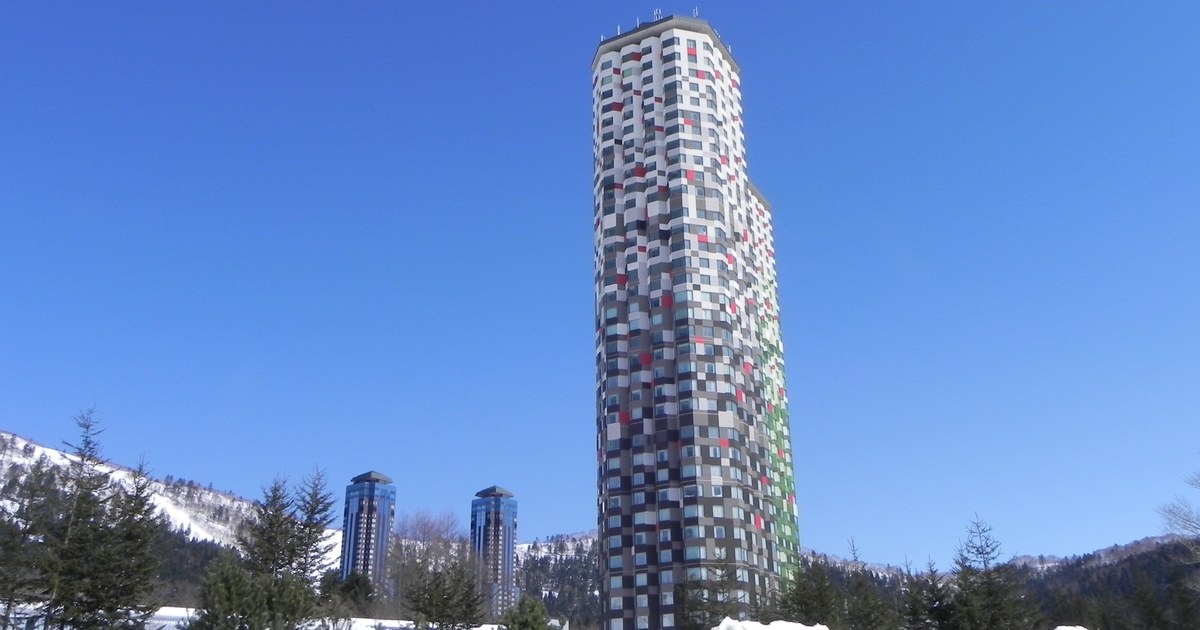
Hoshino Resorts Tomamu has two opening dates in 2026-27: the ski area opens December 1, but the Ice Village does not open until December 20 — a 19-day gap. At the other end of the season it separates again: the Ice Village shuts March 10 while the lifts keep running to April 5, another 26 days. That is 45 days out of a 126-day season, or 36%, when you can ski and ride the gondola but cannot photograph a single one of the ice domes every travel blog leads with. This guide lays out the official 2026-27 dates as four nested windows, identifies the only 22-day stretch when all of them overlap, and answers a question almost nobody runs the numbers on: whether skipping the Ice Village in early December actually costs you anything. It is the Tomamu deep dive companion to our guide to choosing a Japanese ski resort.
- Two opening dates: ski area and Frost Tree Terrace Dec 1, 2026 - Apr 5, 2027 (126 days); Ice Village Dec 20 - Mar 10 (81 days). Combined gap: 45 days, or 36% of the season
- Opening day is not full opening: Ice Chapel Jan 20 - Feb 14 only, Ice Hotel Jan 20 - Feb 20, SHIBARE TIME Jan 20 - Feb 10 — the signature ice structures exist for three to four weeks
- The one everything-open window is Jan 20 - Feb 10, 2027 (22 days), which is also the only stretch when the gondola starts at 7:45 instead of 9:00
- Official frost rates: 72% Dec / 58% Jan / 48% Feb / 42% Mar (2025-26 actuals) — the December gap comes with compensation, the March gap does not
- Watch the season labels: lift prices are still 2025-26 actuals (the resort says new prices land around September), while rentals, lessons and all four bus fares are already 2026-27 official figures
📖 Contents
- 1. Four nested windows: the 45-day gap and the one that isn't
- 2. Frost rates: why December costs less than it looks
- 3. Getting there, and four traps at Tomamu Station
- 4. The mountain: 29 runs and a 4.2km beginner descent
- 5. Lift tickets: how to pay least (2025-26 actuals)
- 6. Rentals: the gloves and beanie are yours to keep
- 7. Ski school: Chinese and English instructors in-house
- 8. Rescue costs: published by the hour
- 9. Staying on site: worth ¥5,200 a day
- 10. Eating and shopping
- 11. Picking your dates: what I would actually do
- 12. FAQ
Four nested windows: the 45-day gap and the one that isn't
It is easy to picture "skiing plus the Ice Village plus the sea of clouds" as one package. Lay the official 2026-27 dates side by side and they are not one package at all — they are four nested windows, each one substantially shorter than the last.
| Layer | Facility | Official 2026-27 dates | Days |
|---|---|---|---|
| 1 | Ski area and Frost Tree Terrace (Unkai Gondola) | Dec 1, 2026 - Apr 5, 2027 | 126 |
| 2 | Ice Village | Dec 20, 2026 - Mar 10, 2027 (planned) | 81 |
| 3 | Ice Hotel (viewing officially free) | Jan 20 - Feb 20, 2027 | 32 |
| 3 | Ice Chapel | Jan 20 - Feb 14, 2027 | 26 |
| 4 | SHIBARE TIME (at the Frost Tree Terrace) | Jan 20 - Feb 10, 2027 | 22 |
The resort spells the mechanism out on its own Ice Village page: each dome and experience opens in sequence after the village opening date, as the ice is ready. So the December 20 opening date does not entitle you to the Ice Chapel — the chapel's own official window is January 20 to February 14, which is 32% of the village's 81 days.
One more thing worth settling before you book anything: the Ice Chapel page lists only the season dates and two wedding ceremony slots, 17:00 and 19:00. It says nothing about general viewing. The Ice Hotel page, by contrast, states outright that looking around is free, with overnight bookings due to open on September 18, 2026. The information density between the two is very different, and I am not going to fill the gap on the resort's behalf — no source means no claim.
The 45 days, and why the two halves are not the same
| Gap | Dates | Days | Open / closed |
|---|---|---|---|
| Early gap | Dec 1 - Dec 19, 2026 | 19 | ✅ Ski area, Frost Tree Terrace (December frost rate 72%, the season's highest) ❌ Ice Village, night skiing (Dec 26), most snow activities (Dec 12), Risonare rental counter (Dec 12) |
| Late gap | Mar 11 - Apr 5, 2027 | 26 | ✅ Ski area (only some lifts run Apr 1-5), Frost Tree Terrace (March frost rate 42%, the season's lowest) ❌ Ice Village, Ice Chapel, Ice Hotel |
| Total | 45 | 36% of the 126-day season | |
The only window where all four layers overlap is January 20 to February 10, 2027 — 22 days. In that stretch the Ice Village, Ice Chapel, Ice Hotel and SHIBARE TIME are all running, and the Unkai Gondola moves its first ride from 9:00 up to 7:45 — the only period all season when you can be standing at 1,088m around first light. There is a condition attached, stated officially: between 7:45 and 9:00 you may not ride for the purpose of skiing down. Those early rides belong to the frost watchers.
If ice structures are the reason you are going, there is effectively no alternative date range. If they are not, then note that this same window is the busiest and most expensive stretch of the season, and avoiding it is a perfectly rational plan.
Frost rates: why December costs less than it looks
This is the most valuable number Tomamu publishes and the one almost nobody uses. The Frost Tree Terrace page gives the monthly frost-formation rate outright:
| Month | December | January | February | March | Season average |
|---|---|---|---|---|---|
| Frost formation rate | 72% | 58% | 48% | 42% | 63% |
(These are the official 2025-26 season actuals, not a 2026-27 forecast.)
Overlay that on the 45-day gap and the conclusion writes itself: the two gaps are not equally expensive.
- December 1-19 (19 days): you give up the Ice Village, night skiing and most snow activities, and you get the season's best frost odds at 72% plus a mountain that has not yet absorbed the Christmas and Lunar New Year crowds. This gap has compensation built in.
- March 11 - April 5 (26 days): the Ice Village is gone and the frost rate has fallen to its seasonal floor of 42%, and from April 1-5 the resort states only some lifts run. Nothing compensates for this one.
So if your dates are floating around the Ice Village opening, move earlier, not later. Early-to-mid December trades one thing for another; mid-March onward just subtracts. The resort's own base-area snowfall figure for March is 82cm, the lowest of the five months it publishes. When three separate official numbers point the same way, that is usually not noise.
First: in winter you ride the "Unkai Gondola" but you do not see unkai
This is Tomamu's most misleading piece of naming. The gondola keeps the name Unkai (Sea of Clouds) Gondola through winter, but the summit facility is officially the Frost Tree Terrace in winter — the product is rime-frosted trees and Hidaka-range views. The actual Unkai Terrace is a green-season attraction; the resort lists that run as April 24 to November 1, 2026. Going up in January expecting a cloud sea is a guaranteed disappointment.
The official definition of frost is worth quoting because it links two of Japan's winter attractions: it forms when water vapour or fog in sub-zero air attaches to trees, and the better-known juhyo is one type of the same phenomenon. If that interests you, the eastern-Japan version of the same physics shows up in our Zao Okama guide.
Practical Frost Tree Terrace details:
- Season: Dec 1, 2026 - Apr 5, 2027. Elevation 1,088m.
- Gondola round trip: adults 12+ ¥2,500, ages 7-11 ¥1,600, pets ¥500. Free if you hold a lift ticket. (This figure appears both on the 2026-27 Frost Tree Terrace page and on the lift-ticket page that is explicitly labelled "2025-2026 information", so we treat it conservatively as a 2025-26 actual pending the September update. Our own older itinerary article once said ¥3,500 — that was wrong and has been corrected.)
- Hours: Dec 1-25 last ride up 15:00 (9:00 start); Dec 26 - Jan 19 9:00-15:30; Jan 20 - Feb 10 from 7:45; Feb 11 - Mar 31 back to 9:00-15:30; Apr 1-5 9:00-15:00.
- Where to buy: the ticket information desk inside the Resort Center. Day visitors follow resort signage to the Resort Center; overnight guests have a shuttle from The Tower and Risonare.
- At the summit: Cloud Walk, Cloud Bar, and Cloud Cafe (indoor, all-weather). Dogs are welcome on a lead — the resort recommends a crate and does not allow them inside Cloud Cafe.
- Official disclaimer: frost may not form, or operations may stop, even inside the published season.
- Filming: shooting or recording for commercial purposes anywhere on the property without permission is explicitly prohibited. Worth knowing if you are producing content.
New for 2026-27 is the Frost Tree Morning High Tea, which the resort calls a first. It runs January 1 to February 28, 2027, from 8:00 to 9:00, at ¥7,500 per person for eight sweet and savoury items plus four drinks, served in Cloud Cafe at the terrace. Capacity is genuinely tiny — three groups per day, maximum two people per group — with bookings opening October 1, 2026 and closing a week before use. One officially stated catch: the ¥7,500 does not include the gondola fare. Bookings do, however, get gondola access from 7:45.
Getting there, and four traps at Tomamu Station
By train: direct from Sapporo, one change from the airport
| Route | Distance | Time | Changes | Fare + reserved express seat |
|---|---|---|---|---|
| New Chitose Airport → Tomamu | 101.2 km | 1h12m - 1h25m | 1 (Minami-Chitose) | ¥4,230 |
| Sapporo → Tomamu | 142.6 km | 1h35m - 1h51m | 0 (direct) | ¥5,880 |
| Furano → Tomamu | 280.7 km | 3h51m | 2 (Takikawa, Sapporo) | ¥9,980 |
Checked directly on JR Hokkaido's official routing search on August 7, 2026 (based on the August 2026 edition of the JR timetable). The limited expresses are the Ozora and Tokachi. The fastest connection runs: New Chitose Airport 7:02, Minami-Chitose 7:05, board the Ozora No. 1 at 7:20, arrive Tomamu 8:26.
One number correction worth making: many search results show ¥5,230 from the airport. That includes the optional ¥1,000 U-Seat reserved upgrade on the airport rapid — the unreserved seat costs nothing extra, so the real floor is ¥4,230. Green car, if you want it, adds ¥2,450 from New Chitose or ¥4,630 from Sapporo on top of the base fare.
Four traps at Tomamu Station (rail pass holders, read this)
This is the section that matters most if you are travelling on a JR pass. All four are stated verbatim on the resort's official access page.
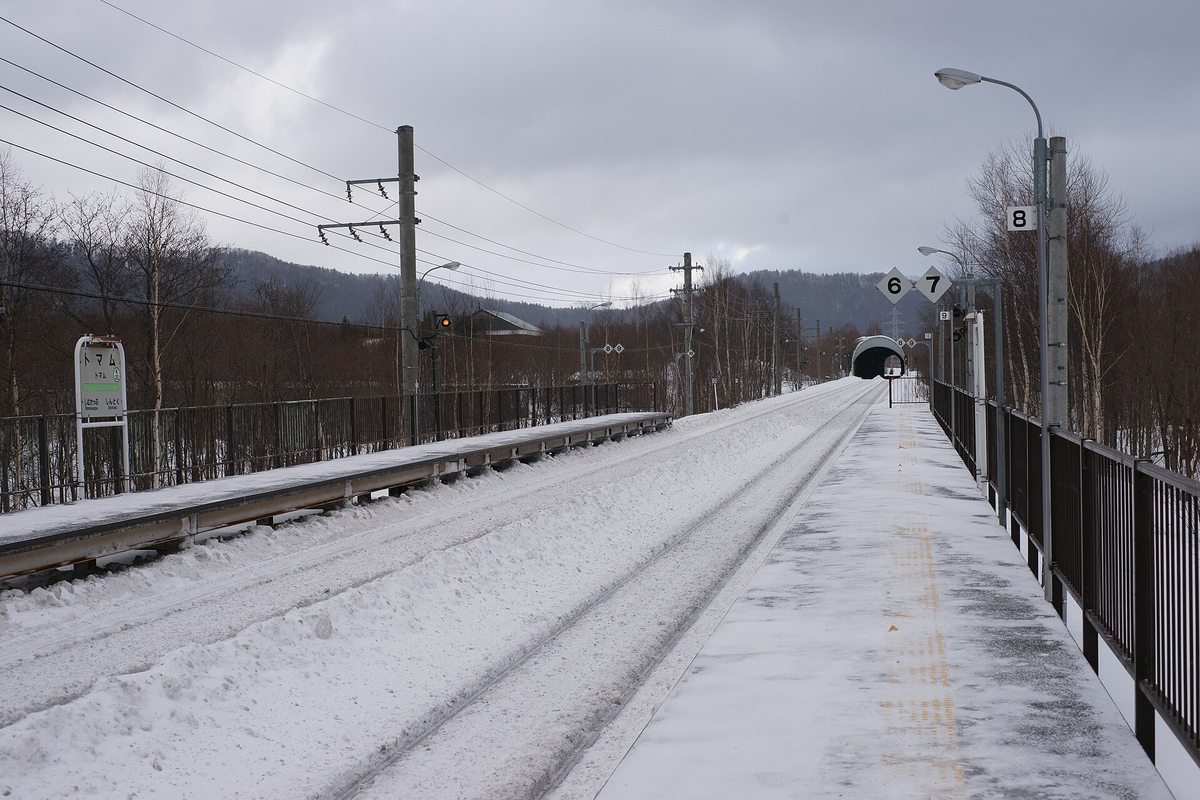
- Every train that stops at Tomamu Station is fully reserved. There are no unreserved cars. A pass covers reserved seats, but you must reserve in advance — you cannot walk on the way you would with an unreserved carriage elsewhere in Japan.
- Tomamu Station has no ticket office. There are exactly three ways to hold a ticket: buy in advance through JR East's Ekinet (Japanese only) or the JR East Train Reservation site for overseas customers; buy in advance at an airport or a staffed station; or use the reserved-ticket machine inside Tomamu The Tower — which the resort notes does not accept cash and comes with no staff available to explain ticketing.
- If you end up on the platform with no ticket and no card, the official fallback is to have a boarding-station certificate issued at Tomamu Station and settle the fare later. Knowing this exists is worth a lot at 6am in the snow.
- The Nemuro Main Line between Furano and Shintoku has had no train service since April 1, 2024. This one reshapes the whole Furano side of an itinerary — see below.
From Tomamu Station to the resort, the official wording is that a shuttle comes to collect you; if no bus is waiting at the station, there is a dedicated phone on platform 2 to call one. The ride is roughly 5 minutes to The Tower and 10 minutes to Risonare Tomamu. The page does not say whether this is free, or whether it is restricted to overnight guests — I could not verify either, so I am not going to assert either. In practice the workable day-visitor route is: train to Tomamu Station, platform phone, Resort Center.
By bus: four routes, all 2026-27 fares, one hard rule
| Route | One way, adult | Operating dates | Duration |
|---|---|---|---|
| New Chitose Airport ⇔ Tomamu | ¥6,000 | From airport Dec 1, 2026 - Mar 30, 2027 From Tomamu Dec 2 - Mar 31 | About 2 hours |
| Central Sapporo ⇔ Tomamu | ¥7,000 | Same | About 3 hours |
| Asahikawa city / Asahiyama Zoo ⇔ Tomamu | ¥6,000 | Dec 2, 2026 - Mar 30, 2027 | Not published |
| Tomamu ⇔ Furano (Hokkaido Powder Belt Liner) | ¥5,500 | Dec 2, 2026 - Mar 30, 2027 | Not published |
Child fares (ages 3-11) are ¥5,000 / ¥6,000 / ¥5,000 / ¥4,500 respectively; under-3s ride free without a seat. Every condition below is stated officially, and each one can break a plan:
- 🔴 "Departures with no reservations by 9 days before the date of use will not run." A service on the timetable is not a service that exists. Book early.
- 🔴 "Ski buses are in principle available only to customers staying at hotels in the boarding and alighting districts." This is not an open public coach route.
- Web bookings close at 18:00 the day before. Minimum party size is 1; there is no tour attendant.
- Cancellation fees: 30% from 7 to 2 days out, 40% the day before, 50% on the day before departure, 100% after departure or for a no-show.
- Assembly is 15 minutes before departure at airports, 10 minutes elsewhere, and the operator states plainly that it does not, as a rule, wait for late passengers.
- Luggage in the hold is limited to ski equipment plus one other item, and you may not board wearing ski or snowboard boots.
- Minimum connection times are specified: domestic flight to bus 45 minutes, bus to flight 60 minutes; international 90 and 120 minutes. The operator also states it does not check your connection times for you.
- Asahikawa route only: the zoo is closed Dec 30 - Jan 1, so you cannot board or alight there on those three days.
- The operator notes that day-trippers from Sapporo will find Tomamu Resort Center the convenient stop, and that Risonare Tomamu is only a stop during its own operating season.
On booking: Hoshino Resorts Tomamu's own bus portal is published in five languages including English, so booking direct is straightforward and the fares above are public. If you would rather handle several Hokkaido resorts through one travel platform, Trip.com also lists a Hokkaido ski resort shuttle that includes the Tomamu route: Hokkaido ski resort shuttle bus (Trip.com) → Both routes work — compare against the official ¥6,000 / ¥7,000 one-way fares before you decide.
The Furano side: the railway is gone
"Furano to Tomamu, 50 minutes by limited express" no longer works. The Nemuro Main Line's Furano-Shintoku section has had no train service since April 1, 2024 — that sentence is on Tomamu's own access page. Rail routing now means Takikawa and Sapporo: two changes, 3 hours 51 minutes, ¥9,980. That is 4.6 times the time and three times the cost of the old 50-minute routing. The working answer is the Hokkaido Powder Belt Liner at ¥5,500 one way, with the same advance-booking and 9-day rules. If Furano is on your itinerary anyway, our Furano and Biei Norokko guide covers that side.
Driving: the resort is at Naka-Tomamu, Shimukappu Village, Yufutsu District, Hokkaido, Mapcode 608 511 304*40. An honest limitation — the official access page gives no driving times or distances at all, from any airport, so I am not going to estimate them. Winter mountain driving times in Hokkaido are exactly the wrong thing to plan around a guessed number. For the driving side generally, see our Japan winter driving guide. There is a Toyota Rent a Car desk on the first floor of Tomamu The Tower, and the resort lists four taxi companies but states explicitly that fares vary by route and season and you should ask the companies directly — no official figure, so no guess from me.
The mountain: 29 runs and a 4.2km beginner descent
| Spec | Official 2026-27 figure |
|---|---|
| Courses | 29 total (4 advanced, 14 intermediate, 10 beginner, 1 first-timer) |
| Total run length | About 21.5 km |
| Skiable area | 123.9 ha |
| Longest single descent | 4,200 m (Silver Bell into Beginners Choice) |
| Steepest pitch | 35 degrees (No Gravity) |
| Vertical | 585 m (summit 1,171 m, base 586 m) |
| Lifts | 1 gondola, 5 chairs |
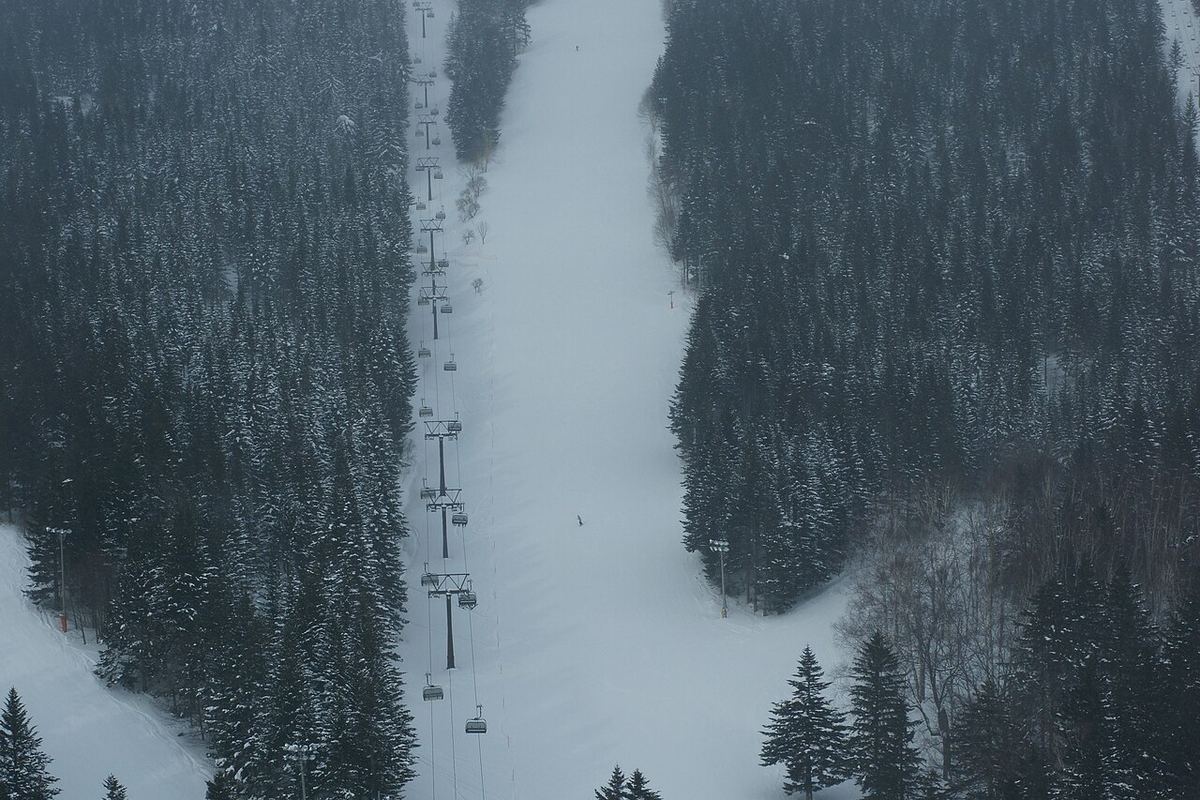
Twenty-nine runs is modest by Hokkaido standards, but the 4,200m longest descent is the genuinely interesting figure — and it gets better when you break it down. That descent is Silver Bell (3,300m, max pitch 10 degrees) running into Beginners Choice (900m, max pitch 7 degrees). Both are beginner runs. In other words a first-time skier at Tomamu can realistically link a 4.2km top-to-bottom descent without first working up to intermediate terrain, which is not true at most resorts, where the long runs are graded higher.
(A correction while we are here: the official claim is "longest run 4,200m", plus a "longest in Japan" claim that applies specifically to its snow cart course. "Japan's longest ski run" is not an official statement — do not repeat it.)
At the other end, No Gravity (advanced, 770m, 35 degrees) and North Star (advanced, 500m, 30 degrees) are where the steep terrain lives. The intermediate backbone is Exhibition (1,500m), Highway Coaster (1,450m) and Dragon Ridge (840m at up to 32 degrees). Two mountains — Tomamu Mountain and Tower Mountain — are joined via the Resort Center at the base.
Those five April days: "open until April 5" is not "all open"
| Lift | 2026-27 operating hours |
|---|---|
| Unkai Gondola | Dec 1-25 9:00-15:00 / Dec 26 - Jan 19 9:00-15:30 / Jan 20 - Feb 10 7:45-15:30 / Feb 11 - Mar 31 9:00-15:30 / Apr 1-5 9:00-15:00 |
| Tomamu Express | Dec 1 - Mar 31 9:00-15:30 |
| Powder Express | Dec 1 - Mar 31 9:30-15:30 |
| Romance Chair | Dec 1-25 9:00-16:00 / Dec 26 - Mar 31 9:00-16:30 |
| Tower Express | Dec 1-25 8:45-15:30 / Dec 26 - Mar 31 8:45-18:00 (night skiing) / Apr 1-5 9:00-15:30 |
| Nipo Chair | Dec 1-25 9:00-16:00 / Dec 26 - Mar 31 9:00-17:00 / Apr 1-5 9:00-15:30 |
Look at the pattern: Tomamu Express, Powder Express and Romance Chair all stop on March 31, and the resort states outright that only some lifts run from April 1 to 5. So those final five days give you three lifts, not the full mountain. Anyone who reads "open until April 5" as "the whole mountain until April 5" is going to be disappointed. The Spring Season one-day ticket for that stretch is ¥5,000 (2025-26 actual) — cheap, but you are buying a third of the lift network.
Night skiing is Tower Express extended to 18:00 from December 26 to March 31 (the ski school page separately notes the night-ski start date as December 25, planned), which is also why "no night skiing" appears in the early-December gap.
Tomamu's own snow and cold
| Month | Dec | Jan | Feb | Mar | Apr |
|---|---|---|---|---|---|
| 3-year average snow depth (mid-month, summit) | 114 cm | 150 cm | 172 cm | 153 cm | 148 cm |
| Total snowfall (base observation) | 230 cm | 168 cm | 138 cm | 82 cm | 0 cm |
| Average 8:00am temperature | -5℃ | -12℃ | -7℃ | -2℃ | 3℃ |
The resort also publishes 618cm total snowfall for the 2025/26 season and season-average depths of 45cm at the base and 139.8cm at the summit. Two things you can plan around: the deepest snow is February (172cm at the summit), but the best frost odds are December (72%) — different months. You have to pick which one you are optimising for. And 8am in January averages -12℃; the resort's own marketing line is "-30℃ Tomamu", so do not economise on layers.
Now an admission: I am not going to compare Tomamu's snow quality against Niseko's or Rusutsu's. Tomamu publishes base-station total snowfall and summit depth; Niseko Grand Hirafu publishes monthly cumulative snowfall. Different observation points, different metrics, different seasons — dividing one by the other produces a tidy number that means nothing, and no official source has ever made that comparison. For cross-resort selection use the resort comparison guide; for single-resort depth, our Niseko guide and Rusutsu guide let you read the figures side by side yourself.
The advanced-only zone, and what the off-piste rules actually say
Tomamu opens an advanced-skiers-only released area from mid-January to March 31, 2027, 8:30 to 15:00 (last entry), with checkout required by 15:30. Entry requires three things: registering on the yukiyama app (GPS-enabled), agreeing to a statement of principles, and wearing a helmet, which is mandatory in this zone. Sign-up is at the snow cart reception inside the Resort Center.
What is worth understanding here is what Tomamu does not have. There is no six-point off-piste code and no gate system of the kind Niseko publishes. The official safety page states three things and only three: the managed boundary is defined on a detailed map, no safety management is performed beyond that boundary, and search and rescue outside the boundary is charged at cost. Do not import Niseko's rules here — the structure is different. Helmets are not mandatory resort-wide; the released area is the only place the resort makes them compulsory.
Three more claims I will attribute rather than assert, because they are the resort's own marketing language: Hotaru Street is described as "Japan's first ski-in ski-out village", Adventure Mountain as "the world's only story-based family slope", and the Tomamu Slopestyle Park as "one of the largest in Hokkaido".
Lift tickets: how to pay least (2025-26 actuals)
Before any number: the lift ticket page currently shows 2025-26 pricing, and says so. The official wording is that this is 2025-2026 information and that 2026-2027 gondola and lift prices will be posted around September. Everything in this section is therefore a 2025-26 actual. Check the official site again before you travel.
| Ticket | Web, adult | Window, adult | Notes |
|---|---|---|---|
| 1-day | ¥7,700 | ¥8,000 | Child 7-11 web ¥5,700 / window ¥6,000; senior 60+ window ¥7,500 |
| 1-day, hotel guest rate | — | ¥7,500 | The Tower / Risonare guests only, ¥500 off; child ¥5,500 |
| Early Season 1-day | ¥5,000 | Same | Valid Dec 1-20 only |
| Spring Season 1-day | ¥5,000 | Same | Valid Apr 1-5 only |
| 4-hour | ¥6,700 | ¥7,000 | Four consecutive hours from gate entry |
| After 15 | — | ¥5,000 | 15:00-18:00, Dec 26 - Mar 31 |
| Unkai Gondola round trip | — | ¥2,500 | Free with a lift ticket |
Two structural conclusions fall out of that table, and both run counter to what you have learned at other resorts:
- Multi-day tickets carry no discount whatsoever. The official wording is that tickets of two days or more are issued at the window and the price is the one-day price multiplied by the number of days. That is the opposite of Niseko, where the per-day rate falls on longer tickets. The "stay longer to amortise the lift pass" strategy simply does not work here.
- Web is ¥300 cheaper than the window, but the hotel-guest window rate of ¥7,500 beats both. Which means: if you are staying at The Tower or Risonare, do not buy online. Show your room key at the counter. It is ¥200 per person per day — ¥2,400 over four days for a family of three.
Other official details worth knowing:
- The resort states that web prices do not fluctuate and recommends buying on the day of use. Unlike the dynamically priced resorts, there is no early-bird advantage locking you into fixed dates.
- Children 6 and under ski free, but must be accompanied and declared at the ticket information desk.
- IC cards carry no deposit — the resort tells you to keep yours, so bring it back next time.
- A 20% disability discount is available at the window on presentation of a certificate or handbook, covering one companion, not combinable with other discounts.
- Resale is prohibited, as is using a resold ticket, and the resort states it runs periodic ticket checks; violating the terms of use means confiscation. Relevant if you were considering a secondhand season pass.
- Payment methods at the window are listed in full: cash, credit cards, WeChat Pay and Alipay, PayPay, au PAY, Merpay, meal vouchers, room charge and in-house vouchers. Cards and mobile payment both work — no need to carry a brick of cash.
- Ticket desk hours: The Tower I ticket information (slope side) Dec 1-25 8:30-16:00, Dec 26 - Mar 31 8:30-18:00, Apr 1-5 8:45-15:30. Resort Center desk 8:30-16:00 across the whole Dec 1 - Apr 5 season.
Season passes are mostly academic for international visitors, but as a pricing reference: the all-days adult pass (18-59) is ¥71,000 early-bird and ¥90,000 at standard rate, with the early-bird window running October 1 to November 30 (also 2025-26 actuals). Against the ¥7,700 day ticket, the early-bird pass needs roughly nine days on snow to break even.
Rentals: the gloves and beanie are yours to keep
Unlike the lift tickets, these are 2026-27 official figures — the rental page states 2026-27 bookings open October 1, 2026, and all its operating dates are 2026-27.
| Package | What's included, officially | Adult, 1 day | Child, 1 day |
|---|---|---|---|
| Full Set | Skis or board plus boots (and poles for skis) plus outerwear, gloves, beanie and goggles | ¥18,000 | ¥13,500 |
| 3-piece ski / 2-piece board set | Only skis or board plus boots (and poles for skis) | ¥8,500 | ¥6,400 |
Clearing up the usual confusion first: Tomamu's "3-piece set" follows the Japanese norm and does not include outerwear. The jacket-and-pants tier is the more expensive Full Set. That pattern has held at every resort we have verified — the cross-resort breakdown is in our Japan skiing beginner guide.
Where Tomamu genuinely differs is elsewhere: the gloves and beanie are brand new and yours to keep. The official points section states that hats and gloves are provided new, and in the itemised price list the "rental period" column for gloves and beanie reads sold — sale only, not rental. That is the same hygiene-driven policy GALA Yuzawa and Kiroro use; Tomamu's twist is bundling both into the Full Set, so ¥4,000 of that ¥18,000 is equipment you take home.
Individual items (adult, one day): skis or board ¥6,000, boots ¥3,000, poles ¥1,500, jacket and pants ¥6,000, goggles ¥2,000, helmet ¥2,000 — not in the Full Set, add it separately, gloves ¥2,000 (sale), beanie ¥2,000 (sale), snow boots ¥3,000.
What a day actually costs
| Scenario | Maths | Total |
|---|---|---|
| Arriving with nothing, cheapest | Full Set ¥18,000 (2026-27) + web 1-day lift ¥7,700 (2025-26 actual) | ¥25,700 |
| Arriving with nothing, plus helmet | Above + ¥2,000 | ¥27,700 |
| Own outerwear, gear only | 3-piece set ¥8,500 + lift ¥7,700 | ¥16,200 |
| Staying at The Tower / Risonare | Full Set ¥18,000 + hotel-guest window lift ¥7,500 | ¥25,500 |
Notice the ratio: rental at ¥18,000 is 2.3 times the ¥7,700 lift ticket. First-timers habitually budget around the lift pass, but the rental is the larger line item. Tomamu's ratio is the highest we have measured, though that is because its Full Set is a genuinely all-inclusive tier including take-home gloves and beanie, not because it is expensive — the gear-only ¥8,500 is entirely normal.
The resort also advertises "up to 50% off when renting on consecutive days". Running that against the published table myself: a 7-day Full Set is ¥57,000 versus ¥18,000 × 7 = ¥126,000, a saving of ¥69,000 or about 55%. (That calculation is mine, derived from official prices; the resort does not publish the comparison.) If you are staying more than a couple of days, book the whole stretch at once rather than re-renting daily.
And one detail that ties straight back to the first section — the three rental counters do not open on the same day:
- Tomamu The Tower: from Dec 1 (Dec 1-25 8:30-16:00, Dec 26 - Mar 31 8:30-17:00, Apr 1-5 8:30-16:00)
- Risonare Tomamu: from Dec 12 (to Dec 25 8:45-16:00, Dec 26 - Mar 31 8:45-17:00)
- Resort Center / VECTOR GLIDE demo center: from mid-December (to Mar 31 8:45-15:30)
So visitors in the first two weeks of December have exactly one rental counter available, at The Tower. That is the other practical meaning of the 19-day early gap: it is not only the Ice Village that has not started, the service infrastructure is still ramping up. On the plus side, the resort states you may return gear at any location, not just where you picked it up.
Ski school: Chinese and English instructors in-house
This is Tomamu's most underrated advantage for non-Japanese-speaking visitors. The official ski school page states, in its points section, that the school has Japanese-, English- and Chinese-speaking instructors on staff. Not a partner operator outside the resort system — the resort's own school.
| Lesson | Length | Capacity | Age | A period | B period |
|---|---|---|---|---|---|
| Ski / snowboard group lesson | 120 min | 4-6 | 13+ | ¥7,800 | ¥6,800 |
| Kids lesson (7-12) | 120 min | 4-6 | Primary school | ¥7,800 | ¥6,800 |
| Kids lesson (4-6) | 120 min | 4-6 | Pre-school | ¥7,800 | ¥6,800 |
| Private lesson | 120 min | 5 | 4+ | ¥26,800 | ¥25,300 |
| 1-day ski lesson (Mountain Host) | 120 min | 4-6 | Primary school+ | ¥75,300 (all season) | |
| Private lesson with photo service | 120 min | 5 | 4+ | ¥54,300 (all season) | |
A period is December 12, 2026 to February 28, 2027; B period is December 1-11, 2026 plus March 1 to April 5, 2027. Private lessons run 90 minutes rather than 120 until the night-ski start date (December 25, planned). Private-format lessons add ¥8,800 per extra participant, and requesting a specific instructor costs ¥2,000 per lesson. All of the above are the officially labelled pre-discount prices — the resort says web bookings get a discount but does not publish the rate, so I am not guessing at it.
My honest read: a ¥7,800 group lesson of 120 minutes is the cheapest and lowest-barrier non-Japanese group instruction we have verified at any Japanese resort. For comparison, GALA Yuzawa's certified foreign-language schools run group classes from age 12 at ¥12,000 per person for 150 minutes, and Kiroro's international academy offers Chinese instruction but only as private lessons, from ¥55,000 for a 2-hour morning. If you want a lesson you can actually understand without paying private-lesson rates, Tomamu is the most sensible option I have found.
Three caveats must run alongside that, or the paragraph becomes misleading:
- The resort says instructors are on staff; it does not say which group classes will be taught in which language. Whether a class forms in your language depends on the day's bookings. Confirm at the time of booking (phone 0167-38-2106; reception 8:15-16:30 from Nov 28 to Dec 25, 8:15-17:00 from Dec 26).
- The children's Yukkids programme for ski Level 3 and below is officially Japanese-only. This is the one that catches families out — the adults have language options, the small children may not.
- The 1-day Mountain Host lesson (¥75,300) is explicitly stated as not available in English or Chinese. Separately, although the booking form's age filter shows a "3" option, the actual course list starts at age 4 — do not plan on a 3-year-old getting a lesson.
If your situation is "I want this locked in before I fly, in my own language" or you need a specific internationally certified instructor, Trip.com lists a Tomamu private lesson you can book ahead: Hoshino Tomamu private ski lesson (Trip.com) → Being straight with you: that listing does not state the lesson length, so I cannot compare it line by line against the official "120 minutes, up to 5 people" product — but it is clearly more expensive than the official private rate of ¥26,800 / ¥25,300. Whether that premium is worth it depends entirely on how much you value pre-trip certainty and platform-language support. On price alone, the ¥7,800 official group lesson is the answer; the platform listing is for people with a specific reason to need it.
The ski school page also links a list of certified external schools. We do not endorse private operators, so all I will state is the structural fact: the resort publishes a list, and you would need to verify those schools' languages, prices and insurance terms yourself.
Rescue costs: published by the hour
Most Japanese resorts describe out-of-bounds rescue costs vaguely — "from ¥100,000" is the typical phrasing. Tomamu is the only resort we have verified that publishes an itemised hourly rate card, printed on its safety map:
| Item | Per hour |
|---|---|
| One patrol member | ¥20,000 |
| One base staff member | ¥5,000 |
| One snowmobile | ¥30,000 |
| One snow groomer | ¥50,000 |
The safety page states that under Article 9 of the resort's terms of use, specific costs arise for rescue operations occurring outside the managed ski area. The map is blunter, in both Japanese and English: there is no safety control beyond the ski area boundary, and you will be charged for any search and rescue operation outside the controlled area — at actual cost.
Do the multiplication and it stops being abstract: two snow groomers for two hours is ¥200,000 in machinery alone, before any patrol staff hours. I am not going to invent an anecdote about someone who got billed — no such case is published and I have no source for one. The rate card is enough on its own; it is more persuasive than any scare story. For the insurance side of this, see the Japan skiing beginner guide.
Staying on site: worth ¥5,200 a day
Tomamu has two hotels, and they do not close on the same day — a detail that bites anyone planning early April:
- Risonare Tomamu: Dec 1, 2026 - Apr 1, 2027. Officially described as an all-suite hotel in the conifer forest on the resort's higher ground, every room over 100 square metres with a view jet bath and sauna.
- Tomamu The Tower by Hoshino Resorts: Dec 1, 2026 - Apr 5, 2027. The resort's landmark, centrally located and close to the slopes and farm area.
Which means Risonare is already closed for the last four days of the ski season (April 2-5). There is also The Village Alpha as a third option.
Now the calculation I think is most worth showing — what staying on site is actually worth:
| Item | Hotel guest | Day visitor | Difference |
|---|---|---|---|
| Lift ticket (1 day) | Window guest rate ¥7,500 | Web ¥7,700 | ¥200 |
| Ice Village entry | Free | ¥600 | ¥600 |
| Mina-Mina Beach (indoor wave pool) | Free | ¥2,600 | ¥2,600 |
| Kirin-no-Yu onsen | Free | ¥1,500 | ¥1,500 |
| Ski locker | The Tower 192×51×50cm, 259 units free (guests with their own gear; rental gear excluded) | Resort Center paid, ¥400-600 | ¥400-600 |
| Frost Tree Terrace transfer | Shuttle from The Tower / Risonare | Walk to the Resort Center | — |
Add the first four and an adult staying on site is ¥5,200 a day better off (of which the ¥500 lift discount is a 2025-26 actual), before counting the free ski locker. That number is the concrete version of "Tomamu is a resort, not a ski hill" — the business model puts the value inside the room rate, and a day visitor feels themselves paying for each piece separately.
What does a night cost? I am not writing a figure. The resort prices dynamically and I obtained no official quote for any single night; inventing a "from ¥40,000" would just corrupt your budget. The only official signal is a best-rate guarantee stating that booking through the official site is the cheapest route. One genuinely useful trap, though: the resort states in writing that it does not handle enquiries about bookings made via Expedia or Booking.com. If those are your usual platforms, work out in advance who you would call when something goes wrong.
Mina-Mina Beach and Kirin-no-Yu operate Dec 1, 2026 - Apr 5, 2027, 11:00-20:00 with last entry at 19:00, opening at 10:00 in peak periods. The resort states that swimmers of junior-high age and below must be accompanied by a guardian aged 18 or over. To slot Tomamu into a wider Hokkaido winter route, see our 7-day Hokkaido winter itinerary.
Eating and shopping
The dining heart of Tomamu is Hotaru Street, which the resort bills as "Japan's first ski-in ski-out village" — a street you can reach with your skis or board still on. The Chinese-language official site describes it as over 20 shops.
Let me get one thing out of the way: ski-in access does not mean eating while you walk. Carrying food across snow in ski boots with a board under your arm is both awkward and a good way to drop it, and it is not how people eat at Japanese resorts. Finish your food in the shop, then move on. That is the only advice worth giving here.
The venues by area (officially listed, not exhaustive):
- Hotaru Street: Tsukino (coffee and burgers), TOMAMU Wine House, Takezo (ramen), Camaro Steak Diner, GARAKU Tomamu no Mori (soup curry), Artezza Tomamu (Italian), Kaisendon x Yoshu GIN, Patisserie Jones Tomamu
- Risonare Tomamu and The Village Alpha: OTTO SETTE TOMAMU (Italian, reservation required), Nininupuri forest restaurant (buffet), Shabu-shabu SORA (reservation required), GRILLED AGI (teppan, reservation required)
- Tomamu The Tower: hal (buffet, dinner reservation required), Mikaku (buffet)
- Foresta Mall: Jingisukan King, Kanemaru Goto Shoten (izakaya)
- On the mountain: Cloud Cafe at the Frost Tree Terrace (the resort highlights frost coffee, clam chowder made with Tomamu milk, and cloud soft serve), Mt.CAFE SOL up top (house roast beef bowls and sandwiches), and the Resort Center's seven outlets — ramen, Nepalese curry, pork bowls — around shared seating
- Inside the Ice Village: the Ice Bar (drinks in an ice glass from ¥1,500 officially, 17:00-22:00, last order 21:45), an ice sweets shop and an ice restaurant
An honest limitation: Tomamu publishes no restaurant prices anywhere on its official pages. The only priced dining item in the entire official dataset is that Ice Bar drink from ¥1,500. So I am not giving you a "meals run about X per day" estimate — I have no source for it, and a fabricated one would not help you budget.
Shops, with official hours (the resort notes they may change):
| Shop | Hours | Location |
|---|---|---|
| Fullmarks Tomamu (outdoor gear) | 11:00-21:00 | Hotaru Street |
| THE NORTH FACE GRAVITY TOMAMU | 10:00-19:00 | Tomamu The Tower |
| Tomamu The Tower Shop (souvenirs) | 8:00-22:00 | Tomamu The Tower |
| Risonare Shop | 8:00-22:00 | Risonare Tomamu |
Lockers at the Resort Center run ¥400-600 by size (8:30-16:00, extended to 18:00 from Dec 26 to Mar 31). The Tower and Risonare are open 24 hours, with small lockers at ¥100-300 and the long ski lockers free to guests carrying their own equipment (rental gear excluded). Both hotel front desks accept courier shipments.
Picking your dates: what I would actually do
Collapsing all of the above into four decisions:
- The Ice Chapel, Ice Hotel and SHIBARE TIME are your main reason for going → January 20 to February 10, 2027. There is no alternative. It is also the only stretch with the 7:45 gondola, so build one early morning into the plan. The cost is that this is the busiest and priciest window of the season.
- You want thin crowds, frost odds and a lower bill → December 1-19. Accept: no Ice Village, no night skiing until Dec 26, most snow activities not running until Dec 12, and one rental counter. Get: the season's best 72% frost rate and the Early Season 1-day ticket at ¥5,000 (2025-26 actual) for Dec 1-20.
- You just want the deepest snow → February. Summit depth peaks at 172cm, but frost odds are down to 48%, and you need to be there before Feb 20 for the Ice Hotel or Mar 10 for the village itself.
- Mid-March onward → I would not make a special trip. The Ice Village is finished, frost is at 42%, base snowfall for March is 82cm, and April 1-5 leaves you three lifts. Four signals in the same direction. If you happen to already be in eastern Hokkaido and want one day on snow, the Spring Season 1-day at ¥5,000 is genuinely cheap.
One last reminder, and it is the biggest time risk in this article: every lift ticket and gondola figure above is a 2025-26 actual, because the resort has committed to posting 2026-27 pricing around September. Rentals, lessons, all four bus fares and facility admissions are already 2026-27 official values. Re-check the official site before booking — especially if you are reading this after September.
Frequently Asked Questions
- Q1:When does the Tomamu Ice Village open? Is it the same day as the ski area?
- No — and that gap is the single most useful thing to know about this resort. Per the official 2026-27 operating information, the ski area and Frost Tree Terrace run Dec 1, 2026 to Apr 5, 2027 (126 days), while the Ice Village runs Dec 20, 2026 to Mar 10, 2027 (planned), open 17:00-22:00 with last entry at 21:30. Opening day is also not the same as everything being open: the resort states plainly that individual domes open in sequence as the ice is ready, and gives separate dates — the Ice Chapel runs Jan 20 to Feb 14, 2027, the Ice Hotel Jan 20 to Feb 20, and SHIBARE TIME Jan 20 to Feb 10. If you want all of it at once, the real window is the 22 days from Jan 20 to Feb 10.
- Q2:Is early December a waste of a Tomamu trip if the Ice Village is closed?
- Not the way most people assume, and the resort publishes the number that proves it. Official frost-formation rates are 72% in December, 58% in January, 48% in February and 42% in March (2025-26 season actuals). December — the exact stretch when the Ice Village is still shut — is the month with the highest odds of actually seeing frost-covered trees from the terrace. What you give up in those 19 days is the Ice Village, night skiing (starts Dec 26) and most snow activities (start Dec 12). What you get is the best frost odds of the season and the thinnest crowds. The March gap is the opposite: no Ice Village and the lowest frost rate of the year. The two gaps are not equally costly.
- Q3:How do I get from New Chitose Airport to Tomamu, and what does it cost?
- Two realistic options. By train: New Chitose Airport to Tomamu is 101.2km, 1h12m to 1h25m, with one change at Minami-Chitose — ¥2,550 base fare plus ¥1,680 for the limited express reserved seat, so ¥4,230 total (checked directly on JR Hokkaido's official search on Aug 7, 2026). The ¥5,230 figure you often see online includes the optional ¥1,000 U-Seat upgrade on the airport rapid; the unreserved airport leg costs nothing extra. By bus: the New Chitose Airport ski liner is ¥6,000 one way for adults and takes about 2 hours (2026-27 official fare). Two hard conditions apply to the bus: any departure with no bookings 9 days out simply does not run, and the operator states the ski buses are in principle for guests staying at hotels in the pick-up and drop-off districts.
- Q4:Does Tomamu have ski lessons in Chinese or English?
- Yes, and unusually it is the resort's own school rather than an outside operator. The official ski school page states that Japanese-, English- and Chinese-speaking instructors are on staff. A group lesson is 120 minutes, 4-6 people, age 13 and up, at ¥7,800 in the A period and ¥6,800 in the B period (2026-27 official pre-discount pricing). That is the cheapest and lowest-barrier non-Japanese group lesson we have verified at any Japanese resort. Two caveats matter, though: the resort says instructors are on staff, but does not guarantee that any particular group class will be taught in English or Chinese — whether a class forms depends on that day's bookings, so confirm when you reserve. And the children's Yukkids programme for ski Level 3 and below is stated as Japanese-only, so a family expecting kids' lessons in English will be caught out.
- Q5:Can I still take the train from Furano to Tomamu in an hour?
- No. The Nemuro Main Line between Furano and Shintoku has had no train service since April 1, 2024 — Tomamu's own access page states this. Routing by rail today means going around via Takikawa and Sapporo: two changes, 3 hours 51 minutes, ¥9,980. The practical answer is the Hokkaido Powder Belt Liner bus, ¥5,500 one way for adults (2026-27 official fare, running Dec 2, 2026 to Mar 30, 2027), which needs booking in advance like every other liner route.
- Q6:Can you see the famous sea of clouds at Tomamu in winter?
- No, and the naming is what confuses everyone. The gondola is still called the Unkai (Sea of Clouds) Gondola in winter, but the summit facility is called the Frost Tree Terrace in winter — the draw is rime-frosted trees and views of the Hidaka range, not clouds. The actual Unkai Terrace is a green-season product; the resort lists that season as Apr 24 to Nov 1, 2026. The official definition of frost worth knowing: it forms when water vapour or fog in sub-zero air attaches to trees, and the better-known juhyo "snow monsters" are one type of the same phenomenon. The resort also warns in writing that frost may not form, or operations may be suspended, even within the published season.
- Q7:Can day visitors enter the Ice Village, and how much is it?
- Yes — the resort explicitly states both overnight and day guests may use it. Admission is ¥600 for ages 7 and up, free for 6 and under, and free for guests of Tomamu The Tower and Risonare Tomamu (some rate plans excluded). Inside, the Ice Bar lists drinks served in an ice glass from ¥1,500, open 17:00-22:00 with last order at 21:45. One honest limit: the Ice Hotel is officially free to look around, but the Ice Chapel page lists only the season dates and wedding ceremony times (17:00 and 19:00) — nothing about general viewing, so do not plan on walking in.