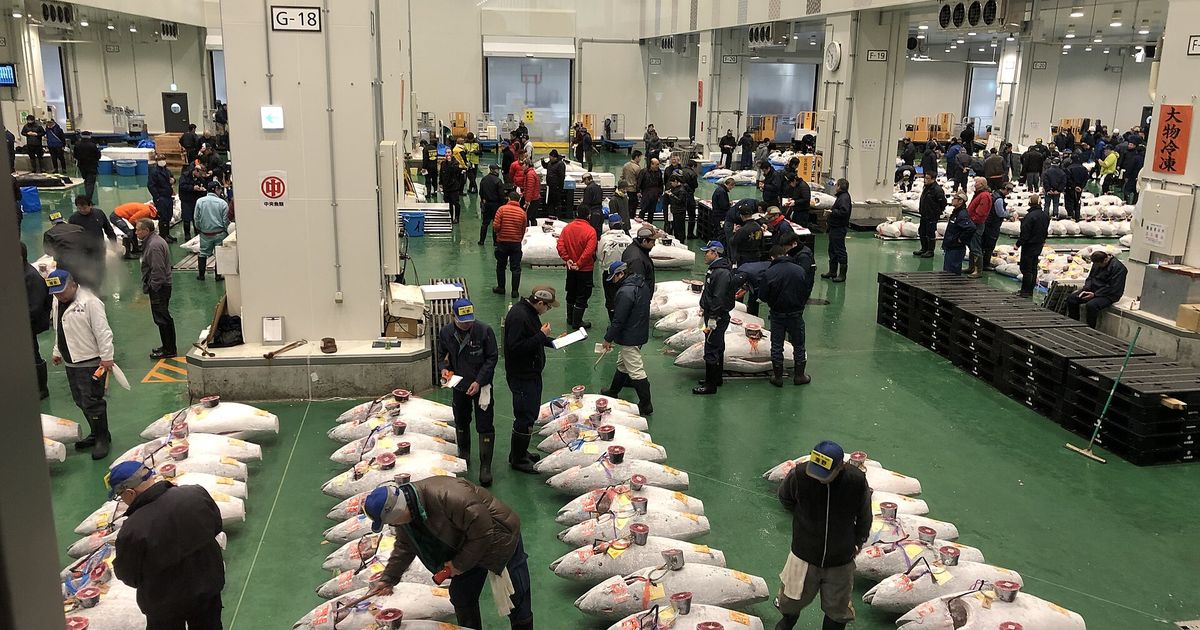
Start with the thing most visitors get backwards: both tuna auction viewing options at Toyosu are free. The market says so in two separate official documents, and the people who lose the lottery can watch the same wholesale floor from the second-floor visitor corridor, from 5:00 am, with no cap on numbers. The lottery does not sell you access. It sells you about twenty metres of proximity, and the price of those twenty metres is a 5:30 am assembly, photo ID for every person in your group, and instant demotion to the second floor if you are late. What will actually ruin your morning is something else: Toyosu does not have opening hours, it has three separate clocks — the market building runs 5:00–17:00 but only on trading days, the auction is finished by 6:25, and the Senkyaku Banrai complex across the walkway never closes yet does not open until 10:00. Stack those three and a three-and-a-half-hour void opens up between 6:30 and 10:00. This guide flattens all three clocks, explains why the first train from Shimbashi mathematically cannot make the assembly, why the Wednesday closure rule is wrong, and what is genuinely left at Tsukiji.
- Both viewing decks are free — stated twice officially. Lottery losers watch the same tuna floor from 5:00 am, with no headcount limit
- My advice: do not enter the lottery. A 5:30 assembly, group-wide photo ID and demotion for lateness is a terrible return — unless you already sleep in Toyosu or Ariake
- 🚨 First Yurikamome from Shimbashi is 5:45 — it cannot reach a 5:30 assembly. What works is Toyosu 5:15, arriving 5:18
- 🚨 On closed days you cannot enter the building at all, restaurants included — but Senkyaku Banrai trades anyway. The two are easy to conflate
- 6:30–10:00 is dead time. The only real fix is the Manyo Club morning bath (5:00–9:00, ¥2,200 for adults)
- Wednesday closures are not a rule — six Wednesdays trade in 2027, including the 5 May public holiday
📖 Table of contents
- 1. Three clocks, all disagreeing
- 2. The tuna auction: both decks are free
- 3. Is the lottery worth entering? No
- 4. Filling the 6:30–10:00 void
- 5. Closed days, and why Wednesday is a myth
- 6. Getting there before dawn
- 7. Senkyaku Banrai: the facility that never closes
- 8. Tsukiji did not disappear
- 9. Three itineraries, including a closed-day rescue
- 10. FAQ
Three clocks, all disagreeing
Search for Toyosu opening hours and you will be told 5:00 to 17:00. That is accurate and it will still wreck your morning, because it describes one of three clocks running on that site.
Toyosu is not a single attraction. It is three operations sharing a postcode, each with its own switch-on time and its own closure logic:
| Clock A: the market building (visitor corridor, in-market shops) | Clock B: the tuna auction | Clock C: Senkyaku Banrai | |
|---|---|---|---|
| Opens | 5:00 | Walk-up 5:00 / lottery assembly 5:30 | Retail 10:00 / dining 10:00 (a few 2F from 9:00) / foot bath 9:00 |
| Closes | 17:00 | 6:25 (lottery slot 5:45–6:25) | Retail 18:00 / dining 22:00 (some 20:00) |
| Closed days | 🚨 No entry at all, restaurants and retail included | Not held | ✅ Trades normally — officially no closing days |
| Cost | Free | Free, lottery deck included | Free to enter (only Manyo Club charges) |
| Booking | None | Lottery deck yes / corridor no | None |
Line the columns up and the trap surfaces on its own: the auction is over at 6:25, and the earliest anything at Senkyaku Banrai opens is the 9:00 foot bath, with the actual shops and restaurants at 10:00. Meanwhile the specialist street inside the market is closing down — it describes its own trading as early morning until around midday, which in practice means that by eight you are walking past shuttered stalls.
That void is the most useful thing in this guide, and section four deals with it. First, the auction, because the misinformation there is worse.
The tuna auction: both decks are free
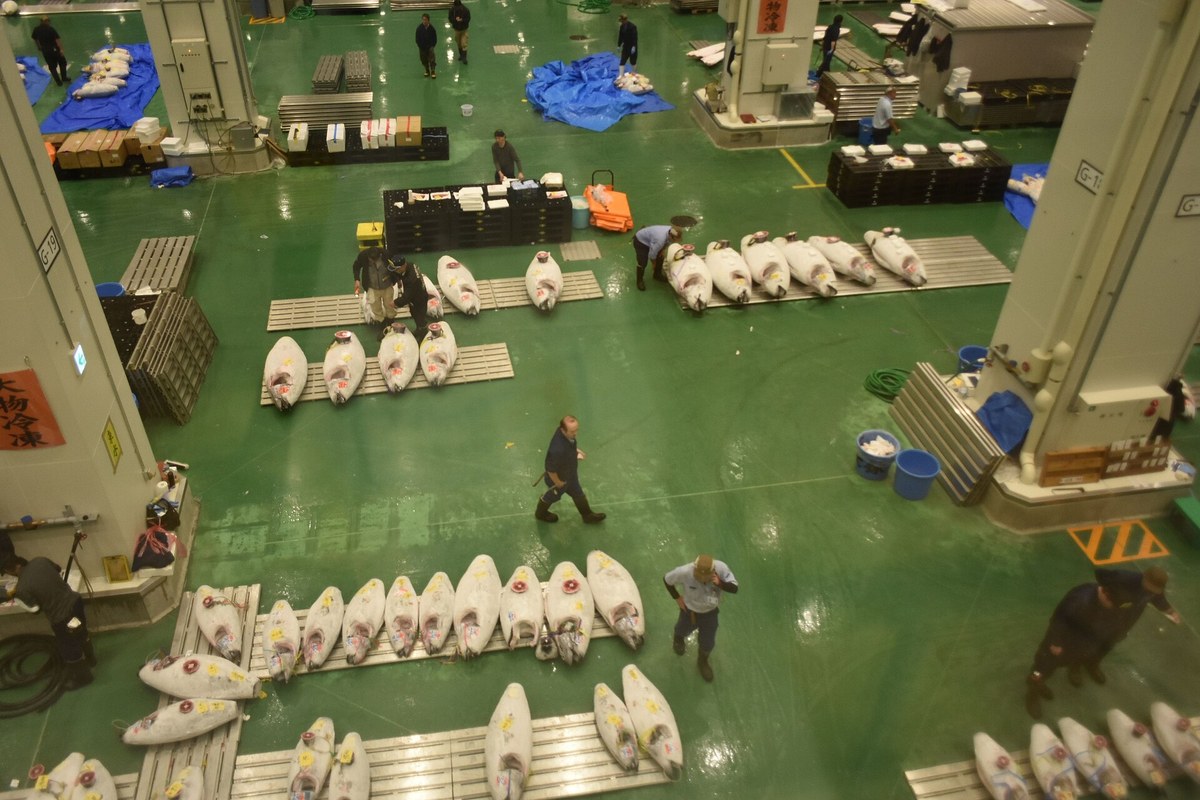
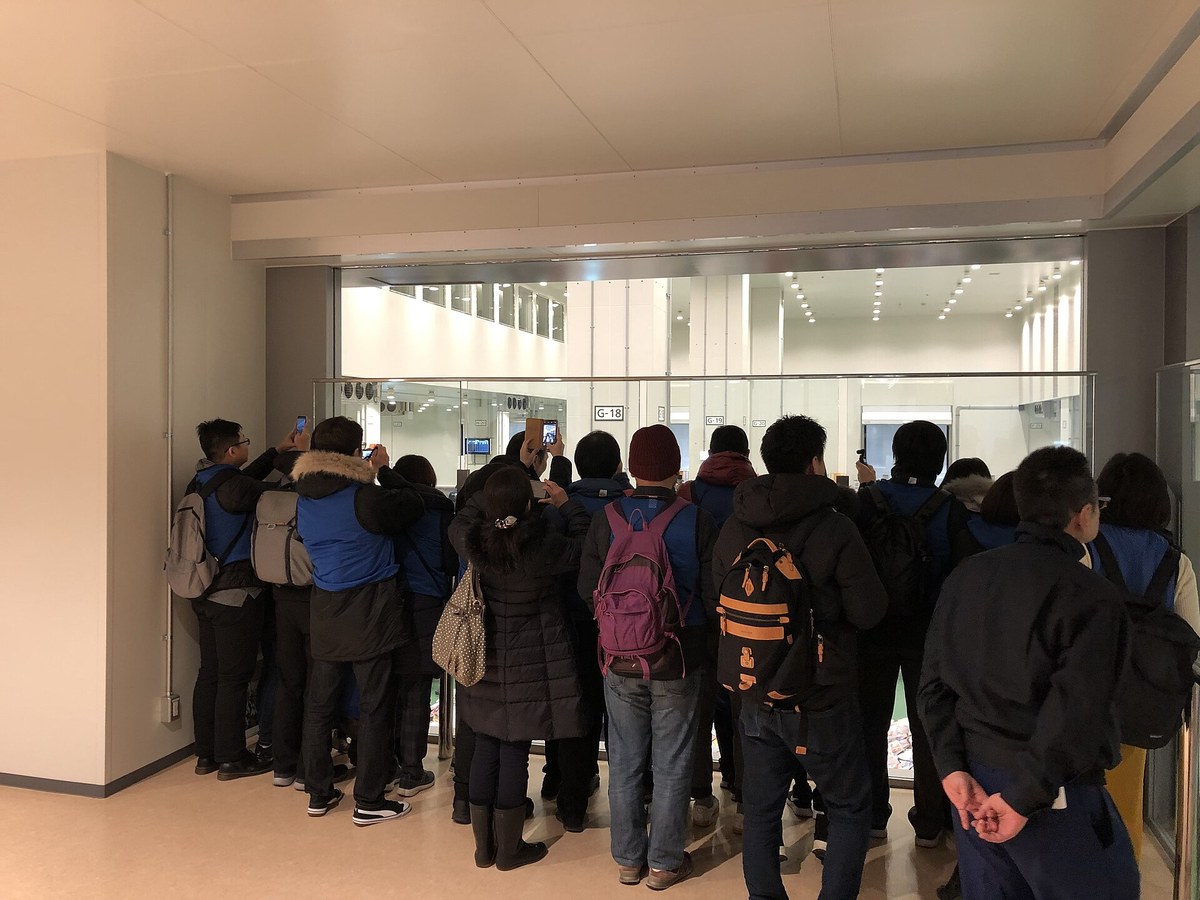
Two facilities, two official names. The Tuna Auction Viewing Deck requires a lottery win. The 2F Visitor Corridor requires nothing at all. Neither official name says upstairs or downstairs, and thinking of them that way is misleading — they are separate places, not two tiers of one grandstand.
More importantly, the widespread claim that the close-up deck is paid is simply false. Section 6 of the lottery guidelines and FAQ item 2 both state that viewing is free of charge. There is no fee anywhere in this process.
| Factor | Tuna Auction Viewing Deck (lottery) | 2F Visitor Corridor (walk-up) |
|---|---|---|
| Cost | Free | Free |
| Booking | Advance application, lottery-drawn (officially not first-come), monthly rounds, one entry per group, up to three preferred dates | None required (FAQ 21) |
| Capacity | 100 people per day, max 5 per group — an infant counts as one person | No entry cap (FAQ 5) |
| Timing | Viewing 5:45–6:25, assembly 5:30 at the PR Corner, 3F of the administration building in Block 7 | From 5:00 am on trading days |
| Hard requirements | 🚨 Photo ID for every member of the group (insurance card accepted for under-12s); no verification, no viewing; latecomers redirected to the second floor | None |
| What you see | The same tuna wholesale floor, closer | The same tuna wholesale floor |
The application rules contain several disqualifiers worth knowing before you waste a form:
- One entry per group. The lead applicant must be junior-high age or older, one email address may apply once, and the system does not support non-smartphone mobile phones.
- No same-day entry, no waitlist, no second round of applications, and no date changes — FAQ items 6, 10 and 23 close each door individually. You get the date you drew.
- Travel agencies and event companies cannot apply on your behalf (FAQ 17), and transferring or reselling passes, or recruiting companions commercially, is strictly prohibited (guidelines 12(4)).
- Photography is allowed but flash is banned, and intoxicated visitors are refused at the discretion of reception staff.
- Applications are not accepted from 25 December to 5 January. If you are in Tokyo over new year, write this one off and use the corridor instead — our Tokyo new year guide covers what else is running those days.
- The odds are officially unpublished. FAQ item 9 states that enquiries about application results and the drawing method will not be answered — so no win rate you see anywhere has an official source.
How the application cycle actually works
The structure never changes even though the dates do: applications open in the first third of the preceding month, results land in the middle of the preceding month, viewing happens during the target month. As a worked example, the next round is for December 2026: applications from 4 November 15:00 to 10 November 23:59, results around 19 November at 18:00.
⚠️ Those specific dates rotate monthly. Check the official lottery page for your own month.
Is the lottery worth entering? No
Winning the lottery is easy to treat as the Toyosu achievement unlock. Price the whole thing out and it is a bad trade for nearly everyone. My position is blunt: skip the lottery, walk up to the second-floor corridor at 5:00. Three reasons.
One: the currency is not money, it is where you sleep. A 5:30 assembly means a 4:30 alarm and being on a platform by roughly 5:10. As the next section shows, the first Yurikamome out of Shimbashi is 5:45, which rules out staying anywhere most visitors actually stay — Shinjuku, Shibuya, Ueno, Asakusa — unless you are paying for a taxi. You are re-planning your accommodation around twenty metres of viewing distance.
Two: the requirements are collective. Photo ID is not just yours, it is everyone in the group. One family member leaves their passport in the hotel safe and the entire group fails verification at the desk. And arriving late means being sent to the second floor — you will have paid every cost and received the free thing you could have had without applying.
Three: the upside is smaller than advertised. Both options overlook the same wholesale floor. The corridor has no headcount limit, opens at 5:00, and lets you stay as long as you like. The lottery slot is a fixed forty minutes, 5:45 to 6:25, after which you are moved on.
So who should apply? One profile, really: you are already sleeping in Toyosu, Ariake or Odaiba, you have nothing else booked that morning, and proximity is genuinely what you came for. Serious photographers and repeat visitors — go ahead, it makes sense. Everyone else should reclaim that morning and spend it on the corridor at five and a bathhouse at half past six.
Filling the 6:30–10:00 void
This is the section that decides whether your morning feels brilliant or bleak.
The auction finishes at 6:25. You walk out, and then what? The specialist shopping street inside the market — around 70 shops selling produce, dashi, pickles, tamagoyaki, knives, containers, kitchen kit and work whites — trades, in its own words, from early morning until around midday. That is a professional rhythm, and 8:00 lands you in the middle of the shutdown. There are 39 restaurants inside the market, entered from the third-floor pedestrian deck in each block, but the market itself warns that shop opening and closing times differ from visitor viewing hours, so check each shop's posted hours on the day.
Senkyaku Banrai, meanwhile, opens at 10:00 (9:00 for the free foot bath and a handful of second-floor eateries).
The one thing that genuinely fills those three and a half hours is the Manyo Club morning bath.
- Reception 5:00–9:00. Adults ¥2,200, elementary schoolchildren ¥1,100, ages 3 to pre-school ¥800.
- That price includes admission, bath towel, face towel and in-house facility charges, but not a yukata. Adults also pay a ¥150 bathing tax (under-12s exempt) — see our Japan accommodation and bathing tax guide for how these local levies work.
- 🚨 No extension past 9:00 am. Staying later means buying the daytime set instead (adults ¥3,850), or accepting the early-entry surcharge of ¥400 per hour before 10:00 — which works out more expensive.
- ⚠️ The main baths are cleaned 3:00–5:00 and the changing rooms are closed 3:30–5:00, so 5:00 really is the earliest usable time.
- 🚨 Entry restrictions are stricter than most visitors expect: tattoos, including temporary stick-on tattoos and body paint, are in principle not permitted; under-18s cannot enter unaccompanied; children not yet out of nappies and adults wearing them cannot use the main baths; outside food and drink is banned. Under Tokyo Metropolitan ordinance, anyone aged 7 or over, or 120 cm and taller, must use the gender-separated baths — families should settle that before arriving.
One correction while we are here: the free foot bath is the eighth-floor Senkyaku Banrai Foot Bath Garden, open to anyone from 9:00 to 22:00. The tenth-floor Observation Foot Bath Garden is reserved for Manyo Club guests. The two are easy to mix up, and people do get turned away on the tenth floor.
If bathing is not your thing, my second-best answer is to stop trying to fill the gap: leave Toyosu at 6:30, head back into town for breakfast, or move on to Tsukiji — where the officially recommended visitor window starts at 9:00 anyway, which times out neatly. Sitting around Toyosu waiting for 10:00 is the worst available option.
Closed days, and why Wednesday is a myth
This section matters more than everything above it, because getting it wrong zeroes out the entire morning.
The official wording: on closed days you cannot enter Toyosu Market, restaurants and retail shops included. Not most places will be shut — the facility does not admit you, and the visitor corridor and PR corner are both shut. The lone exception is the rooftop green space, open 5:00–23:00 regardless. It is a pleasant lawn with a Tokyo Bay view and it will not carry a morning.
🔴 Wednesday closures are not a rule
Closures are designated individually on an annual calendar, not by weekday. The 2027 calendar gives the seafood division 250 open days and 115 closed days, and six Wednesdays are open:
- 6 January, 31 March, 5 May, 22 September, 24 November, 29 December
- On 6 January, 31 March and 24 November only the fruit and vegetable division closes — the seafood division, and therefore the tuna auction, runs normally. The calendar page annotates this explicitly.
The companion myth — public holidays are always closed — fails too: 5 May 2027, Children's Day, is an open day, the only public holiday that trades that year; 23 September 2026, the autumn equinox, traded as well.
Seafood division closed days, October 2026 to December 2027
| Month | Closed days | Total |
|---|---|---|
| October 2026 | 4, 7, 11, 12, 18, 21, 25, 28 | 8 |
| November 2026 | 1, 3, 8, 11, 15, 18, 22, 23, 29 | 9 |
| December 2026 | 2, 6, 9, 13, 16, 20, 23, 31 | 8 |
| January 2027 | 1, 2, 3, 4, 10, 11, 13, 17, 20, 24, 27, 31 | 12 |
| February 2027 | 3, 7, 10, 11, 14, 17, 21, 23, 24, 28 | 10 |
| March 2027 | 3, 7, 10, 14, 17, 21, 22, 24, 28 | 9 |
| April 2027 | 4, 7, 11, 14, 18, 21, 25, 28, 29 | 9 |
| May 2027 | 2, 3, 4, 9, 12, 16, 19, 23, 26, 30 | 10 |
| June 2027 | 2, 6, 9, 13, 16, 20, 23, 27, 30 | 9 |
| July 2027 | 4, 7, 11, 14, 18, 19, 21, 25, 28 | 9 |
| August 2027 | 1, 4, 8, 11, 14, 15, 16, 18, 22, 25, 29 | 11 |
| September 2027 | 1, 5, 8, 12, 15, 19, 20, 23, 26, 29 | 10 |
| October 2027 | 3, 6, 10, 11, 13, 17, 20, 24, 27, 31 | 10 |
| November 2027 | 3, 7, 10, 14, 17, 21, 23, 28 | 8 |
| December 2027 | 1, 5, 8, 12, 15, 19, 22, 31 | 8 |
The holiday periods are where people get caught:
- New year: closed 31 December 2026 and 1–4 January 2027; first trading day is Tuesday 5 January. The lottery takes no applications for 25 December to 5 January, so the corridor is the only option.
- Golden Week 2027: open 30 April, 1 May and 5–8 May; closed 29 April and 2–4 May.
- Obon 2027: closed 11 and 14–16 August.
- ⚠️ Sunday 26 December 2027 is a seafood trading day on the calendar, but the visitor rules say Sundays are closed to visitors. Do not plan around it.
The practical move is embarrassingly simple: once your flights are booked, check every Tokyo morning against the official calendar before choosing which one goes to Toyosu. No itinerary trick beats it.
Getting there before dawn
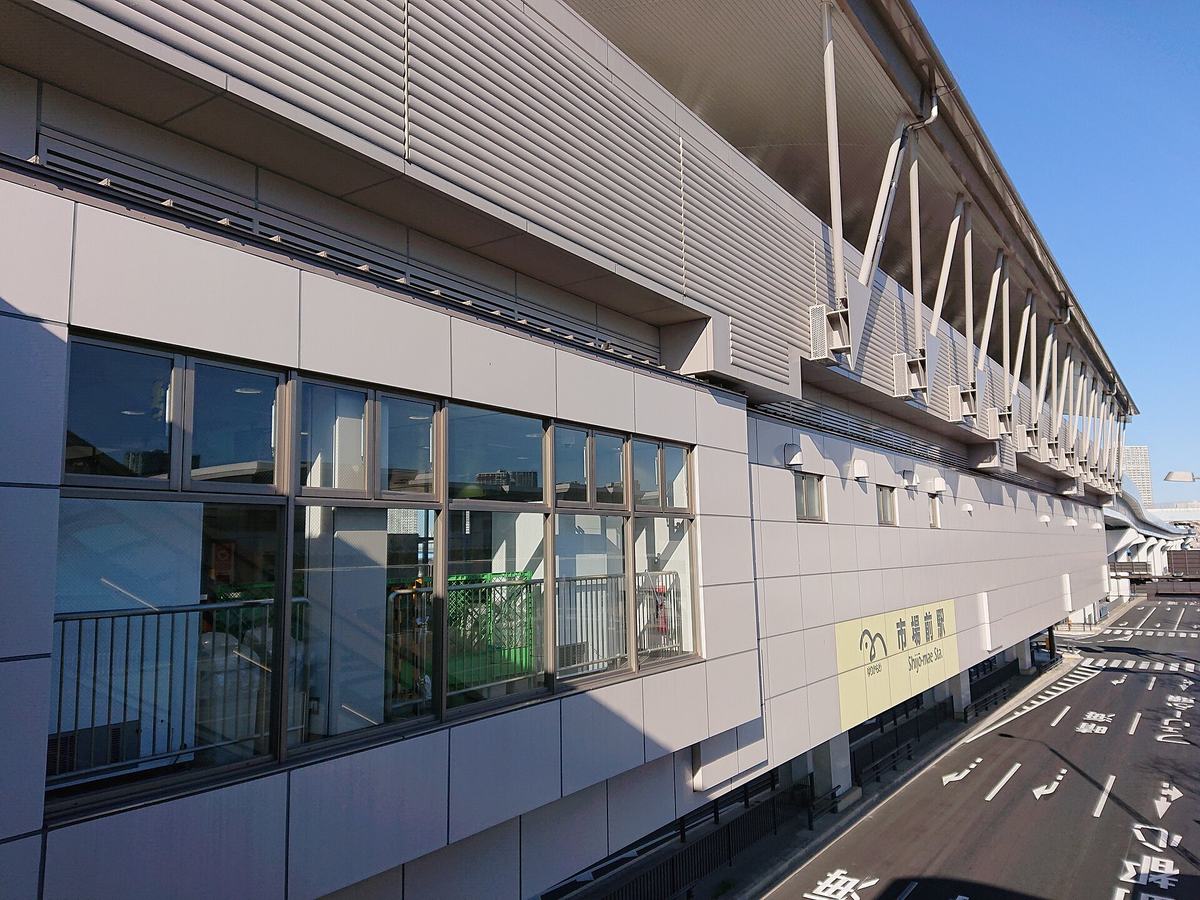
The station is Shijo-mae (U-14) on the Yurikamome line, connected on the second level to the Senkyaku Banrai pedestrian deck, about four minutes on foot. The market building itself is entered from three points along the pedestrian deck, one per block.
From the Yurikamome standard timetable:
| Service | Time | What it means for a 5:30 assembly |
|---|---|---|
| First departure, Shimbashi (same on weekdays and weekends) | 5:45 | 🚨 Mathematically impossible — 15 minutes late before it moves |
| First departure, Toyosu (toward Shimbashi) | 5:15 | ✅ Arrives Shijo-mae 5:18 |
| Shijo-mae, first toward Shimbashi | 5:18 | — |
| Shijo-mae, first toward Toyosu | 5:24 | ✅ Originates at Ariake 5:20 — useful from Odaiba or Ariake hotels |
| Last Shimbashi departure serving Toyosu | 23:50 | ⚠️ The 24:00, 24:10 and 24:20 services terminate at Ariake and never reach Shijo-mae |
Translated: if you win a 5:30 slot, you must sleep somewhere you can reach the Toyosu platform by around 5:10 — the Tokyo Metro Yurakucho line station at Toyosu being the obvious anchor — or in the Ariake and Odaiba cluster for the 5:20. Otherwise it is a taxi.
⚠️ For the leg before that — the first Tokyo Metro Yurakucho line train into Toyosu, and the first Toei bus to Shijo-mae Ekimae or Tokyo BRT to Toyosu Shijo-mae — check with each operator before you go.
On tickets, Yurikamome sells two passes: a one-day pass at ¥820 for adults (¥410 child) and a 24-hour ticket at ¥900 adult (¥450 child). The ¥80 difference buys a different clock: calendar day versus 24 hours from activation. For a Toyosu-plus-Odaiba day the one-day pass is almost always enough; the 24-hour version only pays off in the unusual case of two consecutive dawn visits.
⚠️ One boundary worth stating: Yurikamome does not publish point-to-point fares as text on its site — only these two passes — so check the single fare on the ticket machine on the day. If you are still untangling which operator runs which line in Tokyo, the Tokyo trains and subway guide sorts the JR, Metro and Toei layers out first.
Two closing notes: Toyosu Market provides no visitor parking or bicycle parking and explicitly asks you to use public transport. Senkyaku Banrai does have a car park, but on a spend-linked tariff covered in the next section.
For this article, hotel location is not a comfort question, it is a feasibility question. If you are seriously going for a 5:30 slot, your search radius shrinks to Toyosu, Ariake and Odaiba — one of the few times in a Tokyo trip where where you sleep decides whether something is possible at all. Two platforms to cross-check: Trip.com Tokyo stays → covers all of Tokyo, so search by those neighbourhood names rather than by ward; Booking.com stays near Toyosu Market → leads with Toyosu and Ariake hotels, but the same page also lists places in Roppongi and Shinagawa far from the bay, so check each location.
Senkyaku Banrai: the facility that never closes
Toyosu Senkyaku Banrai, the complex across the walkway, joined the site in 2024, and it is a separate facility running separate rules — currently the single largest source of confusion about Toyosu.
Its official FAQ is unambiguous: it has no closing days and trades even on Toyosu Market closed days. Entry is free — the shops and the eighth-floor foot bath garden charge no admission, and the only paid element is the Tokyo Toyosu Manyo Club bathhouse.
| Area | Hours | Notes |
|---|---|---|
| Retail shops | 10:00–18:00 | — |
| Restaurants | 10:00–22:00 | Some to 20:00; a few second-floor places open at 9:00 |
| 8F Senkyaku Banrai Foot Bath Garden | 9:00–22:00 | ✅ Open to anyone, free |
| 10F Observation Foot Bath Garden | — | 🚨 Manyo Club guests only — not the free one |
| Seafood buffet Iroha Toyosu (3F) | 10:00–16:00 | — |
| BAR GINZA Kou (2F) | 10:00–05:00 | Last orders 4:00 — the only thing here running at dawn |
| Information desk Banya (2F) | 9:00–22:00 | After 22:00, handled by the ground-floor security office |
Practical facilities: coin lockers on the second floor near the pedestrian deck, a prayer room on the second floor of the bathhouse building, free Wi-Fi on SSID SENKYAKU_BANRAI, and wheelchair loan (limited units, advance request). ⚠️ There is no pushchair storage service — worth knowing if you are travelling with a toddler, because Tsukiji does offer that at its information centre.
Drivers: the car park is spend-linked. Using the facilities it is ¥300 per 20 minutes all day, but ¥500 per 20 minutes if you do not spend at least ¥2,000 on site; spending ¥2,000 earns two free hours, ¥3,000 three hours, ¥5,000 five hours, then ¥300 per 20 minutes after that, validated at the second-floor information desk between 9:00 and 22:00 (after 22:00 at the ground-floor security office). Manyo Club spending does not count toward these totals; Manyo Club has its own parking discount, and the two discounts can be stacked. Honestly, do not drive here — the market itself has no visitor parking and the train stops at the door.
⚠️ A brand-new source of confusion
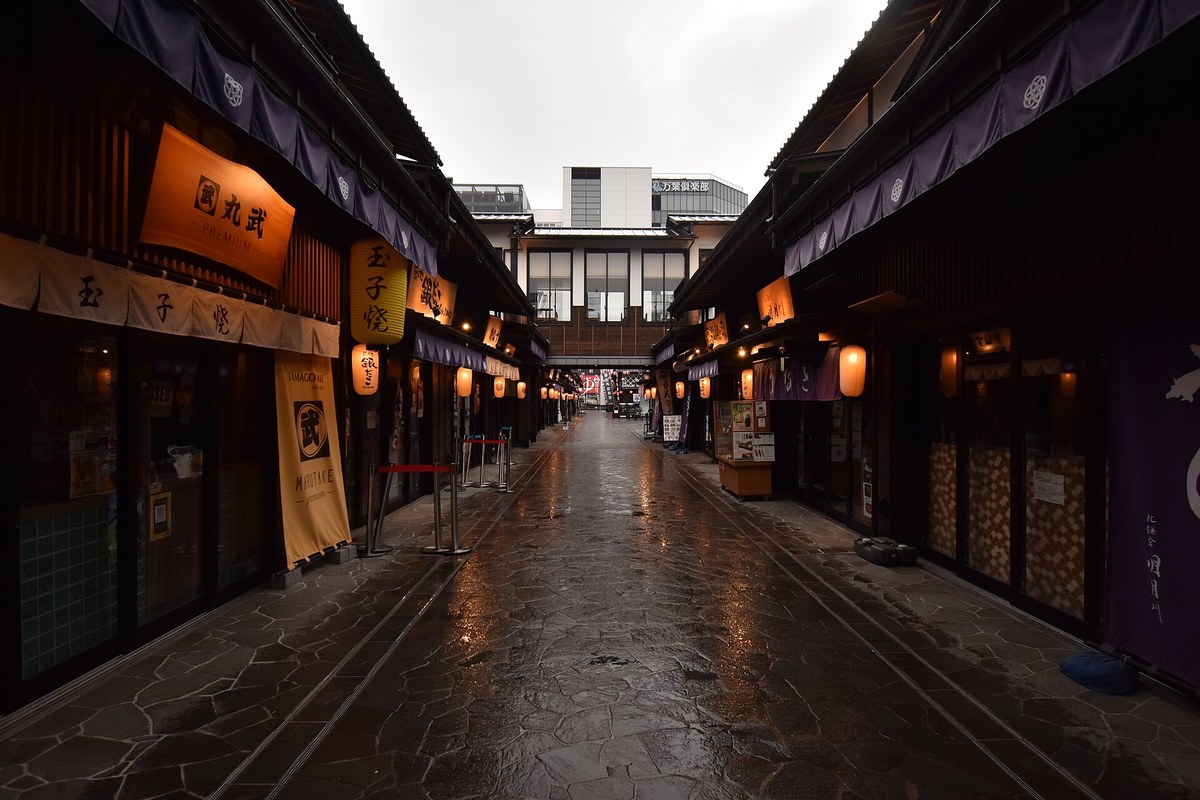
Senkyaku Banrai calls its retail and dining zone Toyosu Jogai Shijo — literally Toyosu Outer Market. That name was adopted on 1 September 2025, replacing a longer previous one.
The problem is that it has nothing to do with Tsukiji Outer Market — different organisation, different site, and Tsukiji Outer Market never relocated. The names are close enough to blend together. Keep the line clear: Outer Market with Toyosu in front of it is a shopping zone inside Senkyaku Banrai; with Tsukiji in front of it, it is the original street in Tsukiji.
Tsukiji did not disappear
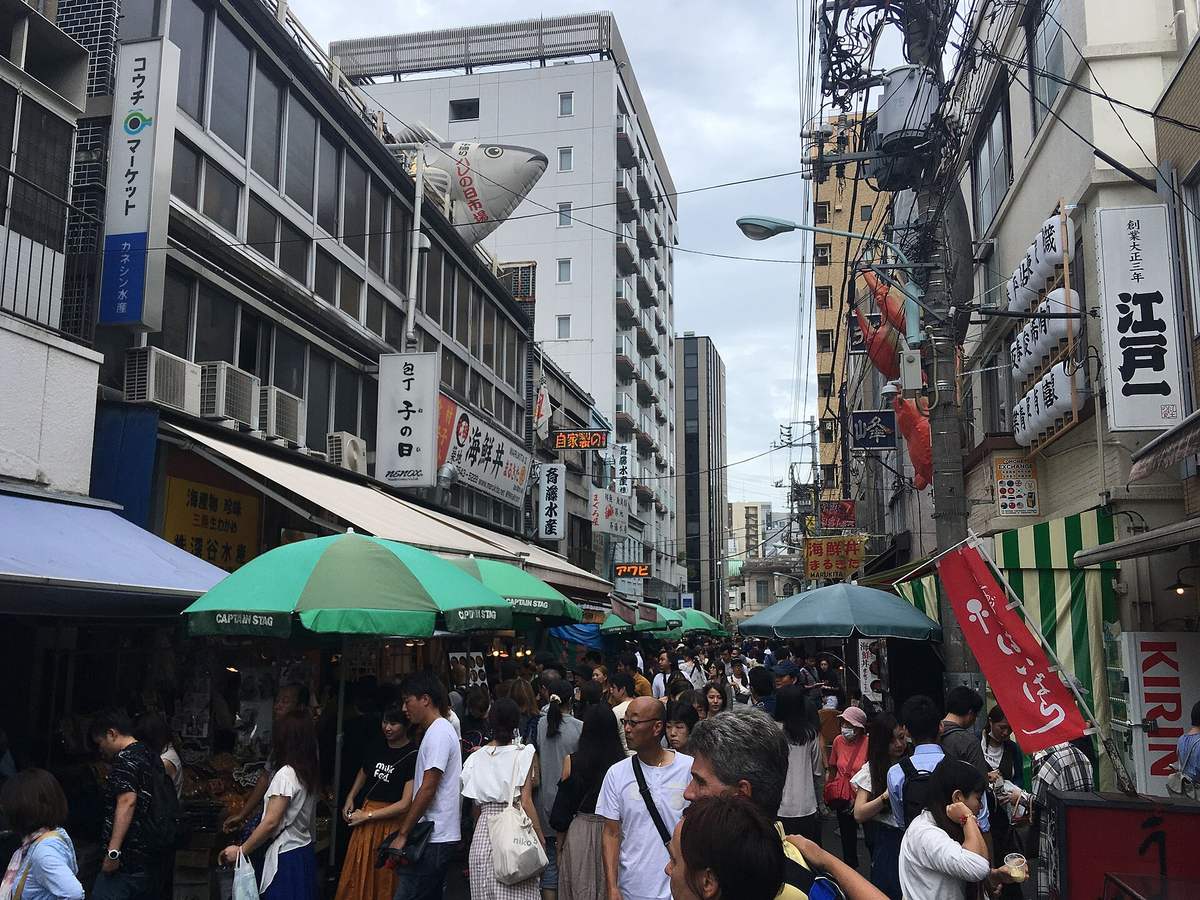
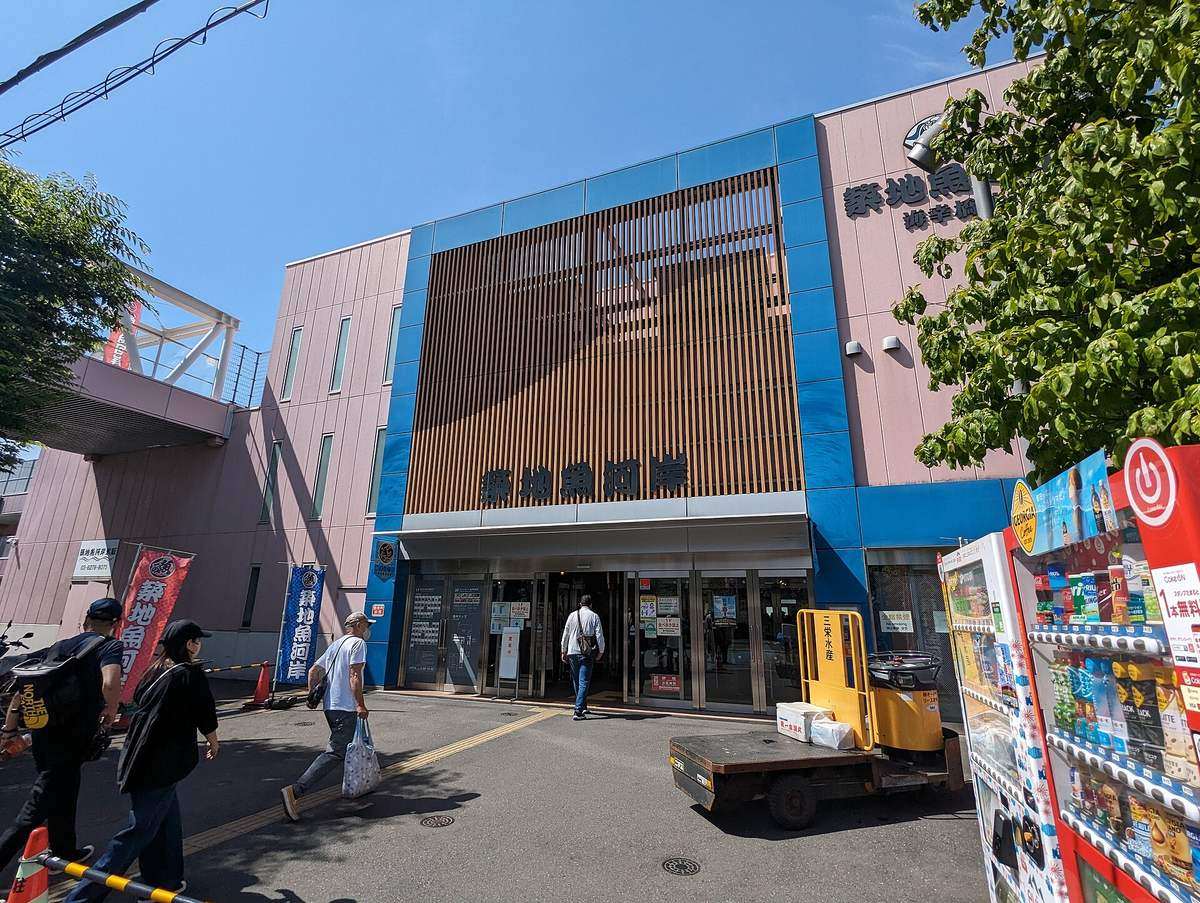
The stubbornest myth about Tokyo fish markets is that Tsukiji is gone. What actually happened on 11 October 2018 is that the inner wholesale market relocated. The outer market stayed exactly where it was.
And it is not merely surviving. Tsukiji Outer Market runs an official site with a current-year calendar, shop directory, events and an information centre. Tsukiji Uogashi — established by Chuo City, roughly 60 retailers operated largely by former intermediate wholesalers, spread across two buildings — trades formally, and describes its own mission as being supported by food professionals while remaining approachable for general customers and tourists.
Its FAQ also settles two things people get wrong:
- Best time to visit: the official recommendation is 9:00 to 14:00.
- Sundays and public holidays: not a full shutdown — about one third of shops, restaurants especially, remain open.
Which makes the division of labour clean, and rather complementary:
| What you want | Toyosu | Tsukiji |
|---|---|---|
| Watch the tuna auction and the wholesale floor | ✅ The only option | ❌ Relocated 11 Oct 2018 |
| Browse and buy | ⚠️ General consumers cannot buy on the intermediate wholesale floor; eating on the corridor is banned | ✅ Outer market plus around 60 Uogashi retailers |
| A reasonable wake-up time | ❌ Auction done at 6:25, shops winding down by midday | ✅ Officially recommended 9:00–14:00 |
| Sundays and public holidays | ❌ Usually closed days — no entry to the building | ⚠️ Around a third of shops trading |
| Access | Yurikamome to Shijo-mae | Hibiya line Tsukiji, exits 1 and 2, 5 min / Oedo line Tsukiji-shijo, exit A1, 2 min |
The Tsukiji Uogashi timing trap
Tsukiji Uogashi opens its doors at 5:00 and closes at 15:00, but the window when every shop is trading is 7:00 to 14:00. More to the point, the official guidance states that 5:00 to 9:00 is reserved in practice for professional buyers, and general customers and tourists are asked to come after 9:00 — the same signal as the outer market 9:00–14:00 recommendation.
Eating on the ground floor is discouraged; use the rooftop plaza or the third-floor rest area instead. The Uogashi Shokudo food hall on the third floor runs 7:00–19:00 with last orders at 18:00 and welcomes general visitors. ⚠️ The operator flags these as provisional hours adopted in response to circumstances, so treat them as more volatile than the rest of this page.
Trading days follow the Tokyo Metropolitan Central Wholesale Market open and closed days — meaning the closed-day table in section five applies here too. The outer market has no unified hours at all, though, and says so on its own calendar page: that calendar shows the wholesale market closures, some outer-market shops close anyway, and you should confirm with individual shops directly.
Two rules of Tsukiji etiquette visitors break most
The outer market publishes an eight-point etiquette code. The two that cause the most friction:
- Before 9:00 is professional buying time. This is the flipside of the 9:00–14:00 recommendation — arriving at seven means getting in the way of people whose livelihood depends on the aisle you are standing in.
- Eat inside the shop or standing in front of it. The official wording states that walking while eating obstructs other pedestrians. Finish the skewer where you bought it, then move.
- The remainder: put suitcases in coin lockers (pushchairs can be left at the information centre), move in small groups, ask before photographing (some shops forbid it), do not handle the food, do not haggle — the market states outright that bargaining is not a Tsukiji custom — and smoke only in designated areas.
One extra for new year travellers, straight from the FAQ: although a few shops trade year-round, most stay closed until 4 January. For year-end shopping the crush peaks around midday and the official advice is to arrive between 7:00 and 8:00, buying anything that keeps well in late November or early December instead. If you are building a whole eating itinerary around this, our Japan food guide helps you set the budget and the shortlist.
Three itineraries, including a closed-day rescue
Everything above, collapsed into three plans you can copy directly.
Plan A: the no-lottery standard (my recommendation)
- 4:45–5:00 — leave from Toyosu, Ariake or Odaiba. Staying in central Tokyo means a taxi here, or switching to Plan B.
- 5:00–6:30 — the tuna wholesale floor from the 2F visitor corridor. No application, no cap, stay as long as you want. Walk the rest of the visitor corridor while you are there; it stays open to 17:00.
- 6:30–9:00 — Manyo Club morning bath (adults ¥2,200 plus ¥150 bathing tax). ⚠️ No extension past 9:00, so watch the clock.
- 9:00–10:00 — the free eighth-floor foot bath garden at Senkyaku Banrai.
- From 10:00 — the retail and restaurants open properly. Brunch, souvenirs, done.
The virtue of this sequence is that it has no dead time in it, and it needs no lottery, no ID check and no punctuality.
Plan B: the sleep-in version (which most people should pick)
- 8:30 — leave central Tokyo for Tsukiji.
- 9:00–12:00 — Tsukiji Outer Market plus Tsukiji Uogashi, inside the officially recommended window. Remember to eat at the stall rather than walking with food.
- From 13:00 — take the train to Toyosu for Senkyaku Banrai and the eighth-floor foot bath.
- ⚠️ This plan does not include the auction — that finished at 6:25. Only Plan A gets you the auction.
Honestly, on a packed five-day trip, Plan B has the better return on effort: you get the atmosphere, the seafood and the shopping, and the only thing you give up is a 4:30 alarm. Our Tokyo five-day itinerary shows where it slots in on the final morning.
Plan C: you hit a closed day
- 🚨 Premise: the market building is entirely shut. Do not turn up hoping.
- From 10:00 — go straight to Senkyaku Banrai, which officially trades on market closed days. It is the only part of Toyosu still available.
- Same district: teamLab Planets is also in Toyosu and walkable from the market. Our teamLab Planets versus Borderless comparison helps you choose between the two venues.
- Or redirect entirely to Tsukiji — about a third of shops trade on Sundays and holidays.
Closed days, weather and dawn timetables tend to go wrong together on the same morning, and all three are things you end up checking on a phone at 5am, so a working data connection matters more here than on a normal sightseeing day. If the rain arrives instead, several options in our Tokyo rainy day guide sit in this same corner of the bay.
What I would do
First time in Tokyo, staying in the centre, with a full schedule: I would take Plan B, skip the auction and keep the sleep. If the auction is the point, I would move the night before to Toyosu or Ariake and run Plan A without entering the lottery. Either way, I would check the market calendar the night before, and on a closed day switch straight to Plan C rather than find out at the door.
Frequently Asked Questions
- Q1:If I lose the tuna auction lottery, can I still see the auction?
- Yes — the exact same auction floor. Tokyo Metropolitan Central Wholesale Market states it plainly in FAQ item 21: you may view the tuna wholesale floor (the tuna auction) from the second-floor visitor corridor without applying for the lottery at all, from 5:00 am on any market open day. FAQ item 5 adds the part that really matters: there is no cap on how many people can enter that corridor. The lottery guidelines themselves confirm that unsuccessful applicants may view the floor from the second-floor corridor. So the lottery does not buy access — it buys proximity. Losing it costs you distance, not the experience.
- Q2:Is the close-up deck paid and the second floor free?
- No. Both are free. The word appears in two independent official documents: section 6 of the lottery guidelines states that viewing is free of charge, and FAQ item 2 asks how much viewing costs and answers that viewing is free of charge. The lottery deck costs nothing either. What separates the two options is not money but three other things: whether you must enter a lottery, how close you stand, and the 5:30 am assembly time. Worth fixing the vocabulary too — the official names are the Tuna Auction Viewing Deck (lottery) and the 2F Visitor Corridor (walk-up). They are two separate facilities, not an upstairs and a downstairs.
- Q3:Is Toyosu Market closed every Wednesday?
- No — closures are set day by day on an annual calendar, not by weekday. For 2027 the seafood division has 250 open days and 115 closed days, and six Wednesdays are open: 6 Jan, 31 Mar, 5 May, 22 Sep, 24 Nov and 29 Dec. On 6 Jan, 31 Mar and 24 Nov only the fruit and vegetable division closes, so the tuna auction runs. Public holidays are not automatically closed either: 5 May 2027, Children's Day, is an open day.
- Q4:Can I at least eat at Toyosu on a closed day?
- No — you cannot get inside the building at all. The wording is explicit: on closed days you cannot enter Toyosu Market, restaurants and retail shops included. This is not the usual amount of places will be shut; the entire facility is shut, visitor corridor and PR corner included. The single exception is the rooftop green space, open 5:00–23:00 even on closed days. But the two are easy to run together, and they are not the same place:Toyosu Senkyaku Banrai across the walkway is a different facility, and its official FAQ states it has no closing days and trades even when Toyosu Market is closed. So a closed day does not cancel your morning — it just means market building out, Senkyaku Banrai (from 10:00) and Tsukiji in.
- Q5:I am staying near Shimbashi. Can the first Yurikamome train make the 5:30 assembly?
- No, and no amount of determination fixes it. According to the Yurikamome standard timetable, the first departure from Shimbashi is 5:45 — identical on weekdays and weekends. The train has not even left by the time you were supposed to be standing at the assembly point. What does work: Yurikamome departing Toyosu at 5:15, arriving Shijo-mae at 5:18 (which means sleeping somewhere you can be on the Toyosu platform by about 5:10), or an Ariake or Odaiba hotel and the 5:20 from Ariake, arriving 5:24. Taxi and walking from Toyosu station are the other options. A Yurikamome one-day pass is ¥820(大人) for adults if you are pairing Toyosu with Odaiba. ⚠️ Confirm first departures for the Toei bus stop and the Tokyo BRT stop directly with the operators.
- Q6:The auction ends at 6:25. What is there to do until 10:00?
- This is the single biggest planning trap at Toyosu. The specialist shopping street inside the market (roughly 70 stores) describes its own hours as early morning until around midday — by 8:00 it is winding down, not opening. Meanwhile Senkyaku Banrai across the way opens its retail at 10:00, its restaurants at 10:00 (a few second-floor places from 9:00) and its free eighth-floor foot bath at 9:00. That leaves roughly three and a half hours with almost nothing in them. The one clean fix is the morning bath at Tokyo Toyosu Manyo Club: reception 5:00–9:00, ¥2,200(大人) for adults (plus a ¥150 bathing tax, no yukata included, and no extension past 9:00). Bathe after the auction and you surface exactly as Senkyaku Banrai opens.
- Q7:Did Tsukiji disappear when the market moved?
- Only the wholesale operation moved. The outer market never left. The move date was 11 October 2018, and what relocated was the inner wholesale market. Tsukiji Outer Market still runs its own official site with a current-year calendar, shop directory and events, and Tsukiji Uogashi — roughly 60 retailers in two buildings, established by Chuo City — trades formally, describing its own goal as serving food professionals while also being approachable for general visitors and tourists. Two official FAQ answers settle the questions people get wrong: the recommended window for sightseeing is 9:00 to 14:00, and the claim that everything closes on Sundays and public holidays is false — around one third of shops, mostly restaurants, stay open. The division of labour is clean: Toyosu for the auction and the wholesale floor, Tsukiji for browsing and buying.
- Q8:Can a tour operator book the tuna auction lottery for me?
- No, and it is prohibited in two places. FAQ item 17 states that applications from event companies and travel agencies are not accepted — only from the participant. Section 12(4) of the lottery guidelines goes further, strictly prohibiting transfer or resale of viewing passes and the commercial recruitment of companions, with viewing refused on discovery. Treat any paid tour advertising guaranteed auction deck access as a red flag. Three more rules eliminate people on the day: every member of your group needs photo ID (a health insurance card is accepted for under-12s), identity verification failure means no viewing, latecomers are redirected to the second floor, and intoxicated visitors are refused at reception.
- Q9:Can I buy fish from the intermediate wholesalers at Toyosu?
- No. The market states it directly: the intermediate wholesale floor serves supermarkets, retailers and restaurants, and general consumers cannot purchase there. Toyosu is a working wholesale facility that happens to admit spectators along a dedicated corridor, where eating and drinking are prohibited on the walkway and benches, and where no visitor parking exists — the market asks you to come by public transport. If your goal is shopping and grazing, that is what Tsukiji Outer Market and Senkyaku Banrai are for.