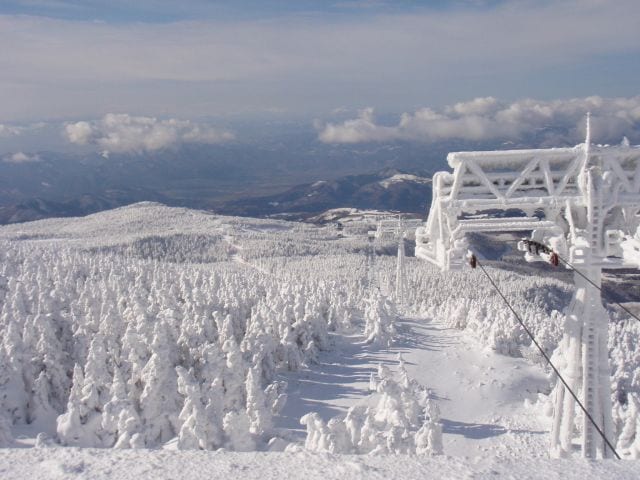
The thing most people miss about Yamagata's Zao is that its two headline sights belong to completely different seasons: the snow monsters (juhyo) appear only in January–February, and the Okama crater lake only from roughly late April to early November — you cannot catch both on one trip. Getting that timeline straight, then deciding whether you're coming for the winter monsters or the summer–autumn crater, is the single most important step in planning Zao. The good news: the Yamagata Shinkansen reaches Yamagata direct from Tokyo in about 2 hours 45 minutes, and whichever season you pick, you can fold in Yamadera (Risshaku-ji) — 20 minutes by the Senzan Line from Yamagata, 1,015 stone steps up to the cliff-edge Godaido viewing deck. This guide covers the Zao Ropeway (¥4,400 round trip to Jizo Sancho), the winter snow-monster illumination, the strong-acid Zao Onsen, the emerald Okama crater, and how to climb Yamadera, plus transport and lodging. It chains beautifully with Sendai for a Tohoku loop, and onsen fans should read our Ginzan Onsen guide.
- Snow monsters only in Jan–Feb, Okama only ~late Apr–early Nov: two headline sights in different seasons — pick one, you can't do both in one trip
- Zao Ropeway to Jizo Sancho: ¥4,400 round trip (4 segments, ¥2,200 children), with a winter snow-monster illumination night run
- Okama is an emerald crater lake — needs the Zao Echo Line open (2026: ~Apr 24–early Nov); closed road, no Okama, in winter
- Zao Onsen is a strong-acid sulfur spring (pH ~1.3–1.6) with three cheap communal bathhouses
- Yamadera, 1,015 steps, admission ¥500 from Apr 2026, cliff-edge Godaido view, and the birthplace of a famous Basho haiku
📖 Contents
- 1. The key thing: two sights, two seasons
- 2. Zao snow monsters & the ropeway (winter)
- 3. The Okama crater lake & Echo Line (summer–autumn)
- 4. Zao Onsen, a strong-acid sulfur bath
- 5. Yamadera (Risshaku-ji): 1,015 steps & Basho
- 6. Transport & lodging (Shinkansen + bus)
- 7. Winter and summer itineraries
- 8. FAQ
The key thing: two sights, two seasons
Plenty of people researching Yamagata see "the snow monsters are incredible" and "Okama is stunning" and write both into one itinerary — only to discover on arrival that they clash by season. So let me nail this down first: the snow monsters need the deep cold and heavy snow of winter, best from late January to late February; Okama can only be reached up close when the Zao Echo Line mountain road is open, and that road is fully closed in winter, opening only from roughly late April to early November. Which means: in snow-monster season the road is shut and you can't see Okama; in Okama season there's no snow and you can't see the monsters. It isn't a question of which is better — they're two separate seasonal trips. My straight advice: if it's your first time and you want that "army of frozen monsters" spectacle, lock in February for the snow monsters; if you'd rather avoid the cold and want an emerald lake against fresh green or autumn color, come June–October for Okama. Either way, Yamadera and Zao Onsen work year-round and make a reliable supporting cast.
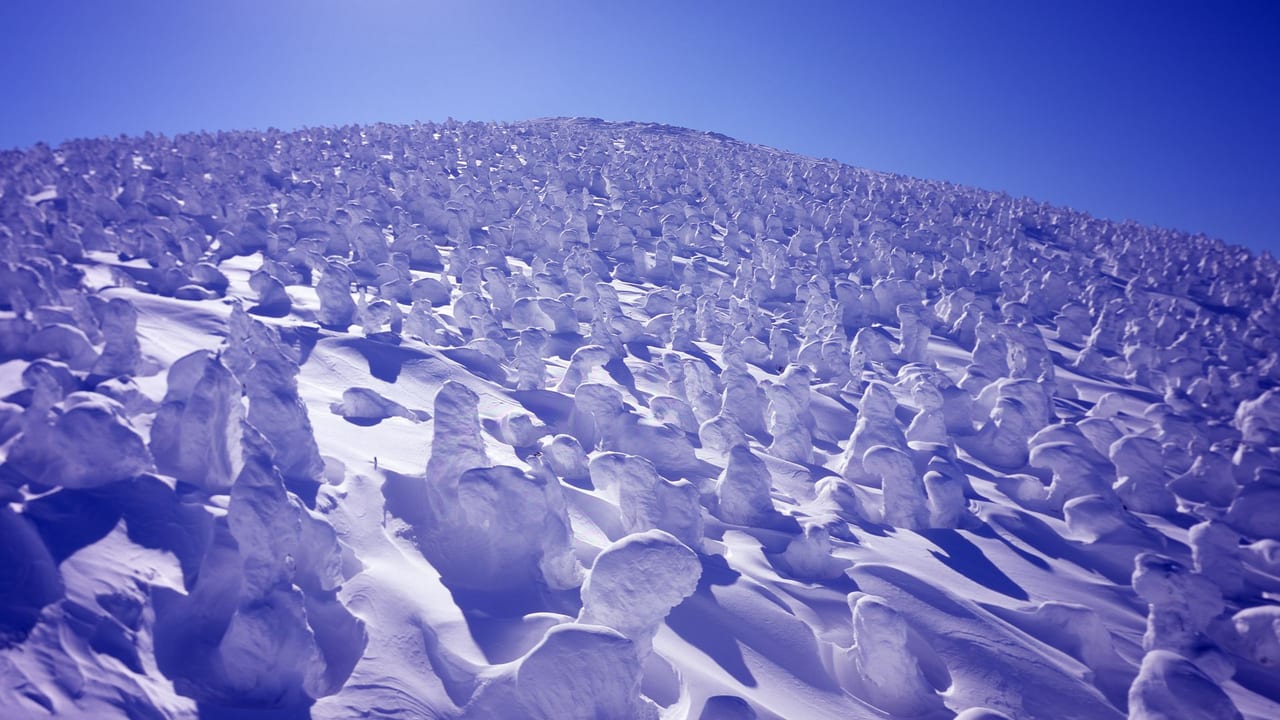
Zao snow monsters & the ropeway (winter)
The juhyo are the absolute star of a Zao winter — the tourism boards just call them "snow monsters," and the name fits. They form when the conifers up high (mainly Aomori-todomatsu fir) are struck by wind-driven supercooled water droplets off the Sea of Japan that freeze on contact, then get wrapped in layer after layer of snow, until each tree is encased into a huge, warped, irregular white monster. Growing to that spectacular scale takes sustained cold, strong seasonal wind, and heavy accumulated snow, so timing is everything:
- December: usually only half-formed — a thin coat of snow, not yet spectacular.
- Late January to late February: the best window, when the monsters are fullest and most army-of-monsters-like; this is the stretch to aim for.
- March: they start melting, deforming, and collapsing, so the scene is past its peak.
You go up via the Zao Ropeway, in two stages: first the Sanroku Line (Zao Sanroku → Juhyo Kogen), then the Sancho Line (Juhyo Kogen → Jizo Sancho). To reach the best monster fields and the views, ride all the way to Jizo Sancho. Fares (per the operator, 2025–2026): the Zao Sanroku ↔ Jizo Sancho round trip (4 segments) is ¥4,400 for adults and ¥2,200 for children; the shorter Sanroku-Line round trip is ¥2,200 adult. The Sancho Line runs roughly 8:45–16:45 (weather permitting). The winter bonus is the snow-monster illumination night run — the monsters lit up in colored light, even more surreal than by day, and the reason many people go up a second time after dark (night-run dates are published each season, so check the site). For ropeway timing, night light-up sessions, skiing and onsen all mapped into one winter trip, see the full Zao snow-monsters ropeway & light-up guide.
The honest caveat: the monsters are a weather lottery. A blizzard suspends the ropeway outright; a mild winter stunts them entirely. Add a few weeks of spring maintenance closures each year, and the rule is simple: check the Zao Ropeway site for that day's operating status and summit weather before you go. And don't read "no matching affiliate product" as "you can't go" — you can buy ropeway tickets on the spot or check operations on the official site; what actually stops you is weather, not a sales channel.
The Okama crater lake & Echo Line (summer–autumn)
In the warm season Zao's signature becomes Okama — a crater lake tucked among the peaks of the Zao range, named for its resemblance to a cooking pot (kama). Its draw is the color: dissolved sulfur and other minerals turn the water a saturated emerald/jade green that shifts from pale green to deep blue-green with the angle of the light and the weather — locals nickname it the "five-color lake," and it never looks quite the same twice.
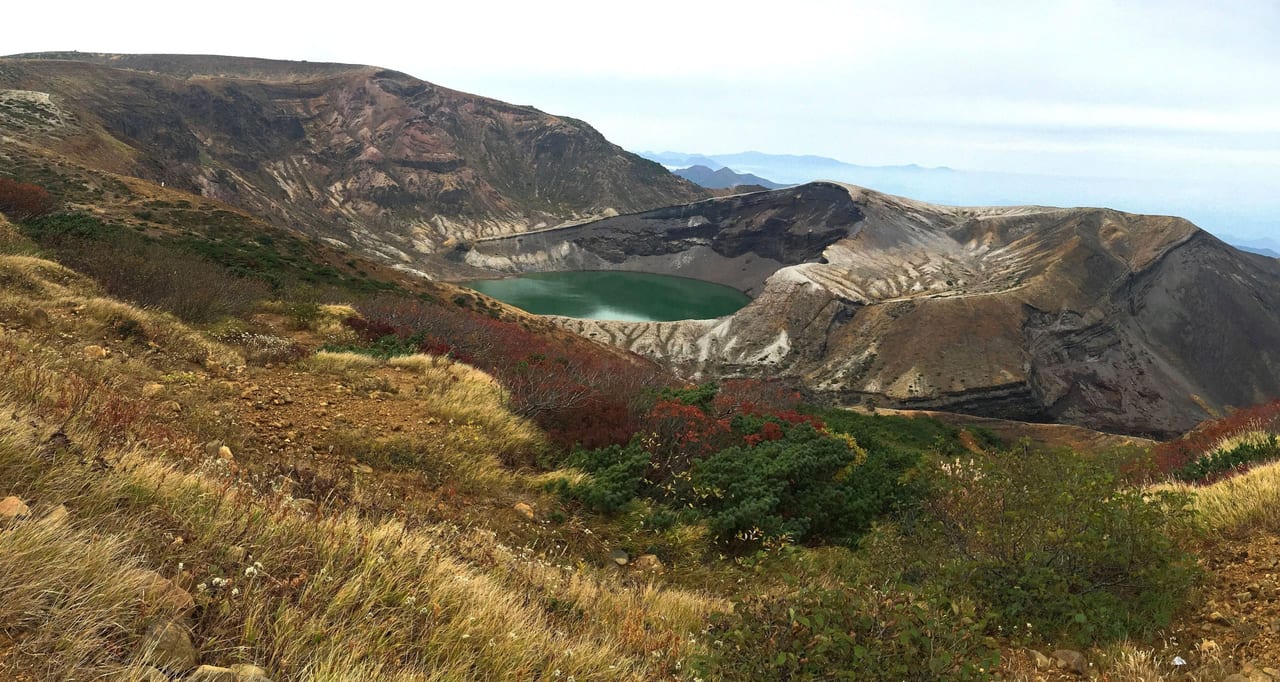
The key words for Okama are the Zao Echo Line plus the Zao Highline. The Echo Line is the mountain road crossing the Zao range to link the Yamagata and Miyagi sides; from it you branch onto the toll Zao Highline, which drives you right up to the viewpoint by the lake — a few steps and there it is. But that road is fully closed in winter: per official notices, the 2025–2026 winter closure runs until the morning of April 24, 2026, then stays open until around early November before snow shuts it again. So the conclusion is clear — Okama is visible only roughly from late April to early November, and is completely off-limits in winter. For Okama with autumn color, aim for early-to-mid October; for fresh green and the most stable weather, June–September is better. For what time of day you can actually go up — the Highline runs 7:30 to 17:00, cut to 8:00–16:00 from mid-October — plus the buses on both sides and the Katta Lift, see our dedicated Zao Okama opening times and access guide. The nationwide foliage timeline is in our Japan autumn foliage guide.
My own take: if you've already come once in winter for the monsters, Okama is honestly worth saving for a dedicated summer return. It's beautiful, but it needs a different season, a different road, and ideally your own car or a seasonal sightseeing bus — there's no way to tack it onto a winter trip. Unless you're already visiting in summer or autumn, leave Okama off the winter plan.
Zao Onsen, a strong-acid sulfur bath
Whether you came for the monsters or for Okama, Zao Onsen will likely be your base. Its water has real character — a strong-acid sulfur spring with a pH as low as 1.3–1.6, among the most acidic in all of Japan. It tingles noticeably, runs milky with a faint green tint, and smells heavily of sulfur; locals tout it as a "beautifying bath," and acidic springs are popularly thought to help skin and circulation (though it varies a lot — sensitive skin, open cuts, or freshly shaved areas will sting more, so go gently). There is an official version of this: in the 2014 Ministry of the Environment posting standard, acidic and sulphur springs are the only two spring types in Japan with statutory bathing contraindications — people with sensitive skin or mucous membranes, and dry skin in the elderly. The same standard defaults to leaving the minerals on your skin after bathing, but writes an explicit exception for these two spring types: people with delicate skin should rinse with warm water. See our guide to reading onsen disclosure notices.
Zao Onsen has a long bathing history, and while the town itself is small it has plenty of atmosphere. The most local way to bathe is at the three traditional communal bathhouses — Kami-yu, Shimo-yu, and Kawarayu — cheap (coin-priced), spartan, and the most direct way into the raw sulfur water (bring your own towel; no body wash sold). If you'd rather soak in comfort, most of the town's ryokan and hotels draw on the same strong-acid source, and staying a night to bathe at your lodging, then catching the morning ropeway up to the monsters, is the smoothest plan. A practical heads-up: the strong acid tarnishes metal jewelry, and you should keep cameras out of prolonged sulfur steam — take rings off, and bag your gear. For the logic of "day trip vs. overnight" across different onsen towns, see how we frame it in our Ginzan Onsen day-trip vs. overnight guide.
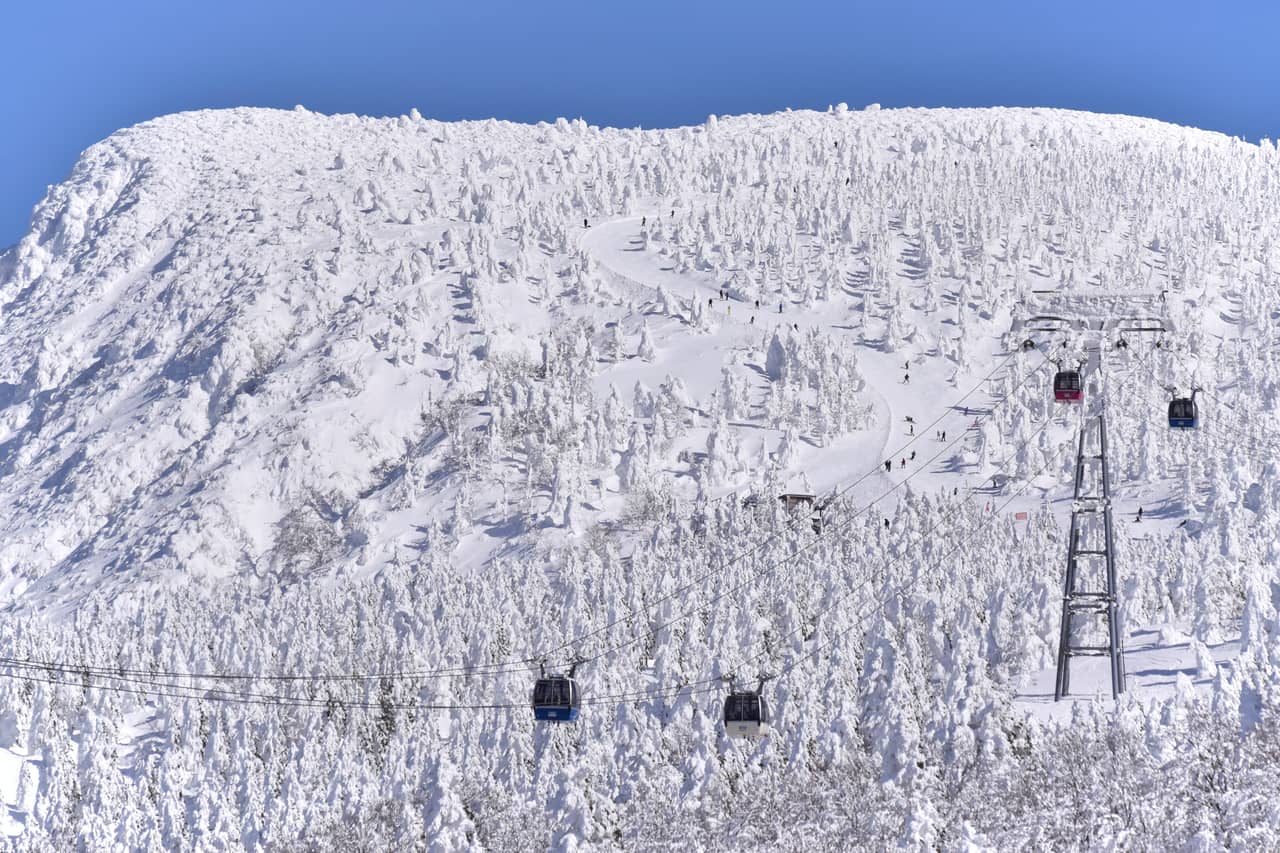
Yamadera (Risshaku-ji): 1,015 steps & Basho
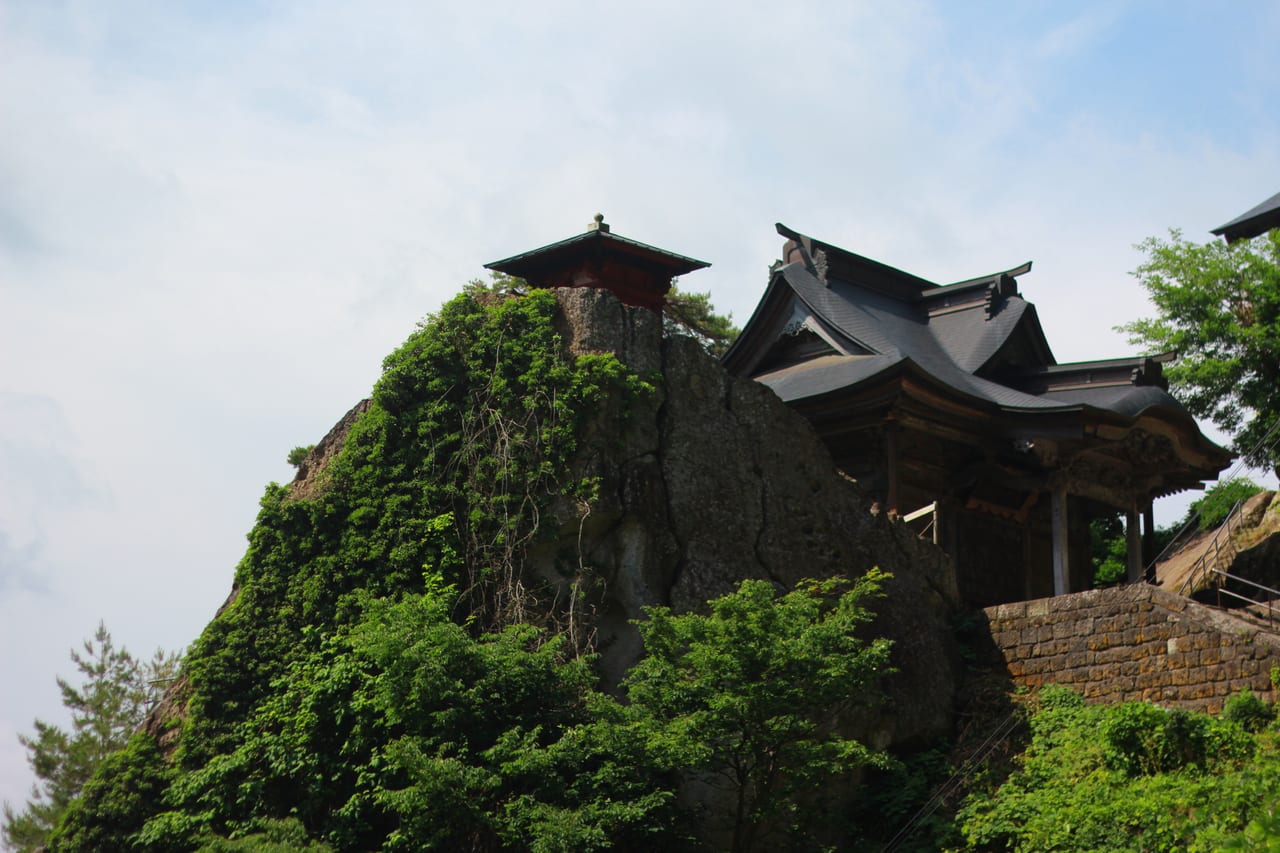
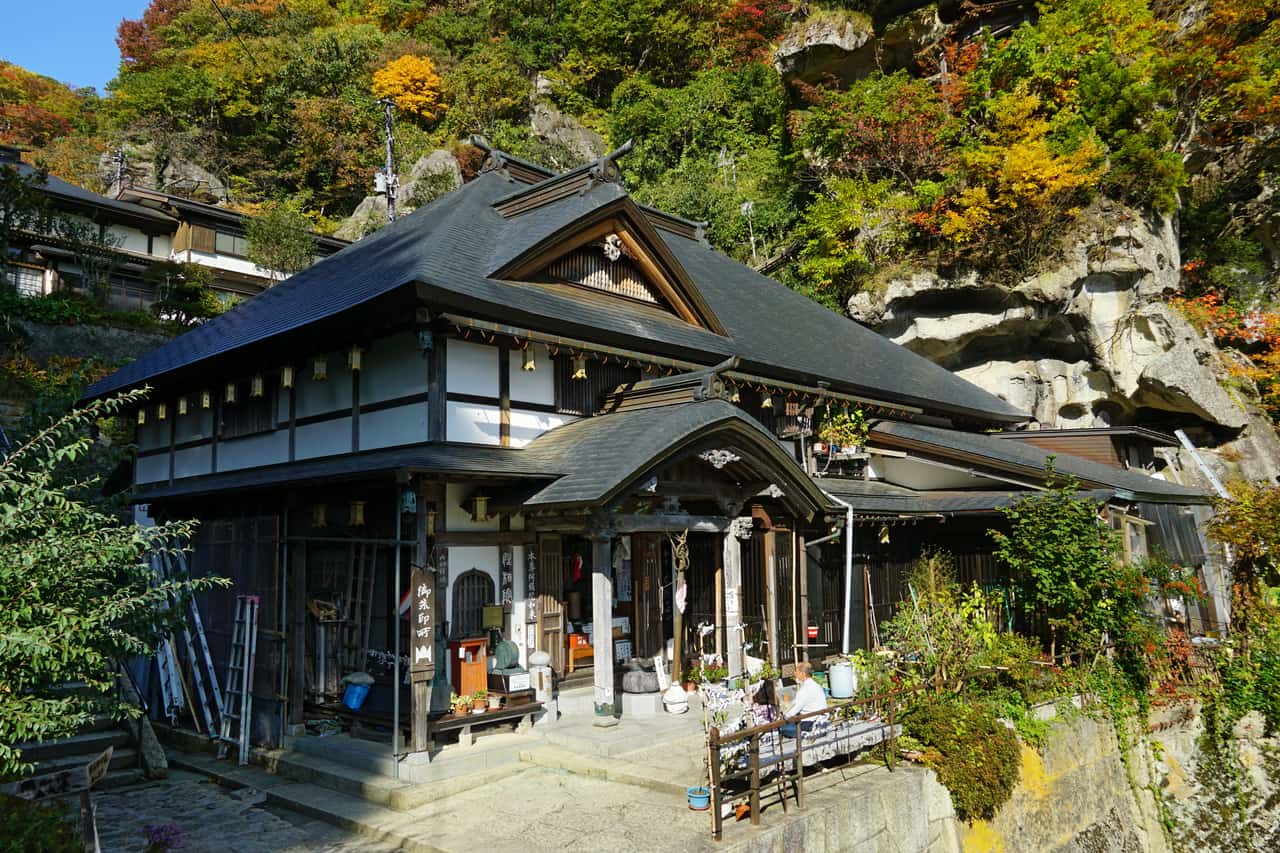
Whichever season you visit Yamagata, Yamadera (Risshaku-ji) belongs on the list — it's the most iconic sight in the prefecture and gloriously easy to reach. Its formal name is Hojusan Risshaku-ji, and it's built into a steep rock mountain: from the gate you climb about 1,015 stone steps, past halls like the Kaisando, Nokyodo, and Godaido scattered along the way, ending at the cliff-built Godaido viewing deck, which opens up the whole valley, village, and distant ranges — the Yamadera shot you've seen on Instagram.
The practicals: admission rose to ¥500 for adults and ¥200 for children from April 2026 (it was around ¥300 before — this is the latest 2026 figure). The 1,015 steps sound daunting, but with halls to pause at and a fairly friendly grade, most people climb up, look around, and descend in about 1.5–2 hours. Two seasonal warnings: summer means a lot of sweat and bugs, while winter ices the steps and they get genuinely slippery — wear grippy shoes, go slowly, and use the rails. Yamadera under snow is gorgeous but the most demanding on your footing.
What gives Yamadera its real depth is the Matsuo Basho connection. Basho visited on his Oku-no-Hosomichi journey and left the line repeated for centuries since — "Shizukasa ya / iwa ni shimiiru / semi no koe" ("Such stillness — the cries of the cicadas sink into the rocks") — and there's a poem monument and a "cicada mound" up the mountain. For anyone who loves classical Japanese literature, climbing the steps while imagining Basho's state of mind is the most layered part of the trip. From Yamagata Station it's just about 20 minutes on the JR Senzan Line to "Yamadera," with the approach right at the exit, and you can see it in half a day — perfect as the opener or closer for a Zao trip.
Transport & lodging (Shinkansen + bus)
For planning Zao, get the transport logic straight first. Getting in is the Yamagata Shinkansen: Tokyo → Yamagata on the "Tsubasa" in about 2 hours 45 minutes direct. From Yamagata Station the two main sights branch in different directions:
- For Yamadera: transfer at Yamagata Station to the JR Senzan Line, about 20 minutes to "Yamadera," where you step off right at the approach — the easiest leg, and a stop on the Sendai ↔ Yamagata line (same line toward Sendai).
- For Zao Onsen: take a bus about 40 minutes up from in front of Yamagata Station to the Zao Onsen bus terminal, then transfer to the Zao Ropeway for the snow monsters. Note this bus is not covered by the JR Pass and is paid separately.
Do you need a JR Pass? It depends on how far your wider Tohoku trip ranges. For a simple Tokyo–Yamagata round trip, point-to-point tickets usually win; if you chain Yamagata, Sendai, and points further north, run the break-even in our JR Pass guide to see if it pays. But remember the Yamagata-to-Zao-Onsen bus and the Zao Ropeway are both out of pocket — don't assume a pass covers them. The Tokyo end and in/out logistics are in our Tokyo 5-day itinerary.
Lodging is simple: for the snow monsters, stay in Zao Onsen (an evening strong-acid soak, a jump on the day-trippers for the morning ropeway, and the night illumination run); for Yamadera plus Okama or city food, stay in Yamagata city (convenient by the station, more choice, friendlier prices). For Zao Onsen rooms, check availability on Booking.com's Zao Onsen page or Rakuten Travel's Zao Onsen page; Rakuten often shows zero rooms for dates far ahead, which means its international site hasn't released that inventory yet, not that the town is full. Yamagata is heavy-snow Tohoku country, so winter lodging and transport are very weather-dependent — heavy snow can delay or suspend buses and the ropeway, so keep the itinerary flexible and don't cut your flights too fine. Pre-trip weather and packing (especially winter cold and ice) are in our Japan packing & weather guide — Zao in winter is genuinely cold, so snow boots, waterproof gloves, and heat packs are all non-negotiable.
Winter and summer itineraries
Because the snow monsters and Okama split by season, here are two different routes — pick by when you come:
- Winter (snow-monster trip, February is best): Day 1 — Shinkansen from Tokyo to Yamagata → Yamadera first (snowy steps, mind the ice) → evening bus up to Zao Onsen, check in, soak the strong-acid sulfur water. Day 2 — early Zao Ropeway up to Jizo Sancho for the monster fields (best light and fewest crowds in the morning) → rest midday in the onsen town → evening snow-monster illumination night run. Day 3 — back down to Yamagata, Shinkansen home or onward to Sendai.
- Summer–autumn (Okama trip, June–October): Day 1 — Shinkansen from Tokyo to Yamagata → Yamadera (green or autumn color) → stay in Yamagata city or Zao Onsen. Day 2 — drive or take a seasonal sightseeing bus along the Zao Echo Line and Highline to the Okama viewpoint (emerald lake against fresh green or red leaves; how to get up there and by when) → afternoon soak at Zao Onsen. Day 3 — head home or continue to Sendai.
If you're tight on time and can only spare one day, the most reliable combo is "half a day at Yamadera plus half a day soaking in Zao Onsen" — both work year-round and have the simplest transport, whereas the monsters and Okama both depend on weather and season and are risky to force into a single day. The most natural extension from Zao and Yamadera is Sendai (beef tongue, city food, Matsushima); see our Sendai travel guide to build a 3–5 day Tohoku loop.
FAQ
- Q1:When should I go to see the Zao snow monsters? Which month is best?
- Per traveler discussion and the Zao Ropeway operator, the best window for the juhyo (the "snow monsters") is late January through late February. The snow monsters form when conifers are coated over and over by wind-driven supercooled water droplets that freeze instantly and then build up layers of snow into huge, frozen, monstrous shapes. That needs sustained cold plus heavy accumulated snowfall — too early (December) and they are only half-formed; too late (March) and they start melting and slumping. For the most dramatic, fully grown monsters, February is the safest bet. One honest caveat: the snow monsters are entirely at the mercy of the weather. A blizzard suspends the ropeway and a mild winter stunts them — that has nothing to do with affiliate stock, you genuinely cannot see them, so always check the Zao Ropeway site for operating status and summit weather before you head up.
- Q2:How much is the Zao Ropeway to Jizo Sancho, and how does it work?
- The Zao Ropeway runs in two stages: the Sanroku Line (Zao Sanroku → Juhyo Kogen) and the Sancho Line (Juhyo Kogen → Jizo Sancho). To reach the snow-monster field and the ridge views you ride all the way up to Jizo Sancho station. Per the operator's 2025–2026 fares, the round trip from Zao Sanroku to Jizo Sancho (4 segments) is ¥4,400 for adults and ¥2,200 for children; the shorter Sanroku-Line round trip to the mid-station is ¥2,200 adult. The Sancho Line runs roughly 8:45–16:45 (subject to weather). In winter there is also a night-time snow-monster illumination run that lights the monsters up — more surreal than by day (the night-run dates are published each season, so check ahead). Note that a few weeks of spring maintenance close the line each year (for example, the Sancho Line was set to close for inspection in early-to-mid May 2026), so confirm on the official site.
- Q3:When can you actually see the Okama crater lake? Can you go in winter?
- It hinges entirely on whether the Zao Echo Line (Zao Eko Line) is open. This mountain road crossing the Zao range is fully closed in winter; per official notices, the 2025–2026 winter closure runs until the morning of April 24, 2026, after which it stays open until around early November before snow shuts it again. In other words, Okama is visible only roughly from late April to early November, and is completely off-limits in winter. Okama is Zao's crater lake, colored a saturated emerald/jade green by dissolved minerals, and it shifts shade with the light and weather — it is Zao's summer-and-autumn signature. So the timeline is blunt: the snow monsters (winter) and Okama (summer–autumn) are two separate seasonal trips — you cannot catch both in one visit, so decide which one you came for before you plan.
- Q4:What is special about Zao Onsen's water?
- Zao Onsen is a strong-acid sulfur spring with an extremely low pH (around 1.3–1.6), making it one of the most acidic hot springs in Japan: it has a distinct tingle, a milky greenish cloudiness, and a heavy sulfur smell. Locals call it a "beautifying" bath, and acidic springs are popularly believed to help skin and circulation (results vary a lot by individual — go gently if you have sensitive skin or any cuts). Zao Onsen has a long bathing history, and the town has three traditional communal bathhouses — Kami-yu, Shimo-yu, and Kawarayu — that are cheap and the best way to experience the raw sulfur water; most ryokan in town draw on the same strong-acid source. Afterward your skin feels dry-clean, and note that the acid will tarnish metal jewelry over time, so take rings off first. For more on Japanese onsen and how to choose, see our Ginzan Onsen day-trip vs. overnight guide.
- Q5:How long is the climb at Yamadera (Risshaku-ji), and what is admission?
- Yamadera's formal name is Hojusan Risshaku-ji, and the path from the gate to the upper halls (the Oku-no-in and Godaido) is about 1,015 stone steps. Per official info, admission rose to ¥500 for adults and ¥200 for children from April 2026 (it was around ¥300 before — this is the latest figure). The steps sound brutal, but with halls to pause at along the way and a manageable grade, most people climb up, look around, and come back down in about 1.5–2 hours. The payoff is the cliff-edge viewing deck at Godaido, which opens up the whole valley below — the classic Yamadera shot. It is also where the haiku poet Matsuo Basho composed his famous line "Shizukasa ya / iwa ni shimiiru / semi no koe" ("Such stillness — the cries of the cicadas sink into the rocks") on his Oku-no-Hosomichi journey. Wear good shoes, bring water, and take it slowly — and in winter the iced steps demand real care.
- Q6:How do I get to Zao and Yamadera from Tokyo? Do I need a JR Pass?
- Getting in is the Yamagata Shinkansen: Tokyo → Yamagata in about 2 hours 45 minutes direct on the "Tsubasa." From Yamagata Station the two main sights split off: for Yamadera, take the JR Senzan Line about 20 minutes to "Yamadera" station, where you step off right at the approach — easy; for Zao Onsen, take a bus about 40 minutes up from in front of Yamagata Station, then transfer to the Zao Ropeway for the snow monsters. Whether a JR Pass pays off depends on how far your wider Tohoku trip ranges — run the break-even in our JR Pass guide first — but note the Yamagata-to-Zao-Onsen bus is not covered by the JR Pass and is paid separately. Zao and Yamadera pair naturally with Sendai for a Tohoku run; see our Sendai travel guide.
Related reading:
Sendai Travel Guide 2027: Matsushima, Aoba Castle, Zuihoden & Gyutan
Tohoku's gateway and City of Trees — Matsushima of the Three Views, Date Masamune's Aoba Castle ruins and Zuihoden, Jozenji-dori, gyutan and zunda.
Ginzan Onsen Day Trip vs Overnight Stay 2026
By day it is crowded; the gaslight magic happens after sunset — day trip or overnight, and is the extra night worth it?
JR Pass 2026: Is It Still Worth It?
Four real routes calculated, six alternatives that may beat the Pass.