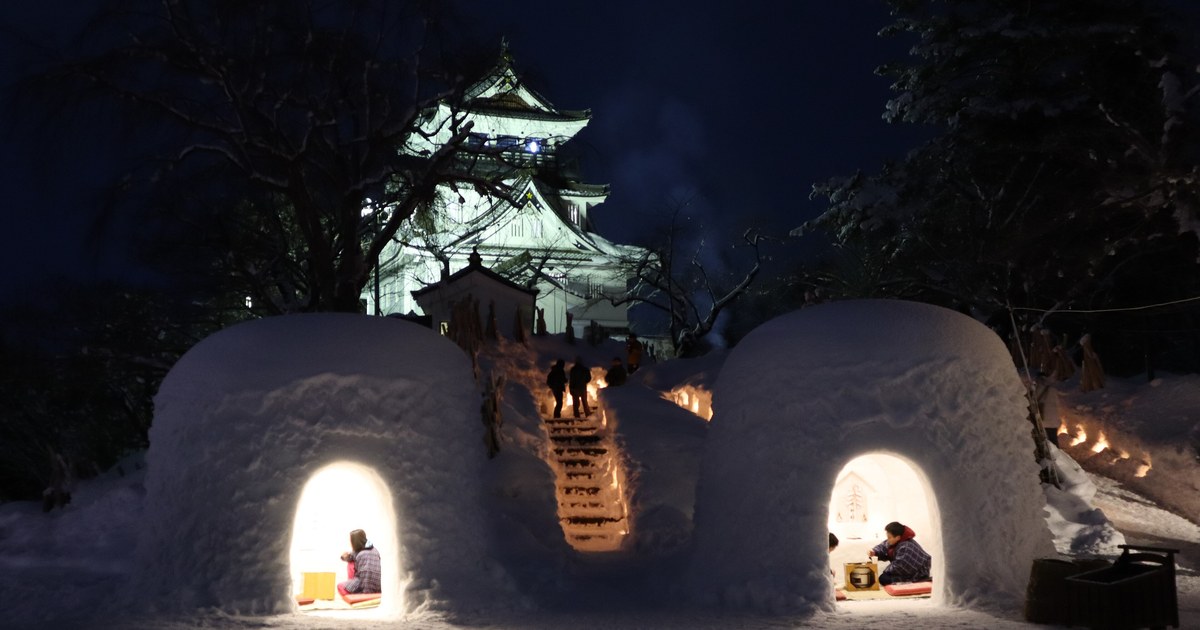
The Yokote Kamakura Festival runs on Friday 12 and Saturday 13 February 2027 — not the 15th and 16th you will find on almost every page about it. This is not a minor schedule tweak. Yokote City and the local tourist association describe it in writing as a change made "on a trial basis for four years, through February 2029", which removes a date that had been fixed since 1952. And here is the part almost nobody outside Japan has written about: the Bonten festival did not move with it, because, in the organisers' own words, "as this is a Shinto rite, it will continue to be held on fixed dates as before." The single day when both halves overlapped — 16 February, Bonten in the morning, snow huts that night — has quietly disappeared, leaving a two-day gap in between. Yokote has gone from a town where you could see two festivals in one trip to a town where you have to choose one. Everything below is checked against the official pages as of October 2026, including a clear line around what the organisers have not published yet.
- 2027 is 12-13 February (Fri/Sat) and 2028 is 11-12 February — both already published. Any page saying "2027 dates pending" is out of date
- It is a four-year trial, not a permanent change — official wording is "through February 2029". The real rule is "the Friday and Saturday before Bonten"; "second Friday and Saturday" is only a shorthand that happens to match until 2029
- Bonten did not move: still fixed on 16-17 February, and it is a morning event (09:30-12:00) while kamakura is an evening one (18:00-21:00), with two blank days between them
- "Unchanged for centuries" is false: the custom is roughly 450 years old, but the 15 February date only dates from 1952 and the combined "Snow Festival" brand from 1954 — this is the second move, not the first
- 2027 venues, shuttles and parking have not been announced. Every operational detail here describes the 2026 edition and must be re-checked before you travel
Table of Contents (click to expand)
- The 2027 dates are already settled
- A four-year trial — and a rule the two official pages describe differently
- Bonten did not move: Yokote is now an either/or
- "Unchanged for centuries" is wrong — this is the second move
- Did it work? The attendance figures, with three caveats
- Three hours only: what the evening actually involves
- Getting there: Sendai's two identical routes, and the WARP trap
- February is Yokote's deepest-snow month
- Missed it? The snow hut that never melts
- Why "kamakura" sounds like Kamakura
- Is Yokote worth the detour? My call
- FAQ
The 2027 dates are already settled
Start with the part that stale guides get wrong. Yokote City's official page states that the festival "changed from 2026 (Reiwa 8) to the second Friday and Saturday of February," then lists the years explicitly: "2027 (Reiwa 9) will be held on 12 February (Friday) and 13 February (Saturday)" and "2028 (Reiwa 10): 11 February (Friday), 12 February (Saturday)." The rule itself was published back in July 2025. So any article still telling you the 2027 dates are pending an announcement has simply not been revisited — including, until this update, our own 5-7 day winter route through Tohoku.
That single sentence from the city, though, is a simplification of the actual rule — and the simplification is about to matter.
A four-year trial — and a rule the two official pages describe differently
The Yokote City Tourist Association publishes the full version: the festival changes "from the traditional fixed dates of 15 and 16 February to the Friday and Saturday immediately before the Bonten festival (through 2029, the second Friday and Saturday), on a trial basis." Two things are buried in that sentence that the city's page leaves out.
First, the trial has an expiry date. A separate city notice — now taken down, and quoted here from a web archive capture — reads "we are changing this on a trial basis for four years, through February 2029," and the association's own English text says the change is being made "on a trial basis until 2029." So describing this as "the festival has been permanently moved to the second weekend of February" is wrong, and that framing is everywhere, including in earlier versions of our own coverage. What happens after February 2029 has not been decided in public.
Second, "second Friday and Saturday" is not the rule. The rule is "the Friday and Saturday immediately before Bonten," and the association flags the equivalence itself with that parenthetical: through 2029. That parenthesis looks redundant until you push the calendar forward:
| Year | 16 Feb falls on | "Friday before Bonten" | "2nd Friday of February" | Same? |
|---|---|---|---|---|
| 2026 | Monday | 13 Feb | 13 Feb | Yes (held 13-14 Feb) |
| 2027 | Tuesday | 12 Feb | 12 Feb | Yes (officially announced) |
| 2028 | Wednesday | 11 Feb | 11 Feb | Yes (officially announced) |
| 2029 | Friday | 9 Feb | 9 Feb | Yes (final trial year, not announced) |
| 2030 | Saturday | 15 Feb | 8 Feb | No — a full week apart |
2030 is the first year the two formulations diverge, and the trial happens to end in February 2029 — which explains the parenthetical rather neatly. But the boundary has to be drawn honestly: the 2029 and 2030 rows above are our own arithmetic from the published rule, and no dates beyond 2028 have been announced by anyone. The organisers have never explained where that parenthesis came from. Treat it as a reading, not a booking basis.
One more thing worth filing away: the two official sources describe the rule differently — the city says "second Friday and Saturday," the association says "the Friday and Saturday before Bonten." They agree for these four years, so nothing breaks yet. If the trial is extended without the wording being reconciled, 2030 becomes a genuine problem. When you check dates, treat the association's version as the rule and the city's as shorthand.
And the obvious question — why change at all? None of the three official documents gives a reason. All they say is that the Snow Festival Committee deliberated and adopted this policy. The "weekend attendance" explanation you will read everywhere, including in AI-generated search summaries, is a reasonable guess, but it is a guess, and this guide will not launder it into an official statement.
Bonten did not move: Yokote is now an either/or
This is the part that matters most for planning, and it is almost entirely absent from English-language coverage.
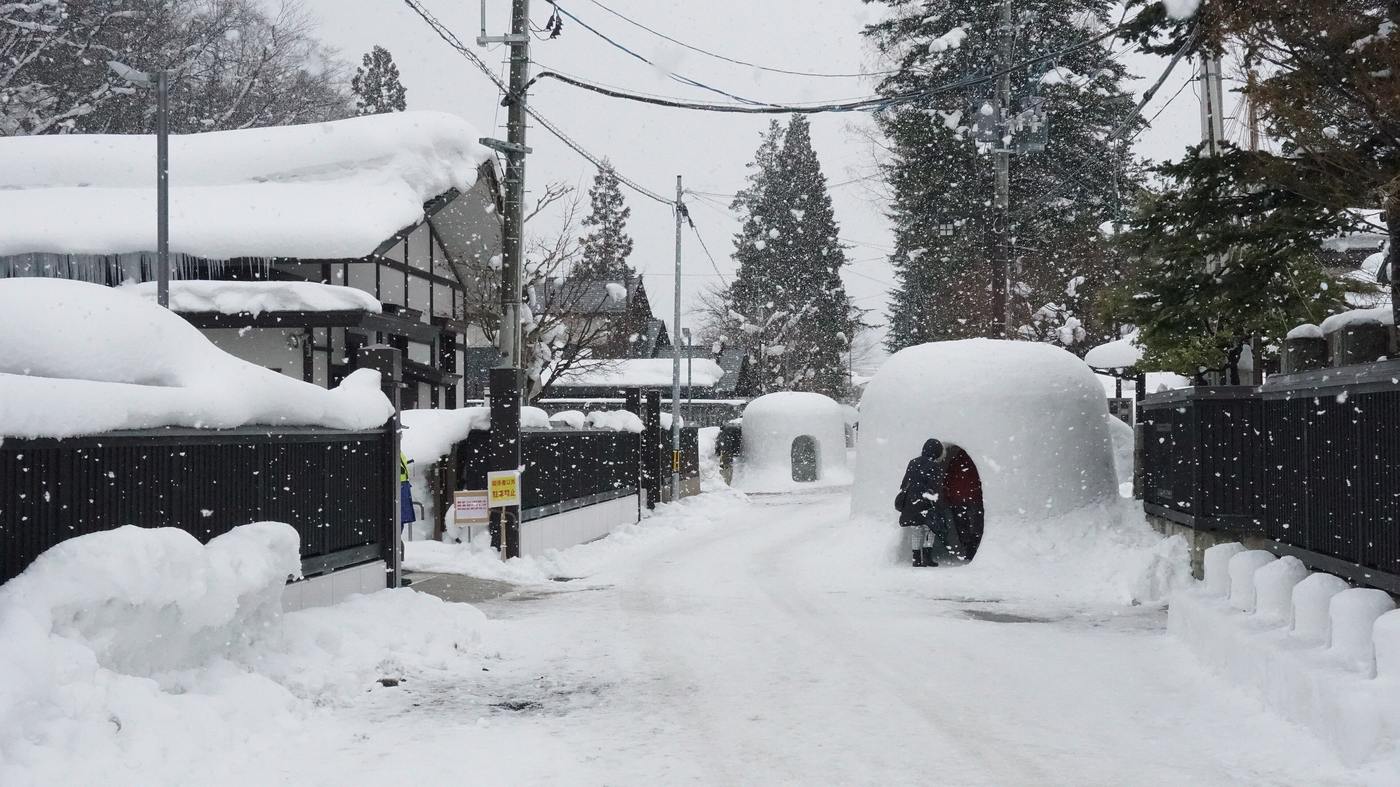
Since 1954, "the Yokote Snow Festival" has never been a single event. It is two things bolted together: kamakura (the snow huts) and Bonten (towering ritual poles offered to a shrine). Under the old schedule, kamakura ran on the 15th and 16th and Bonten on the 16th and 17th — meaning 16 February belonged to both. You could watch the Bonten contest outside city hall in the morning and crawl into a snow hut for sweet sake that night. Yokote City's own Chinese-language page describes exactly this structure: the festival "is held on the 15th, 16th and 17th of February each year, with the 15th and 16th for the snow hut festival and the 16th and 17th for the Bonten festival."
Then only one half moved. The association's notice reads: "Bonten: 16 February (Mon) and 17 February (Tue) (no change to the dates). As this is a Shinto rite, it will continue to be held on fixed dates as before." Here is what 2027 looks like as a result:
| Event | 2027 date | Time | Where |
|---|---|---|---|
| Kamakura (snow huts) | Fri 12 & Sat 13 Feb | 18:00-21:00 (evening only) | City hall front, Yokote Park, Futaba-cho, former Katano Residence and across town |
| Yuki no Geijutsu (snow sculptures) | Moves with kamakura (13-14 Feb in 2026) | 18:00-21:00 in the 2026 edition | Komyoji Park and other sites |
| — | Sun 14 & Mon 15 Feb | Two blank days — nothing scheduled | |
| Bonten contest | Tue 16 Feb | Around 09:30-12:00 (morning) | In front of Yokote City Hall |
| Asahiokayama Shrine offering | Wed 17 Feb | Morning (planned) | Asahiokayama Shrine, a procession of about 4 km from city hall |
Translated into travel planning: seeing both in 2027 means six nights in Yokote, 12 to 17 February, with two of those days containing no festival at all. Yokote is a modest inland city; committing six days of a Japan trip to it is not a realistic proposition for most visitors. So it is a choice — and it is a choice that did not exist before 2026, which is why no older guide warns you about it.
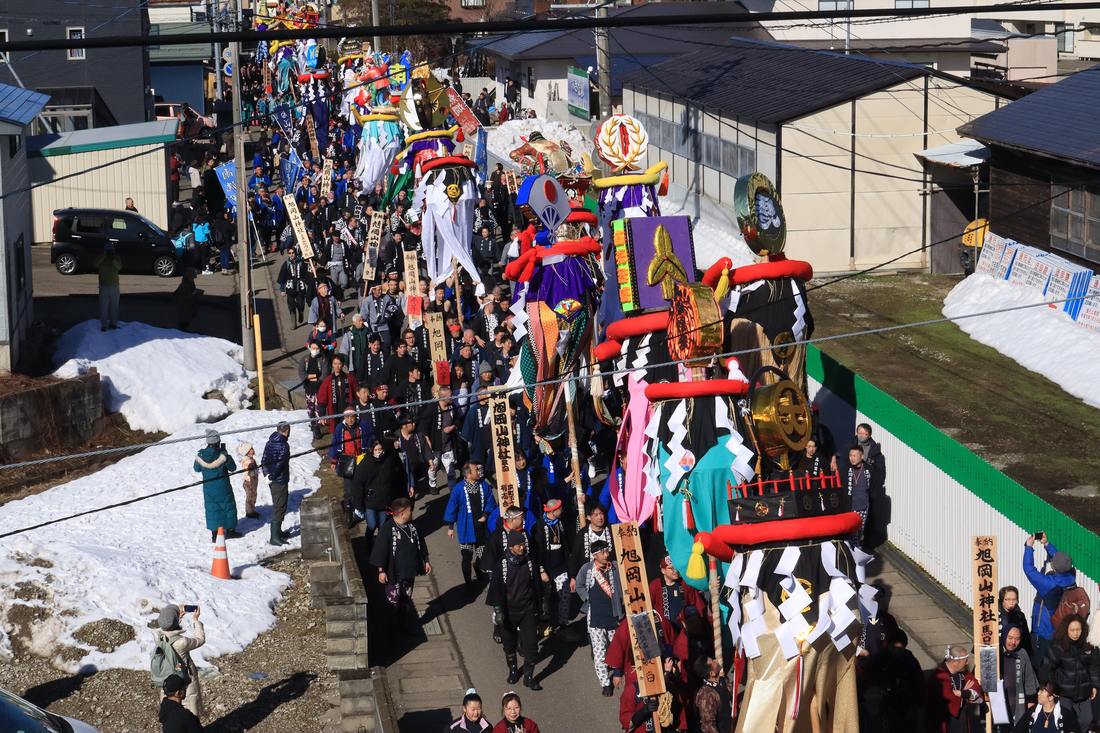
Which one should you pick? For a first visit, take the kamakura. Not because it is objectively better, but because it has no substitute anywhere else — an entire town lighting hundreds of snow domes on the same evening, with children inside inviting strangers in for sweet sake, is a specific thing that exists in one place. Bonten is a different animal entirely, and the organisers define the contrast better than any guide could: young men in matching happi coats blowing conch shells and chanting "joyasa, joyasa" make it "a festival of movement, in contrast to the stillness of the kamakura." Yokote City's Chinese-language page is startlingly frank about how physical it gets: as the procession passes through the shrine gate, those arriving later are blocked by those already there, and the shoving is such that "most of the 30-kilogram bonten have been smashed to pieces before reaching the finish."
On specifications, the two official sources disagree again: the association describes a pole "about 4.3 m long" topped with a cylindrical bamboo basket roughly 90 cm across, "comfortably over 5 m" overall and "more than 30 kg," while the city page says a 4 m pole. Around 40 large bonten are displayed in front of city hall on contest day, and since 1980 local elementary school children have offered their own "ko-waka bonten" alongside. There is a local saying that captures the event's place in the calendar better than any statistic: "when Bonten ends, spring arrives."
"Unchanged for centuries" is wrong — this is the second move
Nearly every write-up of this change reaches for the same line: a festival whose dates had not moved in centuries. That is false, and it is a shame, because the truth is more interesting.
What the city actually publishes is that the kamakura custom "is said to have around 450 years of history" — that part holds. But where does 15 February come from? The city's folk-events page says it directly: "from Showa 27, the kamakura festival date became 15 February in the new calendar." Showa 27 is 1952. The Bonten page fills in the rest: Bonten "was once offered on the 17th day of the first lunar month, but from Showa 27 it was changed, along with kamakura, to 17 February in the new calendar, and from Showa 29 the two became a tourist event as the Snow Festival."
So the real timeline runs like this. In 1952, both halves were moved off the lunar calendar and onto the Gregorian one — a date change in its own right. In 1954, they were merged into the "Snow Festival" brand, which is also what the city's Chinese-language page says ("the Yokote Snow Festival began in 1954"). Which gives:
- The kamakura custom itself: roughly 450 years
- The fixed 15 February date: only since 1952 — 74 years
- The combined "Yokote Snow Festival": only since 1954 — 72 years
In other words, 2026 was not the first time this festival changed its dates. It was the second. The first move took it off the lunar calendar to fit modern life; the second took it off a fixed date to fit modern life again. That framing is both more accurate and far less hand-wringing than "tradition broken," and it is what the documents actually support.
One inconsistency to flag: the city page says the 15 February date began in Showa 27 (1952), while the tourist association's history page says Showa 29 (1954). This guide follows the city page plus the official Chinese-language page, since those two are self-consistent — 1952 for the calendar switch, 1954 for the Snow Festival branding. If you see 1954 given as the start of the fixed date elsewhere, it is sourced from the association, not a typo.
Did it work? The attendance figures, with three caveats
A trial invites a verdict, and Akita Prefecture's tourism statistics provide a checkable set of numbers under the heading "visitor numbers by festival and event":
| Year | Actual dates and days | Schedule | Kamakura visitors |
|---|---|---|---|
| 2023 | 15 Feb (Wed) - 16 Feb (Thu) | Old | 150,000 |
| 2024 | 15 Feb (Thu) - 16 Feb (Fri) | Old | 173,000 |
| 2025 | 15 Feb (Sat) - 16 Feb (Sun) | Old, a full weekend | 240,000 |
| 2026 | 13 Feb (Fri) - 14 Feb (Sat) | First trial year | 173,000 (preliminary) |
It is easy to find people setting 240,000 against 173,000, calling it a 27.9% collapse and declaring the weekend experiment a failure. That reading does not survive contact with the underlying data, and three caveats are all load-bearing:
- 2025 is the best hand the old schedule could draw. That year, 15 and 16 February happened to be a Saturday and a Sunday. Using it as the pre-change baseline systematically exaggerates the decline.
- The like-for-like comparison is 2024 against 2026 — a Thursday-Friday under the old rule against a Friday-Saturday under the new one. Both come in at 173,000, identical. The trial's first year swapped weekdays for a weekend and the number did not move. That is a more honest finding than the 27.9% headline, and a more interesting one.
- The 2026 figure is preliminary. Akita Prefecture has revised multiple past years after publication, and neither 2025 nor 2026 has a final annual report yet. An official verdict on the trial simply does not exist right now.
City-level data points the same way: Yokote recorded 310,638 visitors in February 2026 against 363,987 in February 2025, down 14.7% — but that comparison inherits the same weekend distortion. Two further warnings. The 2018-2020 figures (350,000, 500,000 and 260,000) sit in a completely different magnitude from everything since 2023, so there is a methodology break in between and the two eras should not be plotted as one line. And Bonten shows 3,000 in the 2026 preliminary figures, against 43,000 in 2019 and 2,000 in 2023, with no row at all for 2024 and 2025 — a series that broken is almost certainly a counting-method change rather than an audience collapse, so nothing is inferred from it here.
For scale, it helps to place Yokote on the spectrum of Japanese winter festivals. The Sapporo Snow Festival counts its attendance in millions; Yokote counts in the low hundreds of thousands. That is not a weakness — Yokote's appeal is precisely the inverse: no giant sculptures, no international crush, just an entire small city lighting itself up for one evening.
Three hours only: what the evening actually involves
Here is the fact that should shape how you book your trains: the snow-hut festival runs for three hours, 18:00 to 21:00, and that is all. The association's standing information panel and its information page for the 2026 edition give the same window, with the city noting that "the programme may change depending on snow conditions." Which means daytime Yokote has essentially no festival in it. Planning to arrive at noon, take a look and leave before dark gets the order exactly backwards.
Before the detail, a boundary has to be drawn clearly: the 2027 venues, hours, shuttles, parking and the number of mini kamakura have not been published at all. So everything that follows describes the 2026 edition, the first under the new dates, and it is here to tell you what shape the evening takes and how much time to budget, not to promise what 2027 will look like. Going by past timing, the official 2027 details should appear around mid-January 2027.
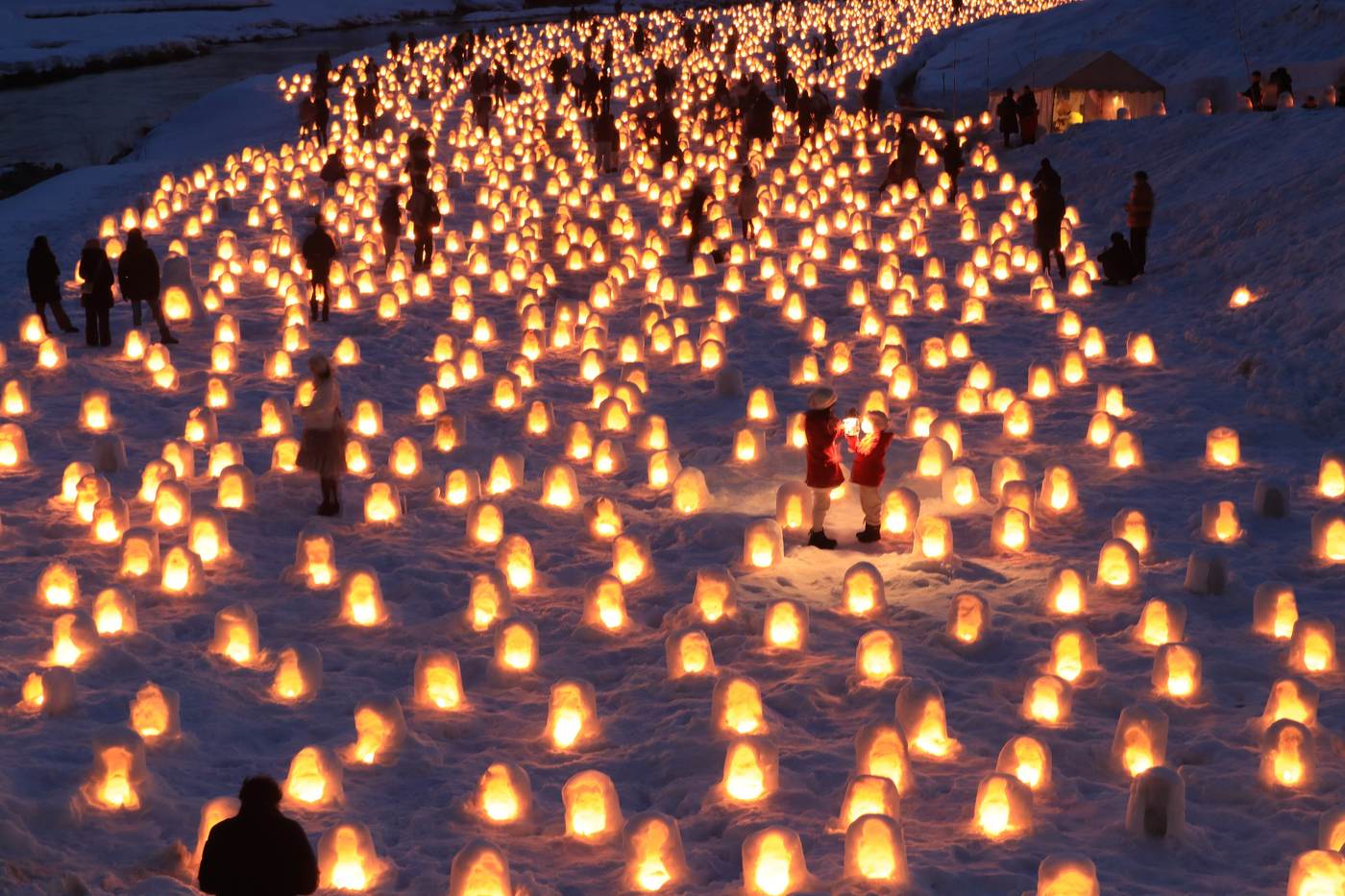
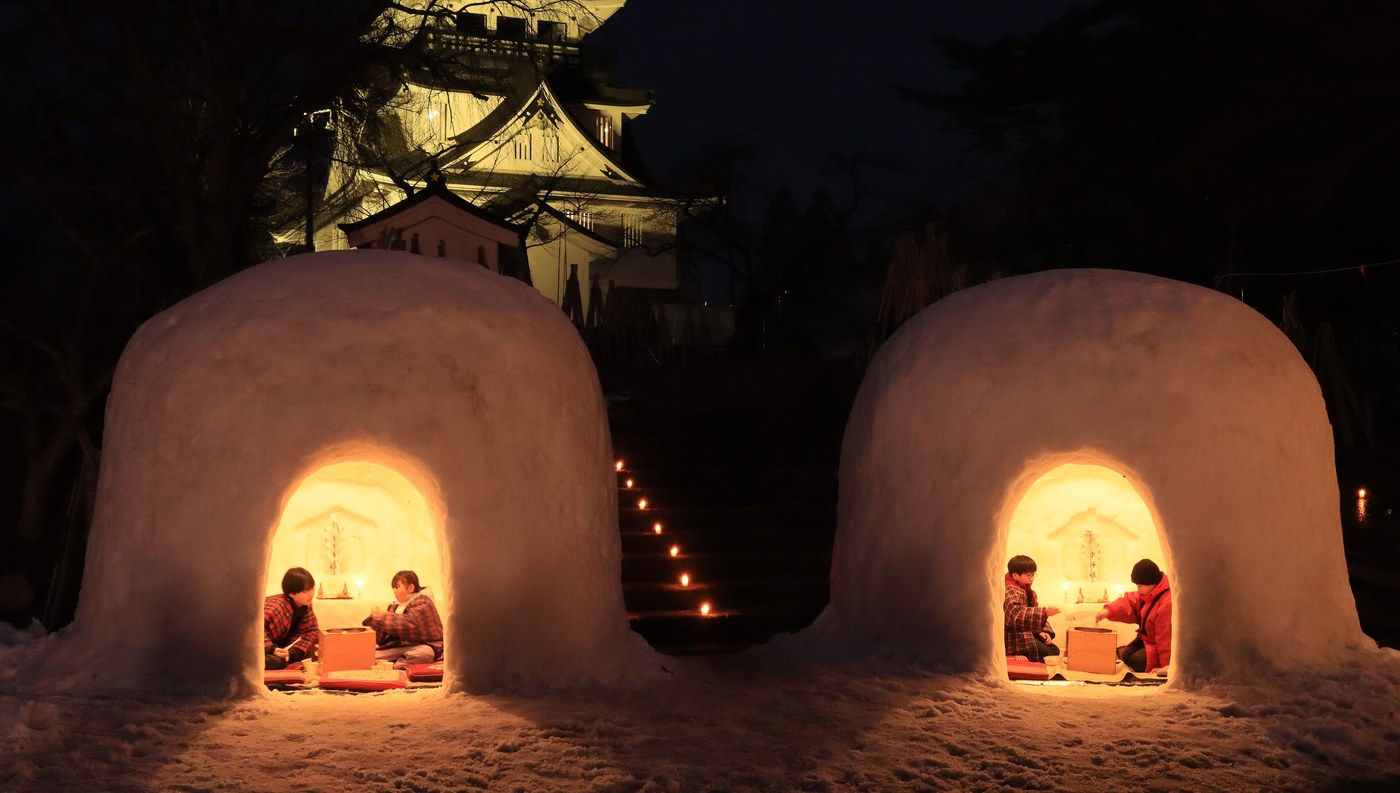
The 2026 edition had two kinds of venue. Four full-size kamakura sites: the front of city hall (which the city calls the hub — "head here first"), the former Katano Residence (a Meiji-to-Taisho merchant house whose garden setting is the most atmospheric of the four), Yokote Park (where the city itself recommends the shot: "kamakura set against the Yokote Castle keep make this a recommended photo spot"), and Futaba-cho, whose huts line an old back lane. Two mini kamakura sites: Janosaki Kawara, where the official description is that "3,500 mini kamakura flickering is truly a Milky Way on earth," best seen in one sweep from the nearby Janosaki Bridge, and Yokote Minami Elementary School.
Worth correcting a common assumption: the mini kamakura do not have their own lighting time. No official source gives them a separate window — they sit inside the same 18:00-21:00 frame as the full-size huts, and the circulating bus only starts about 20 minutes before that, at around 17:40. Claims that the small ones light earlier or later have no official basis.
The real timing split is somewhere else entirely — the daytime venue. The 2026 edition ran "Kamakura at Kido Gorobee Village" out in the Omonogawa district from 09:30 to 16:30, with the huts lit until 18:30 and an official viewing shuttle from the city hall plaza: about 40 minutes and 1,000 yen each way, leaving at 09:30, 12:40 and 14:20 and returning at 10:45, 13:25 and 17:00. Buy the ticket beforehand, at Kamakura-kan (first floor) or at the village. Spending the afternoon out there and taking the 17:00 bus back for the evening is a routing the organisers built themselves. Yokote City's published taxi fare guide puts the same trip at roughly 5,230 yen, so whether the bus runs in 2027 decides whether the daytime venue is worth it. The 2026 edition also ran a photography session at the same site on 12 February, the day before the festival, from 17:00 to 18:30, with one shuttle out at 15:30 and back at 19:00 at the same 1,000 yen each way.
The rest of the 2026 fringe programme, for a sense of scale: snow sculptures at Komyoji Park and other sites, 18:00-21:00, matching the huts; the "Hokkori Yokocho" produce and food market on the road park in front of Komyoji Park, 11:00-21:00 on both days; the former Katano Residence open 10:00-21:00; and Kamakura-kan staying open until 21:00 on both festival days.
Parking and shuttles: the city tells you not to drive to the venues
The 2026 information page is unusually direct: "There are no car parks around the kamakura venues, so please use the venue circulating bus or the car park bus." The two official answers were:
- The free overflow car park at the Yokote Budokan, with a free shuttle running from about 09:00 to about 21:00 — note that it starts nine hours before the festival does. The alternative is the underpass below Fujimi Ohashi bridge, about 20 minutes on foot to the city hall venue.
- The paid municipal car park at Yokote Station's east exit, the multi-storey next to Yokote East, described as "about a 10-minute walk to the kamakura venue at city hall." The price is not published, and neither is capacity or how early it fills, so this guide does not invent either.
Between venues, a free circulating bus ran only from about 17:40 to about 21:00, looping four stops in fixed order: city hall corner, Minami Elementary, Yokote Park, Honcho. It does not exist in the daytime. The venue map gives the walks as 5 minutes from city hall to Minami Elementary, 8 to Janosaki Kawara, 15 from Janosaki Kawara to Yokote Park and 20 from Yokote Park to Minami Elementary — so the bus is a convenience, not a necessity. Three streets were also closed to cars in 2026: Yokkamachi-dori 12:00-23:00, the roads around Yokote Park 10:00-22:00 and Futaba-cho-dori 17:00-22:00.
And to answer the question everyone asks: how far is the main venue from Yokote Station? No official page states a station-to-venue walking time, but the same page places the station's east-exit car park about 10 minutes from city hall — so roughly 10 minutes is a defensible indirect estimate and this guide will not sharpen it beyond that.
Tickets: no price is published, but "free" is never stated either
The wording here has to be exact, because the official wording is exact. No Yokote City or association page lists an admission fee for the snow huts, the mini kamakura or Bonten, and the 2026 venue map explicitly marks the overflow car park, the shuttle and the circulating bus as free. But no official source has ever written "admission is free." So the accurate framing is: no published venue lists a price, the main shuttle and car park are officially free, and there has never been a formal free-admission declaration — but there has also never been a price. Do not read the absence as "buy on the door."
Two pieces of supposed etiquette deserve correcting while we are here. First, "call out before entering a snow hut" has no official basis at all — the official description runs the other way round: the children inside call out to you, "haitte tanse" (please come into the kamakura) and "ogande tanse" (please pray to the water deity). Second, "remember to make an offering" is not an official instruction either. The city describes offerings as what the ritual was "originally" for, and adds that "with the changes of the times, tourism developed and it took its present form." Offerings belong in the historical section of an article, not in the instructions.
What is genuinely on offer inside, though, is officially documented, so you can expect it: the children serve amazake (sweet rice drink) and grilled mochi. The official Chinese-language description is that "inside the snow hut there is a small altar to the water deity, along with straw mats, cushions and a brazier. The children grill rice cakes and warm sweet sake over the brazier."
Getting there: Sendai's two identical routes, and the WARP trap
Yokote City's official access page gives these durations, noting they are shortest times including transfers:
| From | Route | Official duration |
|---|---|---|
| Akita | JR Ou Main Line | About 1 hr 20 min |
| Morioka | Akita Shinkansen via Omagari, then JR Ou Main Line | About 1 hr 30 min |
| Sendai | Akita Shinkansen via Omagari, then JR Ou Main Line | About 2 hr 10 min |
| Sendai | Tohoku Shinkansen via Kitakami, then JR Kitakami Line | About 2 hr 10 min |
| Tokyo | Akita Shinkansen via Omagari, then JR Ou Main Line | About 3 hr 40 min |
| Tokyo | Tohoku Shinkansen via Kitakami, then JR Kitakami Line | About 4 hr |
| Yamagata | Yamagata Shinkansen via Shinjo, then JR Ou Main Line | About 3 hr |
One row is quietly interesting: from Sendai, going via Omagari on the Akita Shinkansen and going via Kitakami on a conventional line take exactly the same time — about 2 hours 10 minutes. One is almost all shinkansen, the other includes a local leg with much thinner service. Unfortunately the official page lists durations only and no fares, so this comparison can be made on time but not on cost. From Tokyo the conclusion is simpler: Omagari beats Kitakami by about 20 minutes.
Flying in, the city puts Akita Airport at "about 1 hour by road" from Yokote; by public transport it is a limousine bus to Akita Station (about 40 minutes) plus roughly 1 hour 20 minutes by train. For Iwate Hanamaki Airport, the city lists rental car as the only connection.
There is also an option the city runs itself that English-language guides almost never mention: Yokote WARP, a reservation-only shared shuttle between Akita Airport and Yokote, operating "every day, including Saturdays, Sundays and public holidays," at ¥500 per person, payable by card, e-money, PayPay, Rakuten Pay or cash. There are four fixed runs: Yokote Station west exit 07:30 to Akita Airport 08:40; Akita Airport 10:05 to Yokote west exit 11:15; Yokote west exit 16:00 to Akita Airport 17:10; and Akita Airport 18:10 to Yokote west exit 19:20.
Convenient in principle — but for a festival running 18:00 to 21:00 it has three traps, each capable of wrecking a plan:
- The last outbound run leaves Yokote at 16:00. The festival starts at 18:00, so you cannot use WARP to reach the airport on festival night. You are staying in or near Yokote that night, full stop.
- The last inbound run reaches Yokote at 19:20. That still leaves an hour and a half of festival, but any flight delay or slow baggage collapses the whole plan.
- You must be an air passenger — the city states the service is "for those travelling by air" and you need to show a ticket or e-ticket — and bookings run from 60 days to 4 days before travel (since 1 July 2026 through the city's public facility reservation system, which requires user registration first). Turning up on the day does not work.
The city adds its own winter warning: "during winter, arrival times may be delayed by snow and ice." Build slack into any onward flight.
On lodging, one myth needs killing first: Yokote has never issued any official statement about accommodation being impossible to find during the festival. That phrasing belongs to a different Akita festival (Nishimonai Bon Odori) and should not be transplanted here. The tourist association's accommodation page lists 15 properties, several of them right by the station — Yokote Plaza Hotel at "1 minute on foot from Yokote Station," Hotel Nostal Yokote at 2 minutes, Hotel Plaza Geihin and Plaza Annex at 3 minutes, Kamadaya at 5, and Hotel Quad Inn Yokote 5 minutes from the west exit. Since the main venue and the first stop of the circulating bus are both at city hall, staying by the station keeps your movement cost inside those three hours to a minimum — which is the first thing to lock in, especially since 13 February 2027 is a Saturday.
February is Yokote's deepest-snow month
The reason this festival is physically possible is written into the Japan Meteorological Agency's climate normals. For the Yokote AMeDAS station, 1991-2020:
| Measure | February normal | (For reference) January |
|---|---|---|
| Mean temperature | −0.8°C | −1.3°C |
| Mean daily high | 2.6°C | 1.4°C |
| Mean daily low | −4.1°C | −4.3°C |
| Total snowfall depth | 202 cm | 276 cm |
| Maximum snow depth | 117 cm | 100 cm |
| Sunshine hours | 52.6 hrs | 32.0 hrs |
The line that matters is the maximum snow depth: February's 117 cm normal is the highest of any month — the annual figure of 119 cm is essentially February's contribution. The festival sits exactly in the deepest-snow window of Yokote's year, which is more convincing than any amount of atmospheric description, and explains how the town can build huts 3.5 m across and 3 m high from roughly 20 tonnes of snow apiece. Look at the sunshine figure too: 52.6 hours across the entire month, under two hours a day on average. Overcast and snowing is the Yokote default in February; a clear sky is luck.
One official discrepancy to flag: the tourist association's page for first-time visitors to snow country says "the average minimum temperature in Yokote in February is minus 3 degrees," against the meteorological agency's 1991-2020 normal of −4.1°C. This guide follows the meteorological agency for temperatures and treats the association's page as a clothing reference.
That clothing advice is worth quoting, because it comes from people who live there. Yokote, the association writes, is one of Akita Prefecture's heaviest snowfall areas; roads are in a compacted-snow state and extremely slippery, so drivers must fit studless tyres. Footpaths are packed down but still slick, and bitterly cold after dark, so footwear should be snow trekking shoes or rubber boots — something with grooved soles that covers the ankle. A water-repellent jacket with a hood handles sudden snowfall, and for small children the association simply recommends a ski suit, since they will end up playing in the snow anyway. Put that together with the numbers above and the picture is unambiguous: you will be standing and walking on snow, outdoors, after dark, at around minus four. A city puffer jacket and sneakers will not carry you through three hours of that. For the wider logic of dressing for Japan by region and season, see our Japan climate and clothing guide; for how to read first-snow and snow-depth normals across the country, see our guide to when it snows in Japan.
Missed it? The snow hut that never melts
If mid-February will not fit your trip, there is a permanent fallback. The Kamakura-kan "Fantastic Gallery" in central Yokote maintains a room at around minus 10 degrees Celsius, and the official description is that it holds "a real kamakura built from Yokote snow, which you can experience throughout the year." Walking into it in August is one of the more surreal things available in Tohoku.
Entry is cheap: ¥100 for high-school age and up, free for junior-high and younger, and it is a four-venue combined ticket covering the Gosannen Kassen Kanezawa Museum, Kamakura-kan, the Ishizaka Yojiro Literary Museum and the Yokote Park Observatory. The city notes it is valid only on the day of issue. Opening hours are 09:00-17:00, closed only 29 December to 3 January.
There is an official trap here that can collide with the festival itself: "due to kamakura maintenance and rebuilding work, the snow-hut exhibition room is closed for about a week between mid-August and mid-September, and for about a week between mid and late February." In 2026 that February closure ran 20-27 February, safely clear of the 13-14 February festival. But the 2027 window has not been announced, and "mid to late February" could in principle overlap 12-13 February. Check the official site before making it part of a festival day.
That combined ticket also includes a venue with a peculiar relationship to the festival: the Yokote Park Observatory, locally known as Yokote Castle. Its closure rule reads "1 December to 31 March (with occasional temporary opening during the kamakura period)" — shut all winter, except possibly during the festival. And Yokote Park is itself one of the snow-hut venues, where the city's own copy recommends the shot of "kamakura set against the Yokote Castle keep." Put those together: the only window in the year when you might photograph snow huts with the keep behind them and actually get up the keep is those two festival evenings. In the 2026 edition it opened 10:00-21:00 on both festival days; the 2027 hours have not been announced.
A little background, since the keep is not original: Yokote Castle was formerly called Asakura Castle, said to have been built around 1550 by the Onodera clan, and nicknamed Nira-jo ("leek castle") because chives were planted to hold its earthworks together. It fell in the Boshin War of 1868, and the three-storey keep-style observatory standing on the second bailey today was built in 1965.
Why "kamakura" sounds like Kamakura
The obvious question for anyone who knows the temple town near Tokyo: is Akita's snow hut named after Kamakura? The official answer is that there are five theories and none can be confirmed. Yokote City writes that "there are various theories, but it is difficult to declare any one of them correct," and lists: a resemblance to a kamado (traditional cooking stove); the worship of Kamakura Daimyojin; a derivation from kamikura (a seat of the gods); a link to the warrior Kamakura Gongoro Kagemasa; and the "Kamakura-dono" of a bird-chasing song.
More useful than the etymology is the custom's double origin, which the city sets out clearly: in Yokote's inner town, where samurai lived, the object of worship was Kamakura Daimyojin, while in the outer merchant town people venerated the water deity beside their wells — and the two practices fused into today's kamakura. That is why the official one-line definition of the festival is that "kamakura is a Little New Year observance in Yokote honouring the water deity." The tourism came later.
A few dates and specifications worth carrying with you. In 1936, the German architect Bruno Taut visited and wrote the passage the city still quotes in his book Rediscovering Japanese Beauty: "What wonderful beauty... these splendid kamakura, these snow rooms of the children! ... The children offer you a cup of amazake. On such occasions, the adults are expected to give the children a one-sen coin. Here too is a beautiful Japan." In 1959, Yokote built a "model kamakura," and the domed shape has been standard ever since. Around 1971, after traffic volumes rose from 1969 and regulated streets could no longer host snow huts, the mini kamakura movement began — which is where those 3,500 lights at Janosaki Kawara come from.
As for the huts themselves, the city publishes a build spec precise enough to follow, produced under the tourist association's guidance: draw a circle about 3.5 m across, pile snow to about 3 m high, mark an entrance 1.3 m tall by 0.7 m wide on the front face and dig in, leave the walls 50 cm thick, and finish with a small altar on the interior back wall. The official Chinese-language page puts it as "about 20 tonnes of snow, each hut 3 m high, walls about 70 cm thick." Note the wall thickness differs between the two official versions (50 cm versus 70 cm), and this guide lists both rather than picking one. The 3 m height, however, is consistent across both — worth saying plainly, because the "roughly 2 metres" figure that circulates widely online (including in older versions of our own writing) understates them substantially.
Is Yokote worth the detour? My call
Stack all the constraints together and a fairly specific plan falls out.
First, if you only have one evening, take Saturday 13 February over Friday the 12th. Not because the content differs — the organisers have never published any difference between the two nights — but because of the exit. With Saturday, you have all of Sunday 14 February to move on at a civilised pace instead of chasing a late connection after 21:00. Invert that if crowds are your main concern: the Friday should, in principle, be the quieter of the two.
Second, give Yokote the whole day, not a stopover. Three hours sounds slight until you divide it across four snow-hut venues and two mini kamakura sites that the venue map puts 5 to 20 minutes apart on foot. Add the daytime venue out at Omonogawa, if it runs in 2027, and this is a full day from morning to night. The day-trip-and-leave plan is the specific behaviour this guide is trying to intercept — after 21:00, onward options out of Yokote are thin.
Third, stay by the station. The main venue and the first stop of the circulating bus are both at city hall, and several of the properties the association lists are 1 to 5 minutes from Yokote Station on foot. After three hours outdoors at minus four, those few minutes are worth more than they look on a map.
Fourth, treat Yokote as one night inside a larger loop rather than a destination in itself. At about 2 hours 10 minutes from Sendai and 1 hour 20 minutes from Akita, it drops neatly into an existing winter route — the full skeleton and stop order is in our Tohoku winter itinerary, and if you want snow-country hot springs on the same trip, Nyuto Onsen is the natural extension. For Tohoku's summer opposite, see the Aomori Nebuta festival.
One closing thought. The real cost of this four-year trial is not the 70,000-visitor gap people keep quoting — it is the loss of 16 February. The official statistics show the first trial year matching a comparable year exactly, so the question of whether weekend scheduling "works" has no answer yet. But for a traveller flying in with a week to spend, the change has done something concrete and permanent-feeling: it turned "see two festivals in one visit" from a three-day proposition into a six-day one. The decision Yokote makes when the trial ends in February 2029 will be worth watching more closely than the 2026 change was — and until then, one rule covers you: do not trust any page that still says 15 and 16 February, including the host city's own foreign-language pages.
Yokote Kamakura Festival FAQ
- Q1:What are the 2027 dates for the Yokote Kamakura Festival?
- Friday 12 and Saturday 13 February 2027. Yokote City states it word for word: the festival "will be held on 12 February (Friday) and 13 February (Saturday) in 2027 (Reiwa 9)," with 2028 already published as 11-12 February. The change took effect from 2026, whose edition ran 13-14 February. The reason you keep seeing 15-16 February online is that almost every page describing those dates predates the change - including Yokote City's own official Traditional Chinese page, produced by the Japan Tourism Agency and last updated 31 March 2023, which still says the festival "is held on the 15th, 16th and 17th of February each year." When the host city's own foreign-language page has not been updated, it is no surprise that the rest of the internet has not either.
- Q2:Is the new date permanent? Is it always the second Friday and Saturday of February?
- No to both. First, this is a four-year trial, not a permanent reform. Yokote City's notice reads "we are changing this on a trial basis for four years, through February 2029," the tourist association writes "changing on a trial basis," and the association's own English version says the change "will be implemented on a trial basis until 2029." What happens from 2029 onward has not been announced at all. Second, the actual rule is not "second Friday and Saturday." The association's wording is "the Friday and Saturday immediately before the Bonten festival (through 2029, the second Friday and Saturday)" - the second-Friday phrasing is only a shorthand that happens to be equivalent during the trial years. Confusingly, Yokote City's page publishes the shorthand while the tourist association publishes the underlying rule, so the two official documents describe the rule differently. As for why the festival moved, none of the three official notices gives a reason - they only say the festival committee deliberated and decided. The "to capture weekend crowds" explanation circulating online, including in AI search summaries, is an inference, not an official statement.
- Q3:Did the Bonten festival move to 12-13 February too?
- No, and this is the single most consequential detail of the whole change. The tourist association states it plainly: "Bonten: 16 February (Mon) and 17 February (Tue) (no change to the dates). As this is a Shinto rite, it will continue to be held on fixed dates as before." Bonten is an offering to Asahiokayama Shrine, so its calendar is nailed down. The result for 2027: kamakura on the evenings of Friday 12 and Saturday 13 February, two empty days on the 14th and 15th, then the Bonten contest on the morning of Tuesday 16 February and the shrine offering on the morning of Wednesday 17 February. Under the old schedule, 16 February was the one day both halves overlapped - Bonten in the morning, snow huts that night - so a three-day visit caught everything. Now catching both means six days in Yokote. For anyone on a five- to seven-day Japan itinerary, Yokote has effectively become an either/or. Note that the snow sculpture programme (Yuki no Geijutsu) does move with the kamakura dates - the association confirms it changes "in the same way."
- Q4:Is the festival during the day or at night, and how long do I need?
- Evenings only, and only three hours: 18:00 to 21:00. The tourist association's standing information panel and its information page for the 2026 edition give the same window. That means daytime Yokote has essentially no snow-hut festival - with one exception. The 2026 edition ran a separate daytime venue, "Kamakura at Kido Gorobee Village" in the Omonogawa district, open 09:30 to 16:30 with the huts lit until 18:30, and an official shuttle from the city hall plaza (three round trips, 1,000 yen each way, about 40 minutes, ticket bought in advance). Spending the day out at Omonogawa and returning to the city centre for the evening is a routing the organisers designed themselves. One important caveat: whether that venue and shuttle run in 2027, and at what fare, has not been announced - every figure above describes the 2026 edition. For scale, Yokote City's published taxi fare guide puts Yokote Station to Kido Gorobee Village at roughly 5,230 yen, so whether the shuttle runs materially changes the cost of that day.
- Q5:Is there an admission fee, and where do I park?
- This needs a careful answer, because the official wording is careful too. No Yokote City or tourist association page lists an admission fee of any kind for the snow huts, the mini kamakura or Bonten, and the 2026 venue map explicitly marks the main overflow car park and the shuttle buses as free. But there is no official sentence anywhere declaring "free admission." So the accurate statement is: no published venue lists a price, the main shuttle and car park are officially free, and the organisers have never issued a formal free-admission declaration. On parking, the 2026 information page is blunt: "There are no car parks around the kamakura venues, so please use the venue circulating bus or the car park bus." The official answer was the free overflow car park at the Yokote Budokan plus a free shuttle running from about 09:00 to about 21:00, or the paid municipal car park at Yokote Station's east exit, roughly a 10-minute walk from the main venue (the price is not published, and neither is capacity or how early it fills). A free circulating bus also loops four stops between venues, but only from about 17:40 to about 21:00, and the venue map puts walking between venues at 5 to 20 minutes. All of this describes 2026; the 2027 venues, timings, shuttles and parking have not been published yet.
- Q6:Can I see a real snow hut outside festival dates?
- Yes, all year. The Kamakura-kan "Fantastic Gallery" in central Yokote keeps a room at around minus 10 degrees Celsius year-round, and the official description is that it holds "a real kamakura built from Yokote snow, which you can experience throughout the year." It opens 09:00 to 17:00 and closes only from 29 December to 3 January. Admission runs on a 100 yen four-venue combined ticket for high-school age and above, free for junior-high and younger, covering Kamakura-kan, the Gosannen Kassen Kanezawa Museum, the Ishizaka Yojiro Literary Museum and the Yokote Park Observatory - valid only on the day of issue. One official trap to watch: the snow-hut room closes for about a week each year for maintenance and rebuilding, in a window the city describes as "mid to late February" (in 2026 it was 20-27 February). The 2027 maintenance window has not been announced, and "mid to late February" could in principle overlap 12-13 February, so check before you build a day around it.
- Q7:Did moving the festival to a weekend actually bring more visitors?
- The honest answer is that nobody knows yet, and the numbers being quoted online are being misread. Per Akita Prefecture's tourism statistics: 2024 (old schedule, Thursday-Friday) drew 173,000; 2025 (old schedule, but falling on Saturday-Sunday) drew 240,000; 2026, the first year of the trial, on Friday-Saturday, drew 173,000 (preliminary). Three caveats matter equally. One, using 2025 as the baseline overstates the drop, because 15-16 February that year landed on a full weekend - the best hand the old schedule could ever draw. Two, the like-for-like comparison is 2024 against 2026, and they are identical at 173,000 - meaning the first trial year moved a weekday slot to a weekend slot and the number did not budge. Three, the 2026 figure is preliminary; Akita Prefecture has revised earlier years repeatedly, and neither 2025 nor 2026 has a final annual report yet. There is also a clear break in methodology between the 2018-2020 figures (350,000 to 500,000) and everything from 2023 onward (150,000 to 240,000), so those two eras should not be plotted as one trend line.
- Q8:What is the fastest way to Yokote from Sendai or Tokyo?
- Per Yokote City's official access page (which notes these are shortest times including transfers): from Sendai, the two options take exactly the same time - about 2 hours 10 minutes either way, one via Omagari on the Akita Shinkansen, the other via Kitakami on the Tohoku Shinkansen and then the JR Kitakami Line. The difference is that one is almost entirely shinkansen and the other includes a conventional-line leg with far thinner service - but the official page lists times only, no fares, so this guide compares duration, not cost. From Tokyo, via Omagari takes about 3 hours 40 minutes against about 4 hours via Kitakami. From Akita it is about 1 hour 20 minutes, and from Morioka about 1 hour 30 minutes. If you are flying, Yokote City runs Yokote WARP, a reservation-only shared shuttle between Akita Airport and Yokote at 500 yen per person, daily. Three limits make it awkward for a festival that runs 18:00 to 21:00: the last departure back toward the airport leaves Yokote Station west exit at 16:00, so you cannot use it on the night of the festival; the last inbound run arrives at 19:20; and it is restricted to air passengers (you must show a ticket or e-ticket) with applications closing four days before travel.
Read next
5-7 Day Tohoku Winter Itinerary: Sendai to Snow Festivals
From Sendai through Ginzan Onsen, Zao snow monsters, Kakunodate and the Hirosaki/Yokote snow festivals — a 5-day core plus 7-day extension.
Nyuto Onsen, Lake Tazawa & Oga Namahage: Akita Guide 2026
The milky open-air bath at Tsuru-no-yu, a ¥2,500 onsen-hopping pass across seven inns, Japan's deepest Lake Tazawa, and the Oga namahage demons — three hours from Tokyo by Akita Shinkansen.
Sapporo Snow Festival 2027: Which of the 3 Sites Is Worth It?
Official 2027 dates: Feb 4–11 across three sites. One evening only covers two — which to pick, when to dodge crowds, and why lodging needs booking now.
📊 See the 2026 Price Index (JR Pass, DPA, eSIM, Airport Transport) →