If Beppu is about the "volume" of hot springs, Yufuin is about the "quality." It's Kyushu's most popular onsen town — set in a basin at the foot of Mt. Yufu, where dreamlike mist rises off Lake Kinrin at dawn, a 1.5 km Yunotsubo street brims with artsy cafes and Oita specialties, and luxury ryokan are booked solid. This guide covers Lake Kinrin, the Yunotsubo stroll, the Yufuin no Mori sightseeing train, Oita food and hiking Mt. Yufu, plus the access, lodging and "day-trip vs overnight" call. It's the Yufuin deep-dive for Kyushu; the rail loop is in our Kyushu 3-day rail itinerary.
- Kyushu's most popular onsen town: below Mt. Yufu, boutique and refined — the "quality" to Beppu's bustling "volume"
- Main route: Yufuin Station → Yunotsubo Street → Lake Kinrin, ~1.5 km, a 20-30 min stroll
- Lake Kinrin's dawn mist is the signature: best autumn-winter, must stay overnight and arrive before 7-8am
- Yufuin no Mori sightseeing train: ~2h15 from Hakata, ~¥5-6k one way, all-reserved — book ahead
- The essence is an overnight: a "big three" ryokan plus the dawn town is Yufuin's best investment
📖 Table of contents
Yufuin vs Beppu: which to pick
Yufuin and Beppu are both in Oita and a 50-minute bus apart, but opposite in character. Beppu is about "volume" — Japan's highest hot-spring output, the tourist spectacle of the "hells," and a busy townscape; Yufuin is about "quality" — a small town at the foot of Mt. Yufu, refined and relaxed, with artsy cafes and design shops, a boutique onsen retreat. Put simply: for the onsen spectacle and bustle, Beppu; for quiet soaking, strolling little shops and a luxury ryokan, Yufuin.
So you don't really have to choose. The smoothest plan is "a night in Beppu and a night in Yufuin," or "a half-day of Beppu's hells plus an overnight in Yufuin": spend the day at Beppu's Sea Hell and Blood Pond Hell and try a sand bath, then take the Kamenoi bus over the mountains into Yufuin in the evening and earn Lake Kinrin's dawn mist the next morning. The two onsen towns are perfect complements, and doing both is far more satisfying than betting on one. If budget or time really forces a single choice and what you value is atmosphere and the lodging experience over tourist spectacle, Yufuin is the better fit. And if it's specifically Beppu's sulfurous "hell" steam that draws you, Nagasaki's Unzen Jigoku and the Nita Pass ropeway are a less-touristed, rawer alternative — though they sit too far from Yufuin to fold into the same loop without a separate leg.
The main route: Yunotsubo Street
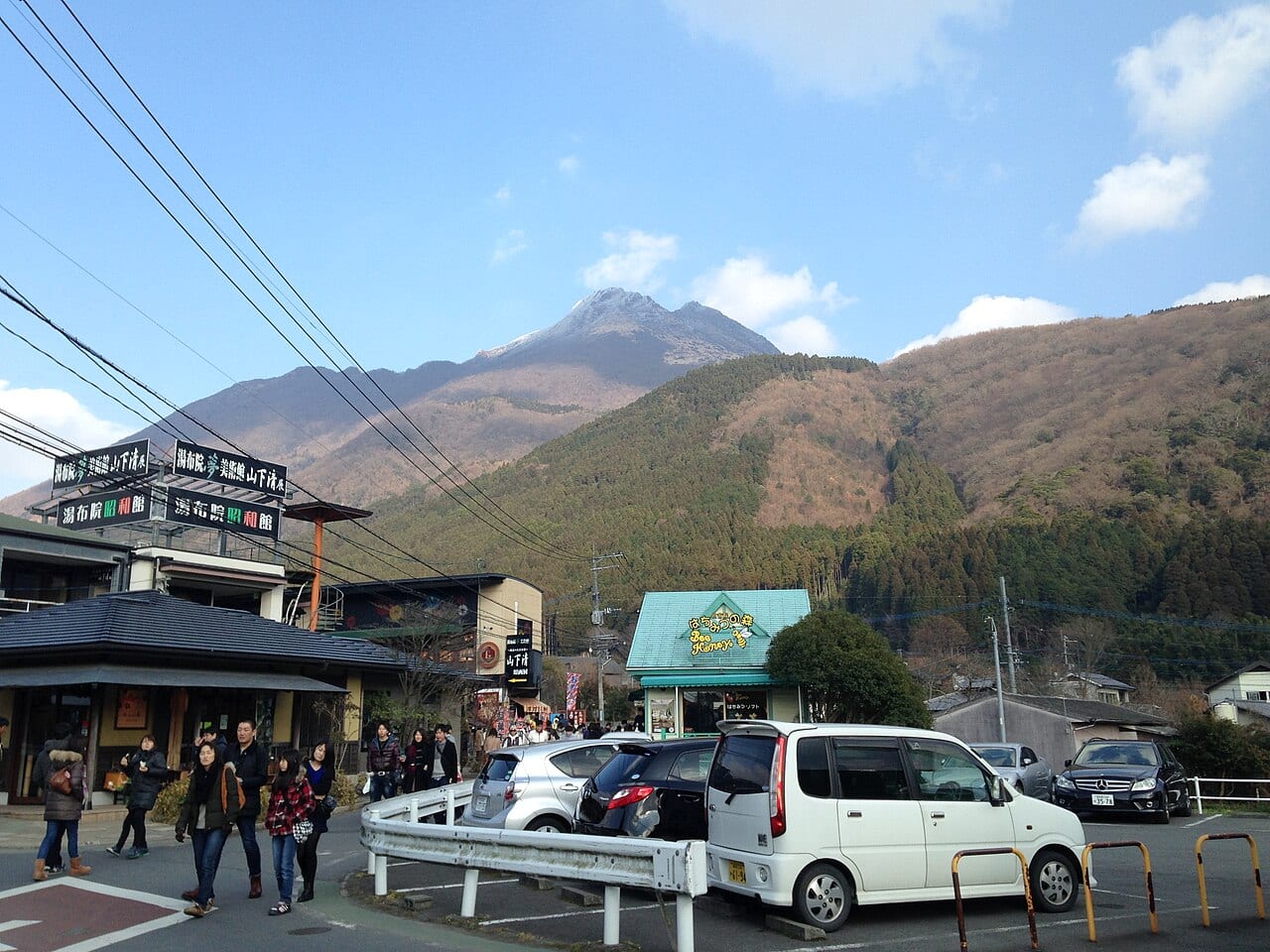
Yufuin is almost entirely walkable, and the main route is Yufuin Station → Yunotsubo Street → Lake Kinrin, about 1.5 km, a 20-30 minute stroll (longer with eating and photos). Yunotsubo Street starts a 5-minute walk from the station, lined with Oita specialties, sweets, croquettes, pudding, artsy cafes and craft shops. Crowd favorites include B-Speak's Swiss roll (often a queue or pre-order), Milch's half-baked cheesecake, prize-winning croquettes and all kinds of soft-serve, plus a Snoopy tea house, the Ghibli-goods "Donguri Republic," and the European-styled Floral Village — easy ways to lose an afternoon.
Honestly, Yunotsubo Street is close to the "Instagram shopping arcade" density of Kyoto's Arashiyama — fun to browse and photograph, but seriously crowded once the day-tour buses arrive. Two tricks to dodge the crowds: one, walk it at 9-10am as shops open and before the tour groups land; two, focus on after 4pm into the evening, when most day-trippers have left, the street is much quieter and the lighting has more mood. Midday is the most packed window, and a clean photo of the empty street is nearly impossible then.
Lake Kinrin and the dawn mist
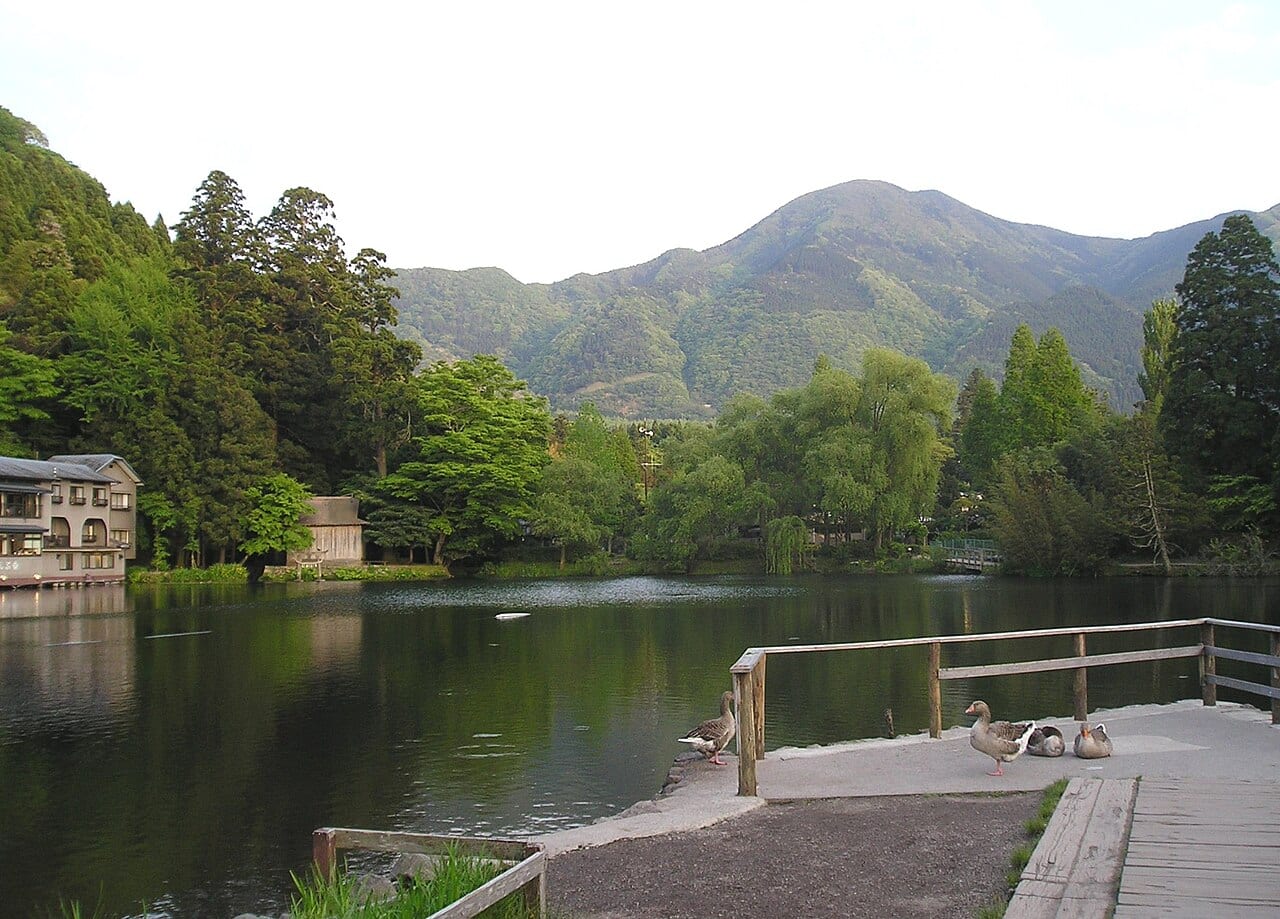
Lake Kinrin is Yufuin's signature — both hot and cold springs well up from its bed, keeping the water warm, so at dawn (especially autumn-winter) a dreamlike mist rises off the surface, paired with the lakeside torii and Mt. Yufu beyond — Yufuin's most iconic scene. But seeing the mist has a key precondition: you must stay overnight and be at the lake before 7-8am. By day the crowds arrive and the mist is gone, so "stay a night to earn the dawn" is the core of how to do Yufuin.
Spots worth lingering by the lake: the red torii of Tenso Shrine on the shore makes the classic foreground for a mist shot; in one corner sits a thatched-roof communal bath, "Shitan-yu," right at the water's edge, around ¥200 — a traditional local bathhouse (mixed-gender, no changing partitions, so consider that). An early-morning loop around the lake when it's quiet, then a seat at a lakeside cafe, is the most pleasant stretch of time in Yufuin — a different world entirely from the daytime crush of Yunotsubo.
The Yufuin no Mori sightseeing train
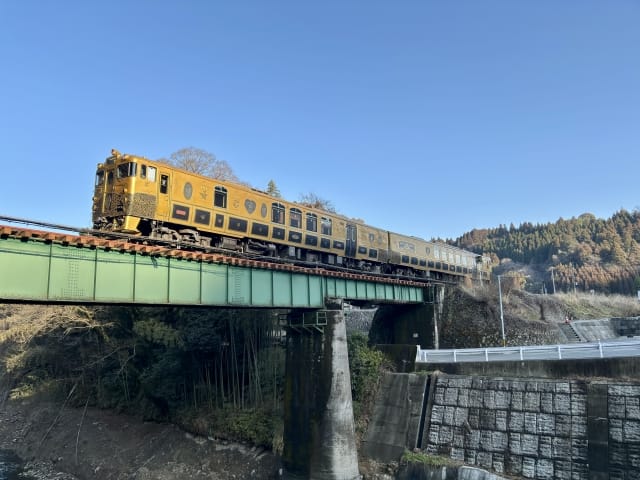
The Yufuin no Mori is JR Kyushu's popular sightseeing train — a deep-green body, wood-paneled interior and big windows — running from Hakata to Yufuin through Kyushu's mountains and valleys, about 2 hours 15 minutes, roughly ¥5,000-6,000 one way (without a pass). The ride is part of the trip — there's a salon car and a simple buffet counter, and the train slows through the Oita gorge so passengers can take photos. Many choose Yufuin just to ride it. Note: it's all-reserved and very popular in peak season, so book ahead on the JR Kyushu site or at a Midori-no-madoguchi counter.
If you can't get a Yufuin no Mori seat, don't worry: the same stretch is served by the regular Yufu limited express, with more departures and friendlier fares and the same mountain-and-valley scenery; or take the Kamenoi bus over the mountains from Beppu/Oita (~50 min, ¥1,100), where the mountain views are just as lovely. For how to chain Yufuin into a Kyushu rail loop — and whether a JR Kyushu pass pays off — see our Kyushu 3-day rail itinerary.
Oita food: Bungo beef and toriten
Oita, the prefecture Yufuin sits in, is an underrated food region. Don't fill up on sweets alone — a few local specialties are worth seeking out:
- Bungo beef: Oita's black-wagyu brand — fine marbling, usually friendlier prices than Kobe beef. Yakiniku joints, steak houses and even croquettes along Yunotsubo and by the station use Bungo beef, and it makes the best main meal here.
- Toriten (chicken tempura): Oita's soul food — chicken in a thin batter, deep-fried and dipped in ponzu soy, crisp outside and juicy within. Nearly every set-meal restaurant serves it, and it's the safest local bite.
- Dango-jiru / yaseuma: Oita country cooking — flat wheat-dough noodles in miso soup (dango-jiru) to warm you up; yaseuma is the same dough dusted with sweet soybean flour as a dessert.
In practice I'd keep the sweets for grazing along Yunotsubo and save a proper meal for Bungo beef or a toriten set — that's the most comfortable rhythm for a day's eating. If your ryokan includes a kaiseki dinner (the big three and most upscale inns do), it usually features Bungo beef too, so leave that meal to the inn.
Hiking Mt. Yufu and the best season
The twin peaks you see overhead, Mt. Yufu (1,583 m), are Yufuin's landmark and one of Kyushu's popular climbs. From the main trailhead it's about 1.5-2 hours one way to the west peak, with a superb summit view that takes in the whole Yufuin basin on a clear day. But it's not a casual stroll — there are rocky chained sections where you scramble hand-and-foot, so wear hiking shoes, pick your weather and timing, and if you're unsure, simply admire the mountain from below rather than forcing it.
On seasons: autumn (around November) turns Mt. Yufu's flanks red against Lake Kinrin's dawn mist — Yufuin at its most dreamlike and most crowded; winter is the best time to soak, with a chance of snow scenery and thicker morning mist, though watch for icy mountain roads. Spring blossoms and summer greenery each have their charm, but overall autumn and winter are Yufuin's prime. For what to wear by month and how to pack, see our Japan packing & weather guide.
Lodging, access and day-trip vs overnight
Day-trip vs overnight: Yufuin's soul is the overnight. A day trip covers Yunotsubo and Lake Kinrin, but its loveliest dawn mist, the quiet ryokan, and the town after the day-trippers leave only happen if you stay. Yufuin is famous for luxury onsen ryokan — the top-tier "big three," Kamenoi Bessou, Yufuin Tamanoyu and Sansou Murata, are all here, many with private baths and kaiseki dinners; there are also plenty of mid-range detached-cottage inns and guesthouses. If your budget allows, a night in a ryokan is the most rewarding investment here. To learn how to choose a Japanese onsen ryokan, see our 5 best Japanese onsen ryokans.
An ideal one-night flow: arrive by the Yufuin no Mori on day one in the afternoon → drop bags, browse Yunotsubo and graze on sweets → stroll the quiet streets after the day-trippers leave, dinner of Bungo beef or your ryokan's kaiseki → soak and sleep early; the next day wake before 7am for Lake Kinrin's mist, loop the lake, return for breakfast and check-out, and move on to Beppu or back to Fukuoka before noon. That's how you capture everything Yufuin only gives up to those who stay.
What it costs: a night at a top-tier "big three" ryokan with private bath and kaiseki dinner typically runs from around ¥30,000 per person and climbs steeply from there; mid-range inns and detached-cottage stays often land in the ¥15,000-25,000 per-person range with two meals; simple guesthouses and business hotels near the station are cheaper still if you only want a bed and a quick soak. A pure day trip from Fukuoka or Beppu is the budget play — your main spends are the round-trip train or bus, lunch (Bungo beef or a toriten set), and sweets along Yunotsubo — but remember you're trading away the dawn mist and the quiet evening town. My honest take: if you can swing even one mid-range ryokan night, do it; Yufuin half-experienced as a day trip is the most common regret here.
Access: from Fukuoka (Hakata) by the Yufuin no Mori or the Yufu limited express, ~2-2.5 hours; from Beppu by the Kamenoi bus, ~50 min, ¥1,100. The town is fully walkable. Yufuin ryokan are booked solid in peak season, so reserve 8-12 weeks out, earlier for long weekends and autumn foliage. The Fukuoka end is in our Fukuoka travel guide. For a quieter cure town to pair, Yufuin connects to Kurokawa Onsen by the cross-Kyushu bus in about 1.5 hours — see our Kurokawa Onsen guide. Set up a KKday Japan eSIM online first so you have a signal to check your ryokan route the moment you step off the train.
Frequently Asked Questions
- Q1:What's the difference between Yufuin and Beppu, and which should I pick?
- Both are in Oita and very close, but opposite in character: Beppu is about "volume" — Japan's highest hot-spring output, the spectacle of the "hells," and a busy town; Yufuin is about "quality" — a small town at the foot of Mt. Yufu, refined and relaxed, full of artsy cafes and design shops, a boutique onsen retreat. Want the onsen spectacle and bustle? Beppu. Want quiet soaking, strolling little shops and a luxury ryokan? Yufuin. With time, do both (a 50-minute bus apart).
- Q2:How do I explore Yufuin, and how much walking is it?
- Yufuin is almost entirely walkable. The main route is Yufuin Station → Yunotsubo Street → Lake Kinrin, about 1.5 km, a 20-30 minute stroll (longer with eating and photos). Yunotsubo Street starts a 5-minute walk from the station, lined with Oita specialties, sweets, croquettes, artsy cafes and craft shops; at its end is Lake Kinrin. You can see the whole town in a day, but the essence is an overnight.
- Q3:Why is Lake Kinrin famous, and when is it best?
- Lake Kinrin is Yufuin's signature — both hot and cold springs well up from its bed, keeping the water warm, so at dawn (especially autumn-winter) a dreamlike mist rises off the surface, paired with the lakeside torii and Mt. Yufu beyond — Yufuin's most iconic scene. But to see the mist you must stay overnight and be at the lake before 7-8am; by day the crowds arrive and the mist is gone. "Stay a night to earn the dawn" is the core of how to do Yufuin.
- Q4:What is the "Yufuin no Mori" train, and do I need to reserve?
- The Yufuin no Mori is JR Kyushu's popular sightseeing train — wood-paneled interiors and big windows — running from Hakata to Yufuin through Kyushu's mountains and valleys, about 2 hours 15 minutes, roughly ¥5,000-6,000 one way (without a pass). The ride is part of the experience, and many choose Yufuin just to take it. Note: it's all-reserved and very popular in peak season, so book ahead. You can also take the regular Yufu limited express, or the Kamenoi bus from Beppu (~50 min, ¥1,100).
- Q5:Is Yufuin better as a day trip or an overnight?
- Honestly, Yufuin's soul is the overnight. A day trip covers Yunotsubo and Lake Kinrin, but its loveliest dawn mist, the quiet ryokan, and the town after the day-trippers leave only happen if you stay. Yufuin is famous for luxury onsen ryokan — the "big three" Kamenoi Bessou, Tamanoyu and Sansou Murata are all here — many with private baths and kaiseki dinners; if your budget allows, a night in one is the most rewarding investment here. Pressed for time, a day trip from Fukuoka or Beppu works, but you miss the best of it.
- Q6:Can I soak in Yufuin's onsen without staying overnight?
- Yes. Many ryokan and bathhouses in Yufuin offer day-use bathing ("tachiyori-yu") open to non-guests during the day, usually ¥500-1,500. The most famous is "Shitan-yu" right on Lake Kinrin — a thatched-roof communal bath at the water's edge, around ¥200, but it's a traditional mixed-gender bath with no changing partitions, so consider that. For a relaxed, proper soak, an overnight in a ryokan with its own bath is still the way to go.