Almost everyone searching for Zao Okama opening hours gets half an answer. This crater lake has two layers of opening time. The outer layer is the season the Zao Echo Line is open — it opened at 11:00 on April 24, 2026 and closes for winter in early November. The inner layer is the daily window of the Zao Highline, the toll road to the summit, which runs 7:30 to 17:00 with last entry at 16:30, and shrinks to 8:00 to 16:00 at both ends of the season. Know only "late April to early November" and you can still turn up in October and find the gate shut. This guide covers both layers, all four ways up the mountain from the Miyagi and Yamagata sides, where the Katta Lift actually fits, and the ropeway misunderstanding that ruins itineraries every year — all verified against official sources as of July 2026.
📍 This guide covers Okama only. Snow monsters, winter ropeway operations and the night illumination are in our Zao snow monsters guide; the Zao Onsen town, its communal baths and strong-acid water, plus Yamadera, are in the Yamagata Zao and Yamadera guide. Nothing is repeated across the three.
- Two layers of opening time: the Echo Line runs April 24, 2026 to early November (exact autumn closing date not yet announced), and the Highline runs 7:30–17:00 daily, last entry 16:30
- Both ends of the season shrink to 8:00–16:00: opening day to early May, and mid-October to the winter closure, with an overnight lockout from 16:00 to 8:00 — so no sunset visits in October
- Okama is free and so is the Echo Line; the only charge is the Highline toll, ¥600 per vehicle, which includes the ~350-space free summit car park
- The ropeway does not reach Okama: Jizo Sancho to the Umanose ridge is a 5 km, four-hour hike graded for strong walkers
- You can get there without a car: Miyagi side by Miyako Bus, ¥2,100 one way (weekends and holidays only); Yamagata side by Yamako Bus plus the Katta Lift, ¥1,000 return — both give you about one hour fifty minutes on top
- The view is not guaranteed: officials state outright that fog makes it invisible; the viewpoint sits at ~1,600 m and runs ~10°C cooler than the base
📖 Table of Contents (click to expand)
- The two layers of opening time
- Four ways up: Miyagi side vs Yamagata side
- The costly myth: the ropeway does not go to Okama
- The Katta Lift and who it is really for
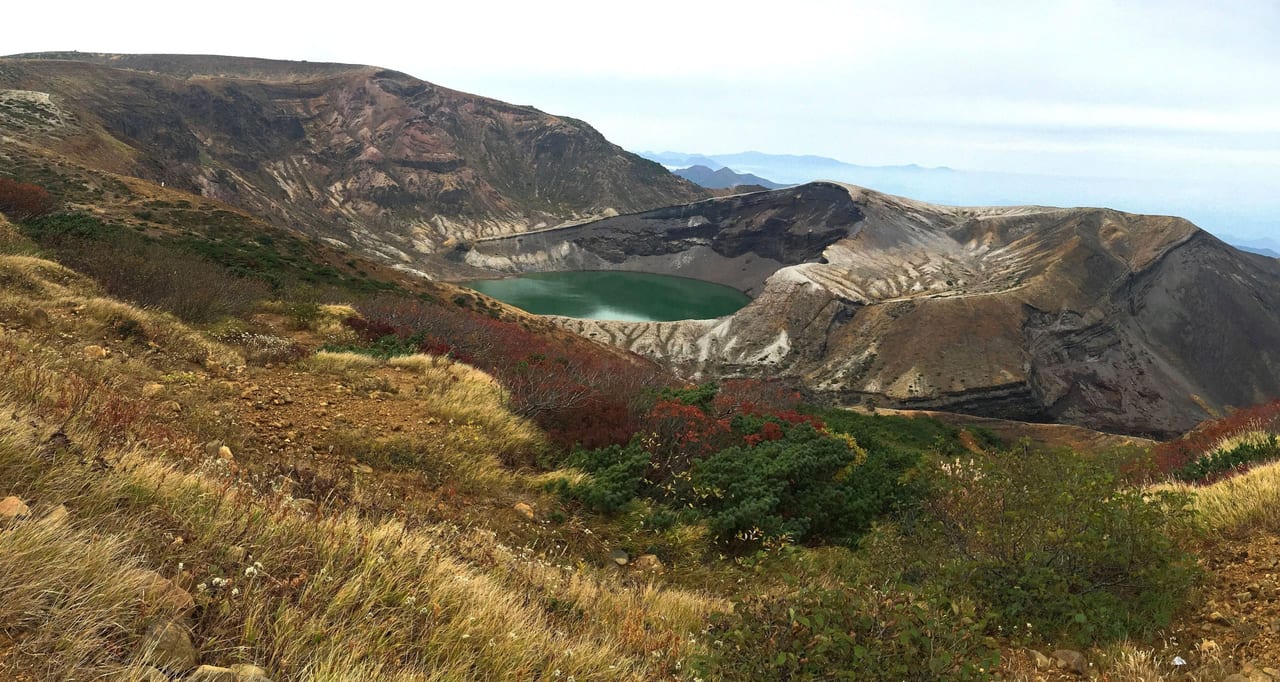
- The lake itself: 325 metres of strong acid
- This is an active volcano
- Will you actually see it? An honest answer
- The summit Rest House: food, toilets and cash
- Kattamine Shrine: one shrine, two halls, one annual move
- Which season to pick
- Is Okama worth the detour?
- FAQ
The two layers of opening time
Start with the thing that trips people up: Okama does not have opening hours. The roads do. The lake is a crater in a volcano and the viewpoint is free public space. Whether it is "open" depends entirely on two stretches of tarmac — one decides whether you can come this month, the other decides what time you can go up today.
Layer one: the Zao Echo Line season
The Zao Echo Line crosses the Zao range and links Miyagi and Yamagata prefectures. Every route to Okama eventually joins it. It closes completely each winter and reopens the following spring.
| Item | Official information |
|---|---|
| 2026 opening | 11:00 on Friday, April 24 (part of Miyagi Prefecture's joint mountain-opening ceremony, 10:30–11:30) |
| Previous winter closure | 17:00 on Tuesday, November 4, 2025 |
| 2026 autumn closure | Not yet announced — typically early November; watch the official traffic page |
| Toll | Free (it was a toll road when it opened in November 1962, but no longer) |
| Status as of July 2026 | Open 24 hours, Okama viewable, prefectural border crossing possible |
One correction worth making because it appears in a lot of travel writing: the Echo Line does not charge a toll. The only paid section is the Highline spur. Anything describing "two tolls on the way up" or "the Echo Line toll" has the geography wrong.
Layer two: the Zao Highline daily window
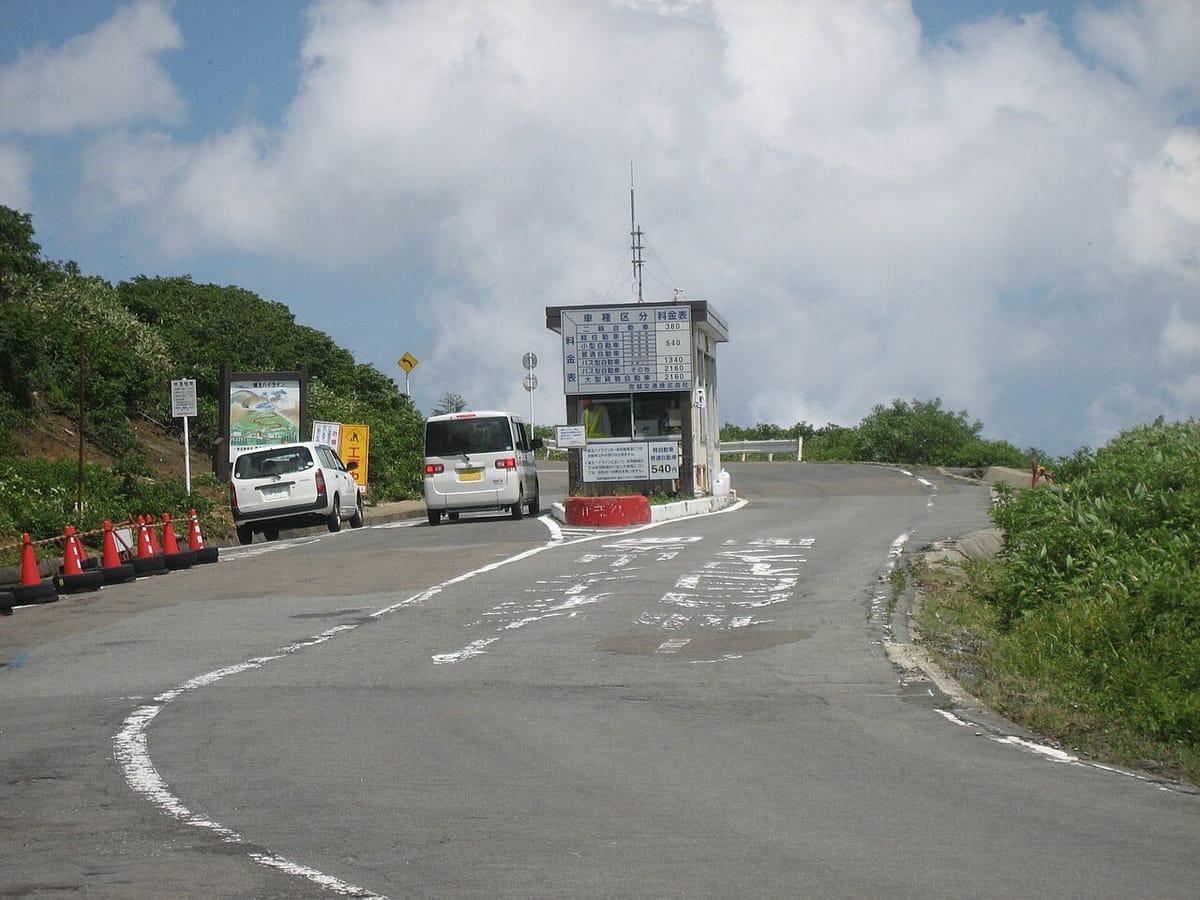
The Zao Highline, operated by Miyagi Kotsu, branches off at the Katta Pass junction — the highest point on the Echo Line — and climbs 2.5 km to the car park on the summit of Mount Katta, roughly 1,750 m. This road's hours are the real answer to the "Okama opening hours" question.
| Period | Hours | Notes |
|---|---|---|
| Standard season | 7:30–17:00 | Last entry 16:30 |
| Opening day – early May | 8:00–16:00 | Overnight closure 16:00–8:00 |
| Mid-October – winter closure | 8:00–16:00 | Overnight closure 16:00–8:00 |
Tolls below reflect the revision of April 1, 2025:
| Vehicle | Toll |
|---|---|
| Standard / kei / small car | ¥600 |
| Motorcycle (over 125cc) | ¥450 |
| Microbus | ¥1,500 |
| Disability discount (standard car) | ¥300 |
That toll includes the summit car park — roughly 350 spaces, free — and from the car park the viewpoint is a two to three minute walk on a step-free path. Pushchairs and less mobile visitors can reach the rim. For the price of a coffee per vehicle you get a volcanic crater at 1,750 m, which is unusually good value among Japan's mountain toll roads.
Layer three, the one that is easiest to miss: the Echo Line overnight closure
⚠️ Planning a sunset shot of Okama in autumn? It cannot be done. The Echo Line closes overnight, 17:00 to 8:00, from mid-October to early November to prevent ice on the road surface, and the same restriction applies in early spring until the morning of May 7. Combined with the Highline shutting at 16:00 in the same period, your real October window is 08:00 to 16:00. The exact start date of the 2026 autumn restriction has not been announced; check the Zao Town tourism association traffic page, which is updated continuously.
Stack the three layers and the practical rule is simple. In summer, June through September, you have a full day from 7:30 to 17:00. From mid-October you have 8:00 to 16:00. From early November you have nothing at all. Autumn visitors in particular need this in their calendar, because peak colour on the mountain lands in mid to late October, exactly when the window is tightest.
Four ways up: Miyagi side vs Yamagata side
Okama straddles the Miyagi–Yamagata prefectural border, and each side has its own transport system. Both work, which is unusual and also the main reason people get confused while planning. Here is the whole picture in one table.
| Method | Route | Cost | Time constraint | Best for |
|---|---|---|---|---|
| Driving, Miyagi side | Murata or Shiroishi IC on the Tohoku Expressway, ~25 min to the Miyagi-side gate (the big torii), then Echo Line and Highline to the summit car park | Highline toll ¥600 | 7:30–17:00, cut to 8:00–16:00 in shoulder season | The best option. Choose your own hour, park 2–3 min from a step-free viewpoint |
| Bus, Miyagi side | Miyako Bus, Shiroishi-Zao Station to Zao Katta Sancho | One way ¥2,100 | Apr 25 – early Nov, weekends and holidays only, 1 round trip a day | Arriving from Tokyo by Tohoku Shinkansen |
| Bus + lift, Yamagata side | Yamako Bus Katta Sancho line via Zao Onsen, alight at Katta Parking, then the Katta Lift plus a 4-minute walk | Lift ¥1,000 return; bus fare see below | Weekends only Apr 25 – Jul 31, daily Aug 1 – Oct 25; lift 9:00–16:00 | Staying at Zao Onsen, or wanting the chairlift ride |
| Driving, Yamagata side | Yamagata city towards Zao Onsen, then Echo Line to Katta Pass | Park at Katta Parking for the lift, or continue on the Highline ¥600 | As above | Trips already based on the Yamagata side |
Miyagi side: Miyako Bus from Shiroishi-Zao Station
This is the intuitive route from Tokyo — Tohoku Shinkansen to Shiroishi-Zao, then a seasonal bus straight to the summit. The 2026 official details:
- Season: April 25 to early November, weekends and public holidays only, one round trip per day, reserved seating
- Outbound: Shiroishi-Zao Station 09:38 → Zao Katta Sancho 11:11
- Return: Zao Katta Sancho 13:00 → Shiroishi-Zao Station 14:35
- One-way fare: ¥2,100
- Suspended whenever the Echo Line is closed. Enquiries: Miyako Bus Shiroishi office, 0224-25-3204
Take "reserved seating" seriously — full means full, and autumn weekends fill. I have not verified the intermediate stops one by one, so I am not listing station names here; if you want to board at Togatta Onsen, call the number above rather than trusting a blog.
For the Tokyo to Shiroishi-Zao leg, if your trip also takes in Sendai, Yamagata or Aomori, it is worth running the numbers on a regional rail pass once — note the Tohoku-area version was withdrawn on March 13, 2026, so the current product is the all-JR-East JR EAST PASS at ¥35,000 for five consecutive days, not the old "any five days within a fortnight". Whether it pays off depends entirely on how many long legs you actually ride, so do the arithmetic rather than buying it for peace of mind.
Yamagata side: Yamako Bus via Zao Onsen
The Yamagata-side service leaves Yamagata Station, calls at the Zao Onsen bus terminal and climbs to Katta Sancho, stopping en route at Katta Parking, where the Katta Lift starts. The operating calendar for 2026 is unusual and worth reading twice:
- April 25 – July 31: weekends and public holidays only
- August 1 – October 25: daily
- No winter service; suspended when the Echo Line is closed. One round trip per day
On timings I need to flag the data quality first: the timetable PDF hosted on the operator's own site carries a day-of-week note that does not match the 2026 calendar, which suggests it is an older edition that has not been refreshed. So treat what follows as indicative and confirm against the current official timetable — outbound Yamagata Station 09:30, Zao Onsen terminal 10:13, Zao Katta Sancho 11:09; return Zao Katta Sancho 13:00, Yamagata Station 14:41. As on the Miyagi side, that leaves about one hour fifty minutes on the summit.
⚠️ I am deliberately not printing one fare here. Yamagata Station to the Zao Onsen terminal is 1,200 yen under the fare table revised on April 1, 2024, with no update notice as of July 2026. But the Yamagata Station to Zao Katta Sancho fare is not published on the Yamako Bus website — the route page only links out to a third-party fare search. Rather than repeat a number of unknown provenance, here is where to get it: the fare search on the Yamako Bus Z90/Z91 route page, or call 023-632-7272.
Driving: parking and traffic, honestly
Driving is what I would recommend to most people, and not mainly for freedom of movement. It is about time structure. Both buses are built to arrive after 11:00 and depart at 13:00, which means you cannot go up early, find fog, come back down and try again — and fog is exactly the variable that decides this visit.
The route is easy enough: leave the Tohoku Expressway at Murata or Shiroishi IC and it is about 25 minutes to the Miyagi-side entrance at the big torii gate, then climb the Echo Line to Katta Pass. There you choose: turn off and pay 600 yen for the Highline straight to the summit, or park at Katta Parking and take the lift. The summit car park holds about 350 vehicles for free, which sounds ample, but the operator states plainly that it can fill and back up during peak leisure season. There is exactly one fix for an autumn weekend: be there when the gate opens at 7:30. You get the thinnest crowds and the most reliable visibility in the same move.
One more practical reality up there: mobile coverage. Checking live road status, whether the bus is running late, whether the Rest House is open — all of it needs data, and the ridge is not uniformly covered. Cache the map offline before you set off rather than assuming you will have a signal at the summit.
No car, and no appetite for the timetable
Put the three variables above side by side and the real problem for a car-free visitor appears. The buses run weekends and holidays only, once a day each way, on a fixed-seat basis; the Katta Lift has its own operating season and a 09:00 to 16:00 window; and the Highline is a separate toll on top. No single item is hard. Getting all three to line up on the same day is.
A shared-ride day tour out of Sendai collapses the three into one vehicle: departing the east exit of JR Sendai Station at 09:00, nine hours in total, taking in Okama plus the Fox Village, Lake Choro and Yokokawa gorge, with a Mandarin-speaking guide on board and free cancellation up to 22 days ahead. For a traveller with one day, a Sendai base and no rental car, it is the version with the fewest moving parts.
Two things the listing does not settle, worth asking before you book:
- Whether lunch is included — the page says both. The plan detail says meals are at your own expense; the purchase notes say one lunch. I am not picking a side on your behalf.
- Whether the Zao Highline toll (¥600) is covered is not stated at all. A chartered coach usually absorbs that 2.5 km spur, but the page does not say so and I will not claim it for them.
Day tours out of Sendai come in two shapes, and the difference is which stops your day contains:
| KKday 145844 | Klook 178500 | |
|---|---|---|
| Price as checked | NT$3,651 | NT$3,309 |
| Rating | 4.9 from 337 reviews | 4.6 from 139 reviews |
| Where the day goes | Okama, Fox Village, Lake Choro, Namezu Falls | Ginzan Onsen, Zao Ropeway and snow monsters, Okama, seasonal fruit picking |
| Zao Ropeway | Not included | Included |
| Lunch | Listing says both things (above) | Local lunch included |
🔴 The Klook title runs "Zao Ropeway" and "Okama" together on one line, but what it means is two destinations in one day — not a ropeway ride to the crater. They are not on the same summit, and why they are not is the whole of the next section. A title like that is not an error, but do not read it as proof that the ropeway reaches Okama.
⚠️ One more thing to check on the itinerary itself: snow monsters are a winter sight, while Okama needs the Echo Line to be open, and the window where both are true is narrow. Put your date in and read what that day's itinerary actually runs.
Klook: Ginzan Onsen, Zao Ropeway and Okama in a day (two destinations, not a ropeway to the crater)
The costly myth: the ropeway does not go to Okama
If you remember one section of this guide, make it this one. None of the three cable systems on the Yamagata side reaches Okama. The misunderstanding persists because the Zao Ropeway is famous, so people reasonably assume that riding a cable car up Zao means seeing the crater lake.
| System | Upper station | Summer hours | Relationship to Okama |
|---|---|---|---|
| Zao Ropeway | Jizo Sancho (1,661 m) | Lower line 8:30–17:00 / upper line 8:45–16:45 (last ascent departs the base at 16:00) | Does not reach it. 5.0 km, ~4 hours, graded for strong hikers |
| Zao Chuo Ropeway | Torikabuto (7 min 30 sec ride) | Apr 1 – Oct 31, 8:30–17:00 | Unrelated |
| Zao Sky Cable | Chuo Kogen (about 8 min) | As above | Unrelated |
The detail matters. Jizo Sancho Station sits on a different summit northwest of Okama, with Mount Kumano in between. Walking from there to the Umanose ridge, where the lake finally opens up below you, follows what the Zao Ropeway operator labels the Kumanodake komakusa viewing course: 5.0 km, about four hours, graded for strong hikers. That is hiking, not strolling — boots, food, a weather forecast and your own risk assessment, on a ridge where conditions turn fast.
So flip the logic and it stays straight: the ropeway is for the snow monsters, the road is for Okama. Cable car in winter for juhyo, mountain highway in summer and autumn for the crater — two seasons, two systems, almost no overlap. And to close that loop in one line: the road is shut in winter, so Okama is not visible then; Zao's winter headline act is the snow monsters, covered fully in our Zao snow monsters guide.
The Katta Lift and who it is really for
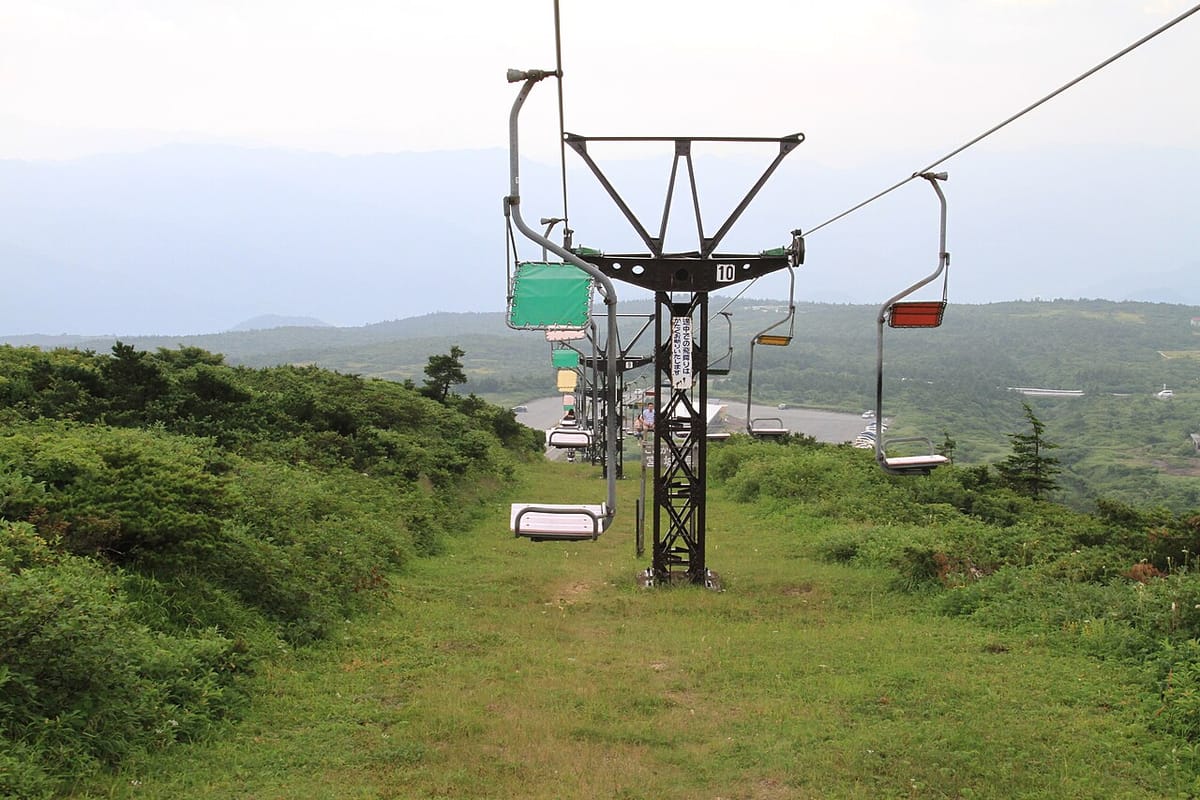
A correction on geography that is often mislabelled: the Zao Katta Lift is on the Yamagata side, not the Miyagi side. It sits at Katta Pass in Zao Bodaira Kogen, Kaminoyama City, Yamagata Prefecture, right beside the Echo Line, and it is run by Zao Liza World, a Yamagata-side operator. Bus passengers reach it by getting off at the Katta Parking stop.
| Item | Detail |
|---|---|
| Fare | ¥1,000 return / ¥600 one way (charged from age 6) |
| 2026 season | From Saturday, April 25 (closing date not published; normally ends with the Echo Line winter closure) |
| Hours | 9:00–16:00 (extended to 16:30 July 18 – August 30) |
| Last ascent | 45 minutes before closing |
| To the lake | About 7 minutes riding plus about 4 minutes on foot |
| Weather | Suspended in strong wind and poor conditions |
So which do you choose? My call: if you have a car, drive the Highline. Six hundred yen covers the whole vehicle rather than one person, and you can be up there at 7:30. The lift makes sense in two cases. First, if you arrived by bus and got off at Katta Parking, it is simply your legs. Second, if you want the ride for its own sake — it is an open chairlift over volcanic scree, and that is a genuinely different experience from watching the same slope through a windscreen.
Mind the timing gap though: the lift opens at 9:00, closes at 16:00, and the last ascent is 45 minutes before that, giving you a usable boarding window of roughly 9:00 to 15:15. That is nearly two hours narrower than the Highline, and the clearest air is usually in the part you lose.
The lake itself: 325 metres of strong acid
Now the thing you came for. Per the Zao Town tourism association and the Zao Geopark:
| Item | Figure |
|---|---|
| Name | From its resemblance to a cooking pot, or kama |
| Diameter | 325 m east–west by 325 m north–south |
| Circumference | About 1 km |
| Depth | 27.6 m maximum, 17.8 m average |
| Water | Strongly acidic; nothing lives in it apart from diatoms |
| Formation | A crater lake on the western flank of Mount Goshiki; first eruption around AD 1200, early Kamakura period, with repeated eruptions since |
| Viewpoint | Around 1,600 m, roughly 10°C cooler than the base of the mountain |
The nickname "five-coloured lake" is not marketing copy. The water genuinely shifts between emerald green and deep blue with the sunlight and cloud, and the colour you get at 9:00 can be noticeably different from the one at 14:00. Official sources use both Goshiki-numa and Goshiki-ko for it, meaning the same thing.
One trap to avoid: officials publish only "strongly acidic" for the water and do not give a pH figure. The pH 3.5 that circulates online comes from a 1968 survey and is old secondary data. More importantly, do not confuse it with Zao Onsen's famous pH of roughly 1.3 to 1.6 — that is the hot spring town's water, an entirely different source and subject. The onsen belongs to our Yamagata Zao guide and is not covered here.
⚠️ Crossing the viewpoint railing to approach the water is prohibited, and that is an explicit official instruction. A strongly acidic crater lake is not somewhere to paddle or touch the water, and the crater wall is unstable volcanic scree. If you want a different angle, move along the rim — do not step over the line.
This is an active volcano
Plenty of write-ups leave this out. I do not think they should. You are standing on an active volcano. Per the Japan Meteorological Agency's volcanic activity report for Mount Zao, as confirmed on July 30, 2026, Zao sits at eruption warning level 1, the lowest tier, phrased as "be aware this is an active volcano". Normal sightseeing is entirely fine at that level.
Two pieces of terminology are worth carrying with you. First, the officially designated potential crater zone is the Umanose caldera, with an assumed impact radius of about 1.2 km — which is to say, the bowl that Okama sits in. Second, fumaroles and volcanic gas are visible in the Maruyamazawa and Furikozawa areas inside that caldera. That is not an anomaly; it is this mountain's normal state.
The recent history is worth one line because it shows the system does move: Zao was raised to level 2, restricted access around the crater, on January 30, 2018, and returned to level 1 on March 6 of the same year, holding there ever since. The right posture is neither alarm nor indifference — just spend thirty seconds on the JMA volcano page before you set out. Officials state that approaching the Umanose caldera is prohibited during periods of elevated activity, and that you should leave immediately if you notice anything unusual on site: strange smells, sounds or ground movement. For the same reason this guide will not suggest wandering deeper into the caldera. Look from the viewpoint.
Will you actually see it? An honest answer
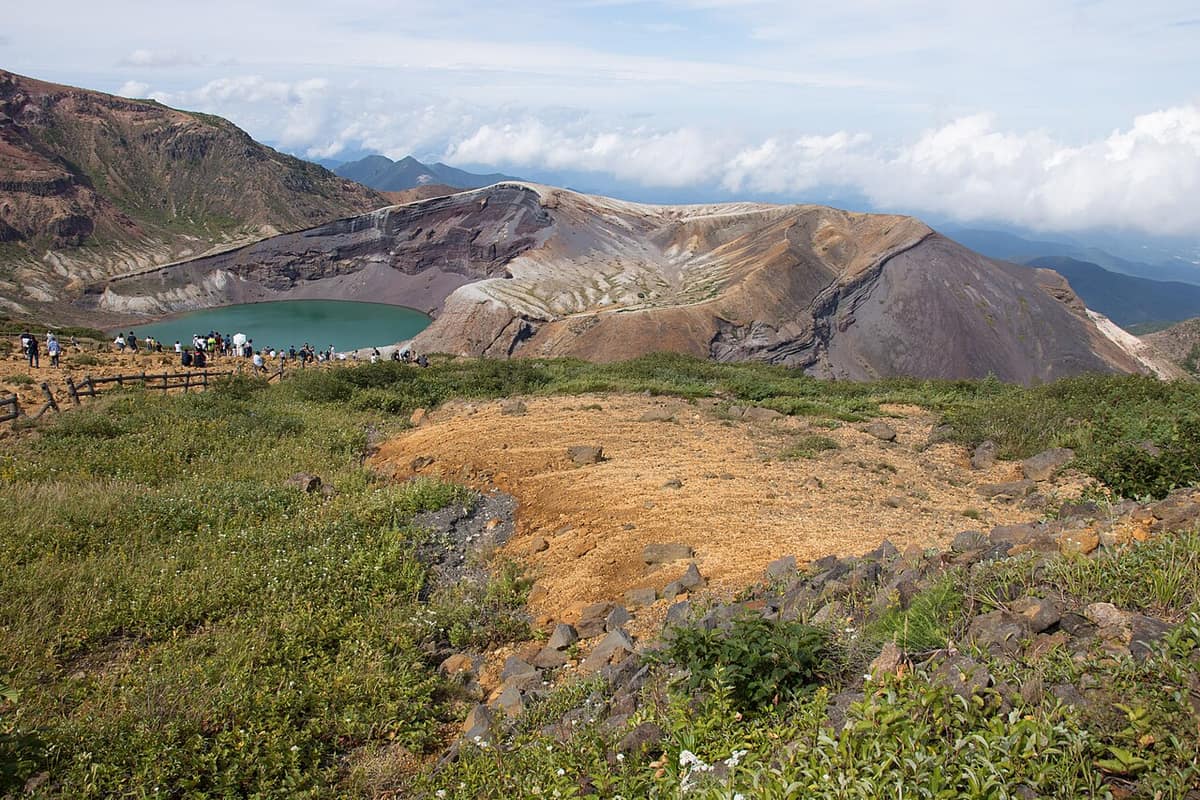
I cannot give you a day that guarantees the view. This is a prefectural-border ridge at roughly 1,600 m, and the tourism association's own page states that in bad weather or thick fog the lake cannot be seen. That is not boilerplate; it is an accurate description of the place.
You will run into a claim that the odds of a clear view are "about thirty percent". I traced it: it comes from media coverage, not from any official statistic and certainly not from any measurement of ours. I mention it because you will meet it elsewhere and deserve to know its provenance — treat it as mood, not as a number to plan around.
Three things genuinely tilt the odds, none of them mysterious:
- Go in the morning. Mountain terrain builds cloud and fog through the afternoon. Note in passing that both buses are timed to arrive shortly after 11:00, which tells you something about how the locals think about it.
- Check the traffic page before leaving. The Zao Town tourism association traffic notice is an official page updated continuously with road status and whether Okama can be viewed.
- Have a fallback. Togatta Onsen below on the Miyagi side, or Zao Onsen on the Yamagata side, are unaffected by cloud. On a fogged-out day, swapping the summit for a bath is the least wasteful move available.
On clothing, one honest sentence: the viewpoint runs about ten degrees cooler than the foot of the mountain, so a 30°C August day down below can be low twenties up top, and ridge wind makes it feel colder still. The official advice is a layer you can put on and take off, plus solid shoes. You do not need mountaineering kit, but sandals and a windbreaker are not enough.
The summit Rest House: food, toilets and cash
Next to the summit car park stands the Miyagi Prefectural Zao Summit Rest House, the only indoor facility up here. Its value is logistical rather than scenic. Per the official listing:
- Ground floor: shop and light meals (9:00–16:40), free rest area, toilets, coin lockers, AED
- First floor: 240-seat restaurant
- Cash only — no cards, no mobile payments. Check your wallet before you drive up
On the operating season I have to be straight with you: the official page's own stated season, mid-May to early October, does not line up with the road season of late April to early November, and other sources give a third set of dates. With three sources disagreeing I am not going to print a fixed answer. Read it as: open during the mountain season, liable to close temporarily in bad weather, confirm against official notices before you go. The practical consequence is that in late April and late October you should not stake lunch on the summit — eat below, or bring something up.
The signature dish is kama katsudon, a pork cutlet bowl using JAPAN X, a Miyagi brand pork, served in a stone pot that echoes the shape of the crater. Both the name and the presentation were designed for this mountain. I have not eaten it, so I am not inventing a review, and the price I found appears only in secondary sources, so I am not printing a figure either. Treat it as a bonus if the place happens to be open, not as a reason to plan.
One more thing that matters specifically up here: finish anything you buy at the shop before you walk off with it. The wind at the summit is strong and bins are scarce, and eating while walking is poor form in Japan anyway.
Kattamine Shrine: one shrine, two halls, one annual move
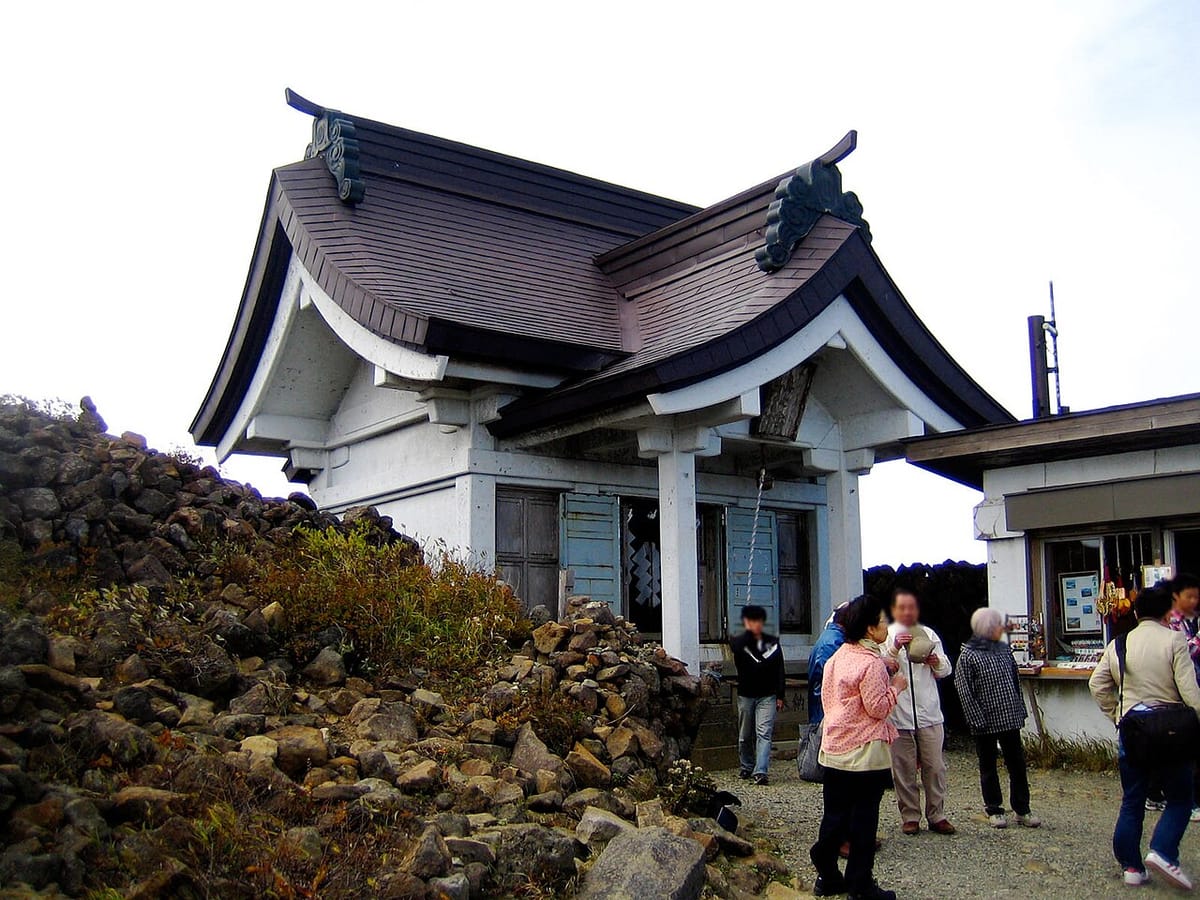
On the summit of Mount Katta, close to the viewpoint, stands Kattamine Shrine (the okumiya, or inner hall). Most visitors photograph the lake and leave without registering it, which is a shame, because it is the most interesting cultural detail on this mountain.
Per the Zao Town tourism association, Kattamine Shrine operates as a paired shrine: the okumiya on the summit and the satomiya, the village hall, down in the Togatta Onsen town. The enshrined deities are Ame-no-Mikumari-no-Kami and Kuni-no-Mikumari-no-Kami. Its predecessor was Zao Daigongen-sha, renamed after the Meiji-era separation of Buddhism and Shinto.
What makes it unusual is how it runs. The sacred object moves with the seasons — down to the satomiya for winter, back up to the summit okumiya for summer. The reason is entirely practical: the summit is unreachable under snow, so this is a tradition built to keep worship continuous through the closure. In other words, the shrine runs on the same clock as Okama. You can visit the okumiya only while the Echo Line is open; during the closure, the satomiya at Togatta is where to go.
📿 On goshuin, the sourcing needs stating plainly. The Zao Town official page carries no mention of goshuin and publishes no desk hours. User records on pilgrimage-logging platforms indicate that both the okumiya and the satomiya issue one, at 500 yen each, but that is secondary data. More important still: whether the summit office is staffed cannot be stated with confidence — depending on weather and time of year it may simply not be open. Treat this stamp as a bonus if it happens, not as something to build a day around. For how goshuin work and what to bring, see our guide to collecting goshuin in Japan.
For completeness, a Zao Kodo pilgrimage version of the stamp also exists in the wider area, though that too rests on secondary sources, so one line is all it gets here.
Which season to pick
The road season runs roughly six months, but those six months look very different from one another. Per official seasonal information:
| Period | What you get | What you accept |
|---|---|---|
| Late April – mid-May | The snow corridor — walls of cleared snow lining the road, visible only in the weeks after opening | Highline on the short 8:00–16:00 schedule, overnight closure until the morning of May 7, summit facilities may not be fully open |
| June – August | Fresh green and the most stable weather; Highline on the full 7:30–17:00; lift extended to 16:30 from July 18 to August 30 | Car park fills on summer weekends; 30°C below can mean low twenties up top |
| Late September – late October | Autumn colour spreading downward from the summit, with the elevation range stretching the viewing period | From mid-October the window shrinks to 8:00–16:00 plus the overnight closure; weekend congestion |
| From early November | — | Full winter closure; Okama becomes unreachable (last season's closure: November 4) |
If I had to pick, I would take two windows. The first is the first half of May, because the snow corridor exists for only a few weeks a year and the crowds are visibly thinner than in the summer holidays. The second is early October, when colour has started descending from the summit but the schedule has not yet tightened to its narrowest — the best balance of scenery and flexibility. What I would avoid is a late-October weekend: peak colour, narrowest window and fullest car park, all landing at once.
For how autumn colour progresses across Japan as a whole, start with our Japan autumn foliage guide. Note that this article does not forecast Zao's peak dates — doing that properly requires current-year observation data, not extrapolation from last year.
Is Okama worth the detour?
Short version: Okama is worth reshaping an itinerary around, but not worth forcing a weather-dependent day trip for.
The reasoning is about cost structure. If you are driving, the marginal cost is tiny — 600 yen of toll, free parking, a two to three minute walk to the rim. You are buying a volcanic crater at 1,750 m for the price of breakfast. That return on investment is rare in Japan, and if your route already passes through Miyagi or Yamagata, going up is close to automatic.
Without a car the picture inverts. You spend three hours or more of travel and a whole day of flexibility to buy one hour fifty minutes on top, with no ability to respond to the weather. One round trip per day on either side, weekends only on the Miyagi side, means that on a fogged-in day you stand at the railing looking at grey and then board the 13:00 bus anyway. The smarter structure in that case is to make Okama a flexible target: sleep at the foot of the mountain in Togatta Onsen or Zao Onsen, look at the sky in the morning, and decide then.
On where to base yourself, there are really two answers. Togatta Onsen on the Miyagi side is closest to the torii gate entrance and pairs naturally with the Miyako Bus or a car; Zao Onsen on the Yamagata side pairs with the Yamako Bus and the Katta Lift, and doubles as your base if you are also chasing snow monsters on another trip. If you would rather use a city and travel in, Sendai is the realistic choice — one Shinkansen stop from Shiroishi-Zao and by far the deepest hotel market in the region: compare Sendai hotels on Trip.com, and book early for autumn weekends. What to do with the city itself is in our Sendai travel guide.
One last note on how the three Zao guides divide up, so you are not hunting the same mountain twice. This one covers the roads and the timing for Okama. Snow monsters, winter ropeway operations and the night illumination live in the snow monsters guide. Zao Onsen, the communal baths, the water chemistry and Yamadera live in the Yamagata Zao and Yamadera guide. To thread the wider region together in winter, continue with our Tohoku winter itinerary; and if you want to extend into Yamagata's onsen country, the day-trip-versus-overnight reasoning in our Ginzan Onsen guide transfers cleanly.
To finish the thought: Okama's appeal is not the "most beautiful crater lake in Japan" label. It is that you can drive to within three minutes of a volcanic crater rim and stand there — with strongly acidic water below, a designated potential crater zone under your feet, and weather that can hide all of it without warning. Your job is only three things: work out both layers of the road's timing, get up there in the morning, and accept that it may show you nothing at all.
FAQ
- Q1:When is Zao Okama open, and what are the actual opening hours?
- Okama has two layers of opening time, and missing the second one is the most common planning error here. The outer layer is the season the road is open: the Zao Echo Line, the mountain highway crossing the range, opened at 11:00 on April 24, 2026 and stays open until it closes for winter in early November. The previous season closed at 17:00 on November 4, 2025, and the exact 2026 autumn closing date has not been announced yet, so check the Zao Town tourism association traffic page before you travel. The inner layer is the daily operating window of the Zao Highline, the toll road that runs to the summit car park: normally 7:30 to 17:00 with last entry at 16:30, but shortened to 8:00 to 16:00 both from the opening day through early May and from mid-October until the winter closure, with the road locked from 16:00 to 8:00 the next morning during those periods. The Echo Line itself also has an overnight closure of 17:00 to 8:00 in early spring and again from mid-October to early November. In practice this means a sunset visit in October is not possible; you have to be off the mountain by 16:00.
- Q2:Can I see Okama from the Zao Ropeway?
- No. This is the single most expensive misunderstanding about Zao. There are three cable systems on the Yamagata side. The Zao Chuo Ropeway goes to Torikabuto and the Zao Sky Cable goes to Chuo Kogen, and neither has anything to do with Okama. The famous one, the Zao Ropeway, ends at Jizo Sancho Station at 1,661 m, which sits on a different summit northwest of Okama with Mount Kumano in between. Getting from Jizo Sancho to the Umanose ridge where Okama comes into view is the operator official Kumanodake komakusa viewing course: 5.0 km, about four hours, graded for strong hikers. That is a mountain hike requiring boots, fitness and weather judgement, not a paved sightseeing path. If you want to reach Okama using a lift or a road, the two real options are the Zao Katta Lift on the Yamagata side, about seven minutes riding plus a four-minute walk, or driving the Zao Highline on the Miyagi side, where the summit car park is a two to three minute walk from the viewpoint.
- Q3:Is there an admission fee for Okama, and do I have to pay for parking?
- Okama itself has no admission fee and the viewpoint is free to enter. What costs money is the road. The Zao Echo Line, which crosses the range, is free; it was a toll road when it opened in November 1962 but is now free of charge. The Zao Highline, the 2.5 km spur that branches off at Katta Pass and climbs directly to the summit of Mount Katta, is the toll section. Since the revision of April 1, 2025 the toll is 600 yen for standard and kei cars, 450 yen for motorcycles over 125cc, 1,500 yen for microbuses, and 300 yen for standard cars with a disability discount. That toll already covers the summit car park, which has roughly 350 free spaces. So for a driver the effective cost of visiting Okama is 600 yen per vehicle, which is inexpensive by the standards of Japanese mountain toll roads.
- Q4:Can I visit Okama in winter?
- No. Both the Zao Echo Line and the Zao Highline close completely for winter, roughly from early November until late April, and during those months there is no open road or lift of any kind that reaches the Okama viewpoint. Winter at Zao is about something else entirely: the juhyo, or snow monsters, on the Yamagata side, reached by the Zao Ropeway to Jizo Sancho. That is a different season, a different peak and a different transport system from Okama, which is why the two rarely appear in the same itinerary. If your trip falls between December and March, take Okama off the list and plan around the snow monsters instead. If Okama is your priority, aim for May through October, when the road is reliably open.
- Q5:How do I get to Okama without a car?
- Each side of the mountain has one seasonal bus, and both share the same shape: one round trip per day, arriving late morning and leaving at 13:00. On the Miyagi side, Miyako Bus runs from Shiroishi-Zao Station to Zao Katta Sancho from April 25 to early November 2026, weekends and public holidays only, with reserved seating. The outbound leaves Shiroishi-Zao at 9:38 and arrives at 11:11; the return leaves at 13:00 and reaches Shiroishi-Zao at 14:35. The one-way fare is 2,100 yen. On the Yamagata side, Yamako Bus runs the Katta Sancho line via Zao Onsen: weekends and holidays only from April 25 to July 31, then daily from August 1 to October 25, stopping at Katta Parking, which is where the Katta Lift starts. The fare for the Yamagata Station to Katta Sancho section is not published on the operator website, so check it through their fare search or by phone rather than trusting a third-party figure. Either way you get roughly one hour fifty minutes at the top, with no ability to choose your time slot.
- Q6:What are the odds of actually seeing the lake, and how do I improve them?
- Nobody can promise you a view. The Zao Town tourism association states plainly on its own page that in bad weather or thick fog the lake is not visible. A figure circulates online claiming the odds of a clear view are around thirty percent; that comes from media coverage rather than any official statistic, so treat it as atmosphere rather than a number to plan around. Three things genuinely help. First, go in the morning, because mountain terrain tends to build cloud and fog through the afternoon, which is also roughly why both buses are timed to arrive before noon. Second, check the tourism association traffic page before you set out, since it is updated continuously with road status and whether the lake can be viewed. Third, keep a fallback: the hot spring towns below, Togatta on the Miyagi side and Zao Onsen on the Yamagata side, are not weather-dependent. Also note that the viewpoint sits at about 1,600 m and runs roughly ten degrees cooler than the foot of the mountain, so even in summer bring a layer you can take off and proper shoes.
- Q7:Katta Lift or driving the Highline: which is better?
- If you have a car, drive. The 600 yen toll is charged per vehicle rather than per person, the summit car park is free, the walk to the viewpoint takes two to three minutes and that path is step-free, so pushchairs and less mobile visitors can reach it. The Katta Lift earns its place in two situations. One is when you arrive by bus and get off at Katta Parking, in which case the lift is simply how you get up. The other is when you want the ride itself: it is an open chairlift over volcanic scree, about seven minutes up plus a four-minute walk to the viewing area, at 1,000 yen return or 600 yen one way for anyone aged six and over. There is also a timing gap worth weighing. The lift runs 9:00 to 16:00, extended to 16:30 from July 18 to August 30, and the last ride up is 45 minutes before closing, so the usable window is narrower than the Highline, which opens at 7:30. The clearest air is usually early, and only a car gets you there for it.
Read next
Zao & Yamadera Guide 2026: Snow Monsters, Okama & Onsen
Snow monsters in winter, the emerald Okama crater in summer — the ¥4,400 Zao Ropeway, strong-acid Zao Onsen, plus Yamadera's 1,015 stone steps. What to see and exactly when.
Zao Snow Monsters 2027: Ropeway, Ski & Onsen Worth It?
Snow monsters peak late Jan–Feb; the ropeway runs ¥4,400 round trip (verified). Is the light-up, skiing and onsen combo worth the trip?
Sendai Travel Guide 2027: Matsushima, Aoba Castle, Zuihoden & Gyutan
Tohoku's gateway and City of Trees — Matsushima of the Three Views, Date Masamune's Aoba Castle ruins and Zuihoden, Jozenji-dori, gyutan and zunda.
📊 See the 2026 Price Index (JR Pass, DPA, eSIM, Airport Transport) →