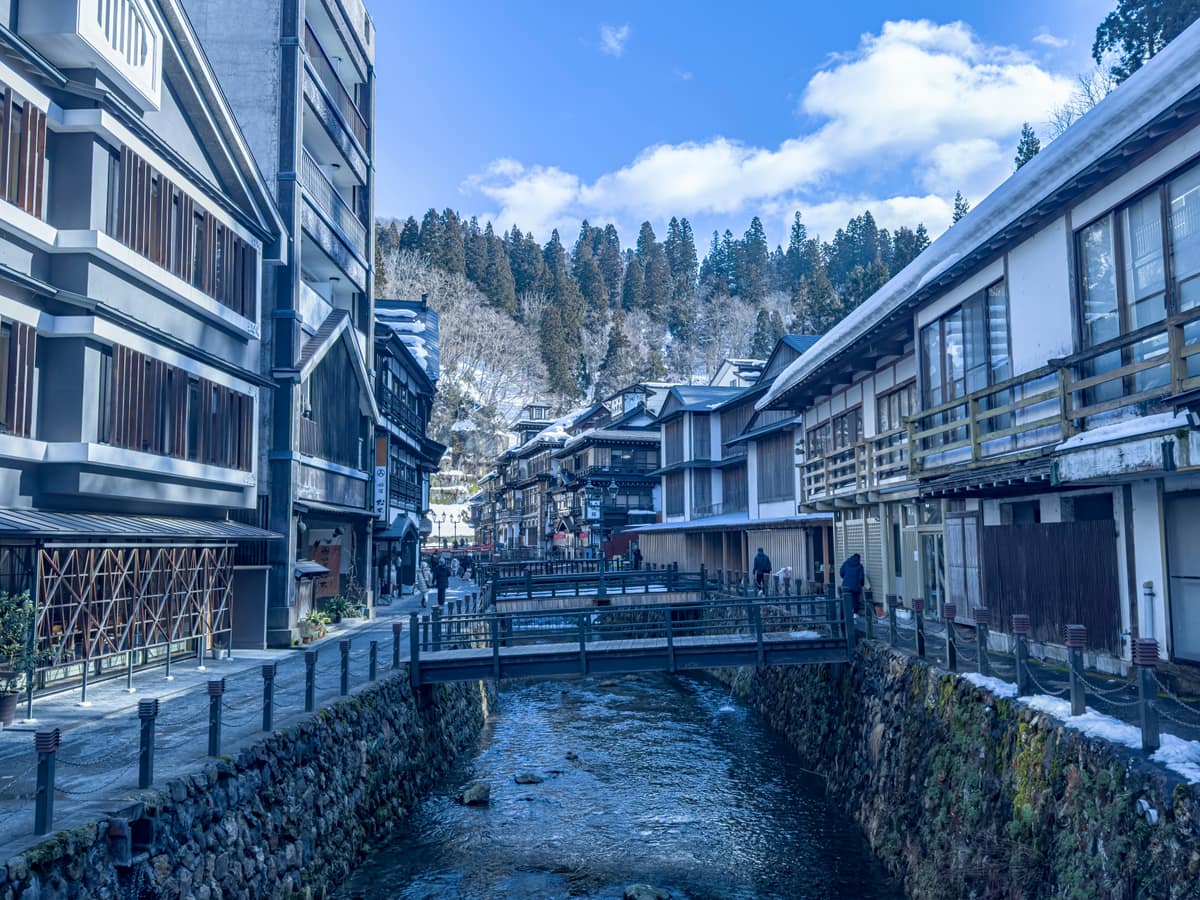
March 2025. The moment our train pulled out of Hakata Station on the "Yufuin no Mori" express — green wood-grain interior, conductors in matching green uniforms handing out commemorative bookmarks, early-spring Kyushu mountain scenery rolling past — I finally understood why Japanese railfans rank Kyushu's D&S trains as their bucket-list pick. Kyushu isn't large (Hakata to Kagoshima takes 1h40m by Shinkansen), but JR Kyushu has carved this island into 12 themed sightseeing routes, each a self-contained travel experience. This is the "how to make a 3-day Kyushu rail trip actually worth the JR Pass" version, built around three iconic D&S routes.
- Route: Hakata → Yufuin (overnight) → Beppu → Kumamoto (overnight) → Aso → Hakata
- JR Kyushu 3-day All-Area Pass ¥22,000 (official website discount ¥1,000), saves ~¥2,500 vs single tickets (2026 fare hike narrowed the margin — only worth it if you ride all three D&S trains)
- Three featured trains: Yufuin no Mori (green), Aso Boy (blue family-theme), Kyushu Crossing Limited Express
- Best windows: March-May (spring blossoms, fresh greens), October-November (foliage — see the Kyushu autumn guide for Mifuneyama and the drive-vs-rail call), January (Fukuoka hotels at their emptiest + Aso snow)
- Budget: Two travelers sharing: ¥105,000-145,000 (excludes flights)
Table of Contents (click to expand)
- Why is Kyushu worth a dedicated rail trip?
- JR Kyushu 3-day Pass math: how much does this route save?
- Day 1: Hakata → Yufuin (Yufuin no Mori express)
- Day 2: Yufuin → Beppu → Kumamoto
- Day 3: Kumamoto → Aso → Hakata
- Optional 4th day: the Kurokawa Onsen extension
- Hotel picks: Yufuin and Kumamoto
- Three trains compared: which one is the highlight?
- When NOT to do this trip
- Common Kyushu rail-travel missteps
- Reservation tactics: seats, timing, booking sites
- 3-day budget breakdown
- Eight mistakes Kyushu rail travelers make
Why is Kyushu worth a dedicated rail trip?
JR Kyushu operates Japan's most complete network of "D&S Trains" (Design and Story Trains) — 12 sightseeing routes, each with its own narrative, carriage design, food service, and merchandise. This density doesn't exist on Honshu or Hokkaido. Just this 3-day plan covers:
- Yufuin no Mori (ゆふいんの森). Hakata-Yufuin-Beppu route. Deep-green wood-grain carriages, retro saloon car, often called "the moving onsen ryokan."
- Aso Boy (あそぼーい). Beppu-Aso-Kumamoto route. Blue family-themed train with a kids playroom and large panoramic seats.
- Kyushu Crossing Limited Express. Beppu-Aso-Kumamoto. Standard limited express that crosses Mount Aso's outer crater rim — window scenery rivals dedicated sightseeing trains.
The core logic of this 3-day design: one themed train per day, with city sightseeing time controlled to 3-5 hours each. The point is to make transit itself part of the experience. If you treat trains as "just A-to-B," Kyushu will completely flip that mental model.
JR Kyushu 3-day Pass math: how much does this route save?
| Segment | Train | Single fare |
|---|---|---|
| Hakata → Yufuin | Yufuin no Mori (indicated seat) | ¥4,910 |
| Yufuin → Beppu | Sonic / Yufu Limited Express | ¥1,150 |
| Beppu → Kumamoto | Aso Boy / Kyushu Crossing Limited Express | ¥6,140 |
| Kumamoto → Aso | Hoso Main Line Limited Express | ¥1,470 |
| Aso → Hakata | Kyushu Shinkansen (connecting) | ¥10,830 |
| Total | ¥24,500 | |
The JR Kyushu 3-day all-area Pass at ¥22,000 saves ~¥2,500 per person (the 2026 fare hike from ¥17,000 → ¥22,000 narrowed what used to be a ¥7,500 margin). Add the time saved on flexible re-booking and not buying tickets at every station, and the Pass is still defensible for this route — but no longer a no-brainer.
When does the Pass not pay off? If you only do Hakata-Yufuin round trip (¥4,910 × 2 = ¥9,820 < Pass ¥22,000), single tickets win comfortably. The Pass break-even threshold is roughly "single-fare totals over 3 days exceed ¥22,000" — this full D&S itinerary clears that, but just barely. For full Pass comparisons across Kyushu, Hokkaido, and the national tier, see our JR Pass complete guide 2026.
Day 1: Hakata → Yufuin (Yufuin no Mori express)
- 09:00 Depart from Fukuoka Airport or Hakata hotel. Airport-to-Hakata subway: 5 minutes ¥260, the most convenient option. Compare prices on Trip.com Fukuoka hotels (Hakata vs Tenjin districts).
- 10:14 Hakata board Yufuin no Mori #1 (all seats reserved, so book ahead). Journey 2h17, ¥4,910 / with a pass, reserving at a Japanese ticket window is free; only booking ahead from home costs anything, at ¥1,500 for the KRP Option Ticket on a D&S train. The train has a saloon area, commemorative stamp station, and free souvenir bookmark.
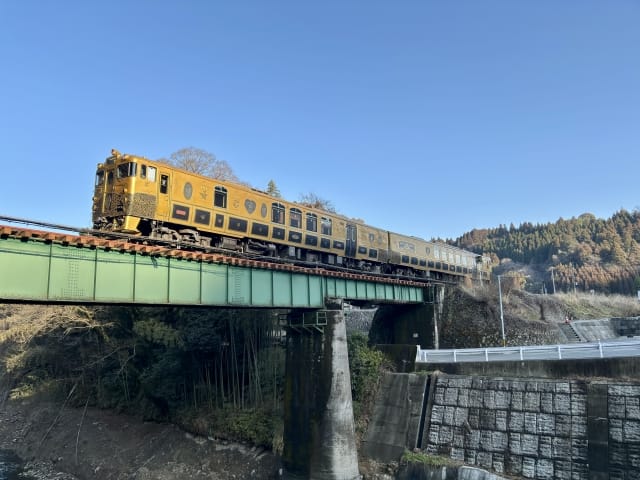
The Yufuin no Mori (ゆふいんの森) at JR Hakata Station. Three round trips daily; peak-season indicated seats sell out roughly one month ahead. - 12:31 Arrive Yufuin. Walk straight onto Yunotsubo Street (the main tourist drag) for lunch. Kinrin Lake is a 15-minute walk; the morning mist over the lake is Yufuin's signature image.
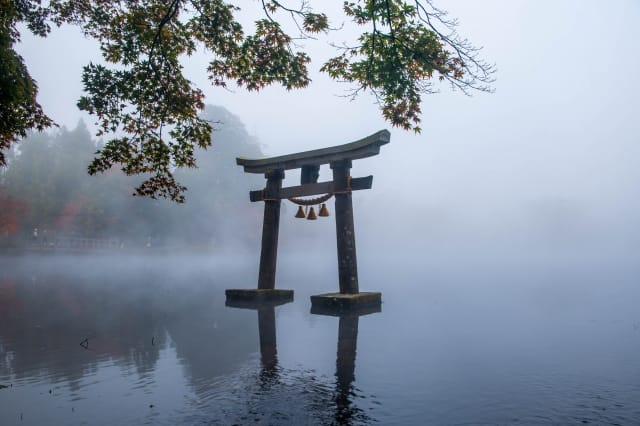
The morning steam mist over Kinrin Lake. Underwater hot spring vents keep the water at 30°C year-round; winter mornings produce the densest mist — the postcard image of Yufuin. - 15:00 Hotel check-in. Yufuin's most famous ryokan are Kamenoi Bessou and Tamanoyu (¥40,000-80,000 per person per night). Mid-tier picks include Yufuin Kinrinko (¥18,000-25,000) with included dinner.
- 16:00 Yukata + open-air onsen. Most Yufuin ryokan offer "kashikiri buro" (private onsen) by reservation — book at check-in.
- 18:30 Ryokan kaiseki dinner. Yufuin ryokan typically include dinner and breakfast in their rate. Kaiseki is 8-10 courses; Yufuin wagyu beef is the must-order.
Day 2: Yufuin → Beppu → Kumamoto
- 08:00 Ryokan breakfast + morning onsen.
- 09:30 Yufuin → Beppu (Sonic or Yufu Limited Express, 30 minutes ¥1,150 / Pass-free).
- 10:30 Beppu Hells circuit. Eight "hells" (sea hell, blood pond hell, tornado hell, etc.) — combined ticket ¥2,200, takes 2-3 hours. Best two for photos: Sea Hell (cobalt-blue sulfur pool) and Blood Pond Hell (red mud pool) — both have intense colors that photograph well.
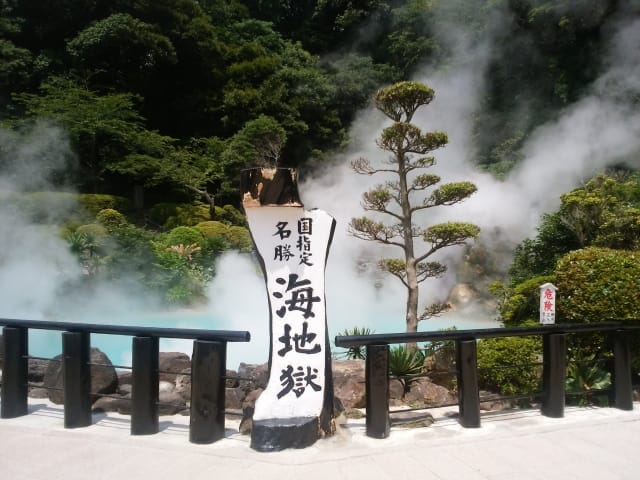
Umi Jigoku's cobalt blue comes from iron sulfate dissolved at depth; the water boils at 98°C year-round. Tight close-ups capture the color; wide shots capture the steam plumes. - 13:00 Lunch near Beppu Station. Recommend Toyotsune, a century-old tempura shop; their special tendon is ¥1,200.
- 14:30 Beppu → Aso Boy → Kumamoto (3h05, ¥6,140 / pass-free, and reserving in Japan is also free; only advance booking from home costs ¥1,500). The route crosses Mount Aso's outer crater rim — the visual highlight of the entire 3-day trip. Inside the train: 2nd-floor panoramic seats, kids playroom, KURO mascot photo spot.
- 17:30 Arrive Kumamoto. Kumamoto Castle keep closes at 18:00 — defer to next morning. Check in, then walk to Sakuramachi shopping street for dinner.
- 19:00 Dinner: Kumamoto horse meat regional cuisine. Sugano-ya is a century-old shop; horse sashimi ¥2,800, horse sushi ¥1,800.
Day 3: Kumamoto → Aso → Hakata
- 08:00 Kumamoto Castle (admission ¥800). Post-2016-earthquake reconstruction is roughly 90% complete; the keep is fully open. 1-2 hours to walk through.
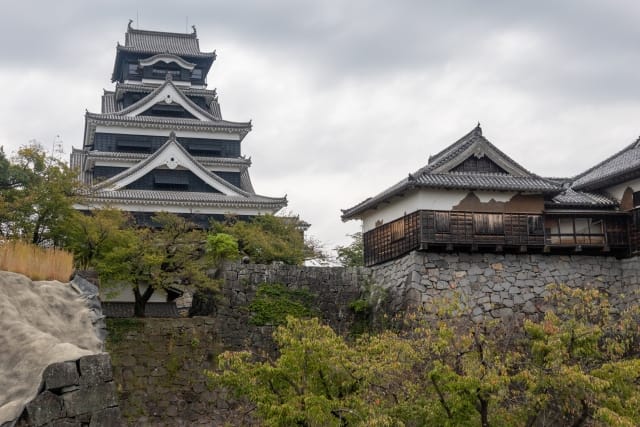
Kumamoto Castle's black keep is one of Japan's three great castles. Post-2016-earthquake restoration has reopened both the main keep and the Honmaru Goten palace. - 10:30 Kumamoto Station → Hoso Main Line Limited Express → Aso (1h20, ¥1,470 / Pass-free). The route crosses Mount Aso's outer rim grasslands — Kyushu's most expansive train-window scenery.
- 12:00 Arrive Aso. From Aso Station take the bus to "Aso Crater" (¥570, 35 minutes). Crater access depends on the volcanic alert level — always check the Aso Volcano Museum's daily alert level before going. Level 2+ means the crater zone is closed.
- 14:30 Aso Shrine (post-earthquake reopening complete) + "Aso Kusasenri" observation deck. This area has Japan's most dramatic volcanic-crater landscape — bring a wide-angle lens.
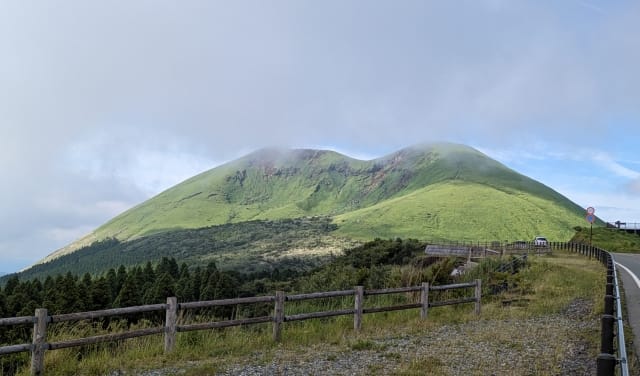
Kusasenri is the grassland basin inside Aso's outer crater rim, with grazing horses from June through October and visible sulfur steam from Nakadake crater in the distance. A wide-angle lens is essential for the scale. - 16:30 Aso → Kyushu Shinkansen back to Hakata. Aso Station → Hoso Main Line to Kumamoto (1h20) → Kumamoto → Kyushu Shinkansen to Hakata (45 minutes + ¥4,990 surcharge: the Aso-Hakata Shinkansen segment requires a separate ticket — confirm with your Pass terms before traveling).
- 19:00 Arrive Hakata. Canal City mall for dinner and souvenir shopping (mentaiko, Hakata Tsuten Manju, Sakurajima volcanic ash soap).
- 21:00 Fukuoka Airport → home.
Optional 4th day: the Kurokawa Onsen extension
If you have 4 days and onsen is a priority, swap to: Yufuin (1 night) → Kurokawa Onsen (1 night) → Aso → Kumamoto (1 night) → Hakata. From Yufuin to Kurokawa requires the Kyushu Crossing Bus (2h25, ¥2,800 — Pass does not cover). The downside: you sacrifice the Yufuin no Mori experience for 2.5 hours of bus travel. The trade-off: Kurokawa's "nyuto tegata" (¥1,500 wooden pass for three external onsen baths) is Kyushu's most distinctive onsen culture experience. Worth the extra day depends entirely on your taste.
JR Kyushu Pass
This itinerary uses the 3-day all-Kyushu Pass to cover Yufuin no Mori, Aso Boy, the Kyushu Crossing Limited Express, and partial Kyushu Shinkansen segments. Pre-purchase issues an eMCO e-ticket — nothing is shipped; exchange it for the paper pass at a JR Kyushu counter after landing.
JR Kyushu Rail Pass eMCO e-ticket →Hotel picks: Yufuin and Kumamoto
The two overnight cities have very different hotel personalities. Yufuin's appeal is ryokan culture (kaiseki + private onsen, dinner-and-breakfast included); Kumamoto is a modern transit hub where business hotels at the station make most sense.
Yufuin (1 night)
- Splurge: Kamenoi Bessou (¥45,000-90,000/person/night). The benchmark of Yufuin ryokan, in a private forest 10 minutes' walk from the station. Each villa has a private outdoor onsen. Books out 3-4 months ahead during cherry blossom and foliage seasons.
- Mid-tier: Yufuin Kinrinko (¥18,000-25,000/person/night). Walking distance to Kinrin Lake, kaiseki dinner included, private bath bookings available. The most consistent mid-tier pick for first-time Yufuin visitors.
- Budget: Yufuin Sansou Wakaba (¥12,000-16,000/person/night). Smaller family-run ryokan, communal onsen only, but the food quality matches places at twice the price.
Kumamoto (1 night)
- Mid-tier: Hotel New Otani Kumamoto (¥10,000-15,000/night, room basis). Connected to Kumamoto Station, large rooms by Japanese standards, great for an early Day 3 departure to Aso. Onsen and breakfast buffet are above the price point.
- Budget: APA Hotel Kumamoto-jo Sakuranobaba (¥7,000-10,000/night). 7 minutes' walk to Kumamoto Castle, basic but clean rooms. Good if you want castle-front access in the morning.
- Splurge: ANA Crowne Plaza Kumamoto New Sky (¥18,000-26,000/night). Riverside views, the closest top-tier hotel to Sakuramachi Bus Terminal (useful if your Day 3 departs by bus instead of rail).
Three trains compared: which one is the highlight?
This itinerary chains three D&S sightseeing trains in three days. If your trip budget or schedule only allows one, this is how they stack up:
| Train | Yufuin no Mori | Aso Boy | Kyushu Crossing |
|---|---|---|---|
| Route | Hakata-Yufuin-Beppu | Beppu-Aso-Kumamoto | Beppu-Kumamoto via Aso |
| Journey | 2h17m | 3h05m | 3h00m |
| Theme | Forest retreat / vintage saloon | Family-friendly / kids playroom | Standard limited express with crater views |
| Booking difficulty | Hardest (1 month ahead in peak) | Medium (2 months for weekends) | Easy (walk-up usually fine) |
| Best for | First-time D&S; couples | Families with kids 6-12; train enthusiasts | Time-sensitive travelers; budget-conscious |
| Window scenery rating | ★★★★ (Yufu Mountain) | ★★★★★ (Aso outer rim) | ★★★★ (Aso outer rim, less curated) |
| If picking one | Pick this for design experience | Pick this for scenery + family | Pick this if other two are sold out |
Our pick if forced to choose one: Aso Boy. The Aso outer-rim grasslands view from the 2F panoramic seats is the single most memorable train window in Japan we've ridden — better than Yufuin no Mori's forest views, better than Hokkaido's snow scenes, better than the Kyoto-Hakata Sanyo Shinkansen at speed. Yufuin no Mori is more "design experience," Aso Boy is "natural scenery experience" — and the natural scenery wins on a rail trip.
When NOT to do this trip
Three scenarios where this 3-day rail loop isn't the right call:
- Mid-July to late August: Kyushu summer hits 32-35°C with 70%+ humidity in the Aso plains. Outdoor exposure during the Beppu Hells circuit and Aso crater observation is genuinely uncomfortable. Either swap for spring/autumn, or move to indoor-heavy Fukuoka city itinerary.
- Late August to early October typhoon peak: JR Kyushu suspends limited express services during typhoon warnings, and Mount Aso routinely closes. If you must travel in this window, build a 50% buffer into Day 3 or skip the Aso segment entirely.
- If your travel companion has motion sickness: The Hoso Main Line Limited Express to Aso navigates a switchback section (the train reverses direction twice in 15 minutes climbing the outer rim). The novelty of the railway engineering can hit the motion-sensitive hard. Bring medication or skip Aso.
For trip-planning context across other seasons and regions, see our Japan weather by month quick reference.
Common Kyushu rail-travel missteps
Three patterns repeatedly surface in Kyushu rail trip reports — each costs either time or money, and each is fully avoidable with a small amount of preparation.
Skipping the indicated-seat reservation
"The train will have seats" is a common assumption. The Yufuin no Mori 11:01 service from Hakata routinely runs 100% indicated-seat sellout in peak season, with overflow standing in the unreserved car. Without a seat that is two hours 17 minutes on your feet, in the one car that does not have the windows the train is famous for. Lesson: lock a seat on every D&S train 2-4 weeks ahead. But understand what you are actually paying for, because this is the easiest place to overpay: with a pass, reserving at a green ticket window once you are in Japan is free (unlimited on the All Kyushu pass, up to six times on the Northern and Southern ones) — the risk is simply that in peak season the seats are gone by the time you reach the window. Booking ahead from home through the official system costs ¥1,500 as a KRP Option Ticket, and what that buys is not the seat but the certainty. On a peak-season Yufuin no Mori it is the best ¥1,500 of the trip; off-peak it is money you do not need to spend.
Choosing the wrong side of the train
On Yufuin no Mori, the right-hand window seats face Yufu Mountain (a perfect cone visible for the entire 2-hour journey); left-hand seats face the rice paddies and town backs. Lesson: when booking, specifically request "右側" (right side) for the outbound Hakata→Yufuin direction; if the booking site doesn't allow side selection, change at the green ticket window after arrival.
Underestimating Mount Aso closure
The Aso crater rim is sometimes closed due to volcanic gas emissions — JMA upgrades to Level 2 or higher can happen the day before. Lesson: always check the Japan Meteorological Agency's Aso volcano page (jma.go.jp → 火山 → 阿蘇山) the morning of your visit. Levels 2-5 close the crater area; Level 1 means walking to the rim is fine. Have a backup plan (Aso Shrine, Kusasenri grasslands viewing deck) in case of closure.
Reservation tactics: seats, timing, booking sites
- D&S trains require indicated-seat reservation. Yufuin no Mori, Aso Boy, and the Kyushu Crossing Limited Express all sell out 1 month ahead in peak season.
- Online: JR Kyushu official site jrkyushu-kippu.jp opens 1 month before departure with English interface.
- On-arrival reservation: Hakata Station's "midori-no-madoguchi" (green window) handles Pass-holder seat reservations free; indicated-seat surcharge is paid separately.
- Yufuin no Mori best seats: Car 1 facing forward, right window (Yufu Mountain views); Car 2 saloon area (large window for photography).
- Aso Boy best seats: 2nd-floor panoramic seats and the rear "Family Car" with the kids playroom. The whole train is reserved seating and pass holders reserve free in Japan — the seat type costs nothing extra, it is purely a question of whether it is still available. The box seats are sold only at green ticket windows, never online.
Japan unlimited data eSIM
Kyushu mountain regions (Yufuin, Aso) have weaker signal than Fukuoka city, but Docomo / KDDI hold 4G even at the Aso crater area — photo uploads work throughout. eSIM activates the moment you land — lighter than pocket WiFi.
Get Japan eSIM →3-day budget breakdown
Reference budget for two travelers sharing a room:
- Lodging 2 nights (Yufuin ryokan with dinner + Kumamoto business hotel): ¥55,500
- JR Kyushu 3-day Pass × 2: ¥44,000
- Indicated-seat surcharges (Yufuin no Mori + Aso Boy × 2): ¥4,500
- Kyushu Shinkansen Aso-Hakata supplement (× 2): ¥10,500
- Attractions (Beppu Hells combined ticket, Kumamoto Castle, Aso Crater bus): ¥7,500
- Food 3 days × 2 people (including 1 horse meat regional dinner): ¥28,000
- Souvenirs (mentaiko, horse meat jerky, Yufuin handmade soap): ¥10,000
- Two-person total: ¥160,000 (excludes flights)
Tokyo-Fukuoka domestic flights run ¥12,000-27,000 round-trip; international flights via Tokyo vary widely by season. Compare prices on Trip.com Taipei-Fukuoka flights (book 8-12 weeks ahead for the best rates).
Eight mistakes Kyushu rail travelers make
- Boarding without a reservation. D&S trains have only one unreserved car; peak season means standing for 3 hours.
- Assuming the Pass covers all Kyushu Shinkansen. The Hakata-Kokura segment is excluded; Hakata-Kumamoto is included. Confirm your specific route before buying.
- Underestimating Mount Aso's volcanic alert level. Levels 2-5 close access to the crater. Common in January-February and after rain — always check the Japan Meteorological Agency website before departure.
- Day-tripping Yufuin. Yufuin's magic is concentrated at 7 AM (before crowds) and after 8 PM (after day-trippers leave). Skipping the overnight wastes the place.
- Skipping Beppu Hells. Many travelers think "eight is too many," but each has a distinct character. Three hours covers them efficiently.
- Scheduling Kumamoto Castle for evening. The keep closes at 18:00 and needs 1.5 hours to explore properly — must be a morning visit.
- Underestimating Kurokawa Onsen's transit cost. No JR access, round-trip bus ¥5,600, and 5+ hours total bus time. Don't squeeze it into 3 days; either commit to 4 days or skip.
- Skipping Fukuoka itself. Canal City, Dazaifu Tenmangu, and the yatai food stalls deserve at least half a day — add a buffer day before or after this 3-day rail loop.
To go deeper on each city: every city on this route has its own in-depth guide — the gateway in our Fukuoka guide, the onsen pair of Yufuin and Beppu, castle-and-volcano Kumamoto Castle and the Aso crater, the port city of Nagasaki (and Gunkanjima), and volcano-harbor Kagoshima with the Sakurajima ferry. To extend the rail loop further: from Kagoshima-Chuo you can ride the JR Ibusuki-Makurazaki line south on the "Ibusuki no Tamatebako" sightseeing train to add Ibusuki's sand baths and Kirishima; or head west from Hakata on the JR Sasebo line for Saga's Arita porcelain and Ureshino onsen. Pairing this rail itinerary with the per-city deep dives makes planning most complete.
Read next
JR Pass 2026: Is It Still Worth It?
Four real routes calculated, six alternatives that may beat the Pass.
What to Wear in Japan 2026: 4 Regions × 4 Seasons Packing Guide
A 4,500-word pillar: climate physics, region-by-region clothing strategy, four-season packing lists.
Japan trip prep checklist
eSIM, Visit Japan Web, tax-free, insurance — done in one read.
5 Best Japanese Onsen Ryokans 2026
From a 1925 Cultural Property to Michelin 3 Key — five definitive Japanese onsen inns.
🏨 The best ryokans to pair with a Kyushu rail trip: Yufuin Tamanoyu (Big Three, food-focused) or Kurokawa Shinmeikan (30m cave bath, village tegata pass). Full breakdown: 5 Best Japanese Onsen Ryokans 2026.